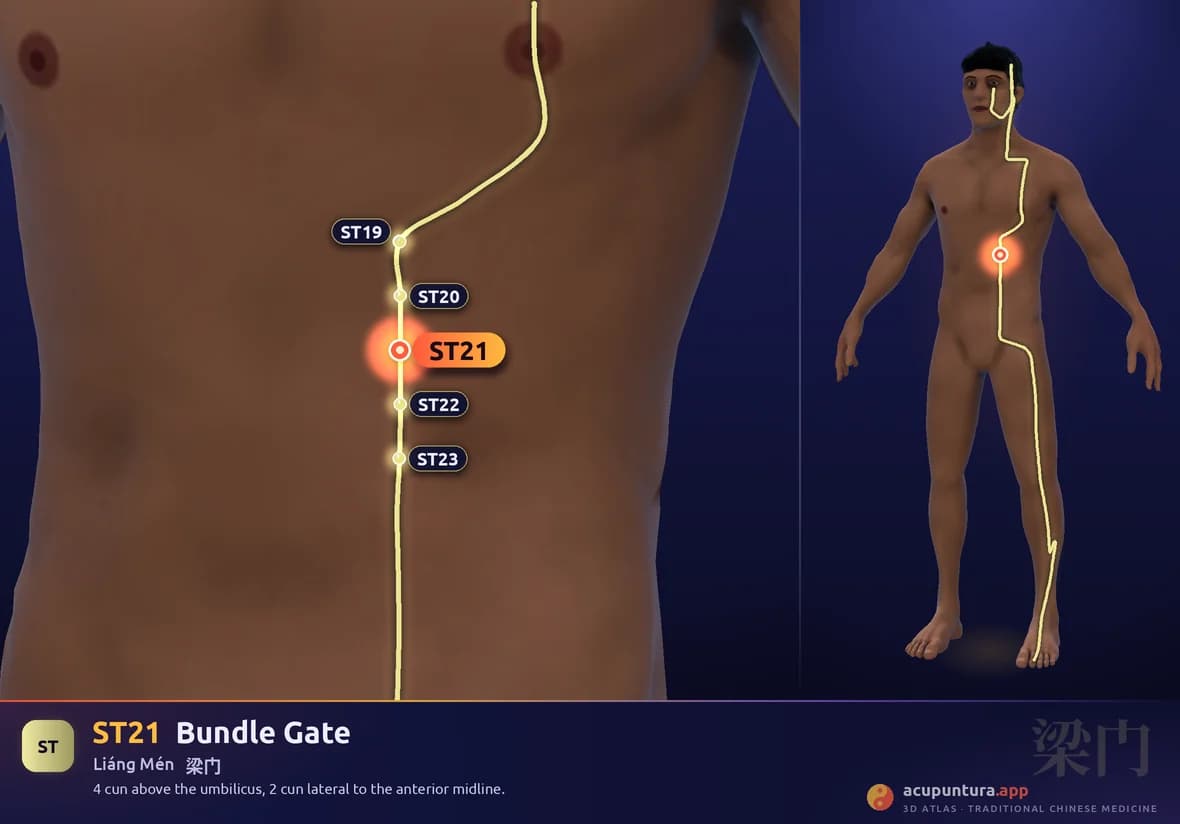
Stomach Channel
Bundle Gate
梁门Liáng MénAnatomical location
4 cun above the umbilicus, 2 cun lateral to the anterior midline.
Main function
Regulates the Stomach, harmonizes the Middle Jiao, descends rebellious Qi, relieves epigastric pain.
Therapeutic indications
- Epigastric pain
- gastritis
- nausea
- vomiting
- loss of appetite
- diarrhea
- gastric pain
- indigestion
- lack of appetite
- gastric ulcer
- gastroesophageal reflux
- chemotherapy-induced nausea and vomiting
Name and classical tradition
Liangmen (梁门) combines 梁, “beam” or “bridge,” and 门 (門), “gate.” The character 梁 allows two readings. As a beam, it would be the prominent muscular mass of the epigastrium that supports or limits the passage of Qi. As a homophone of 粱, the grain, the name would mean “the grain gate,” the passage of food toward the intestine. Both coexist, and no ancient commentary decides between them.
The standard references add a third, more erudite route. The Nanjing (Classic of Difficulties) calls the accumulation of the Heart 伏梁, “hidden beam”: “心之積曰伏梁”. According to this interpretation, the point would treat that kind of mass beneath the heart, and the 梁 in the name would allude to it. The Nanjing quotation is real, but applying it to the name of the point is a later interpretation. The Nanjing does not name the point.
Liangmen belongs to the sequence of epigastric names that follows the passage of food, between ST20 and ST22. The first work to record it is the Zhenjiu Jiayi Jing (Systematic Classic of Acupuncture and Moxibustion).