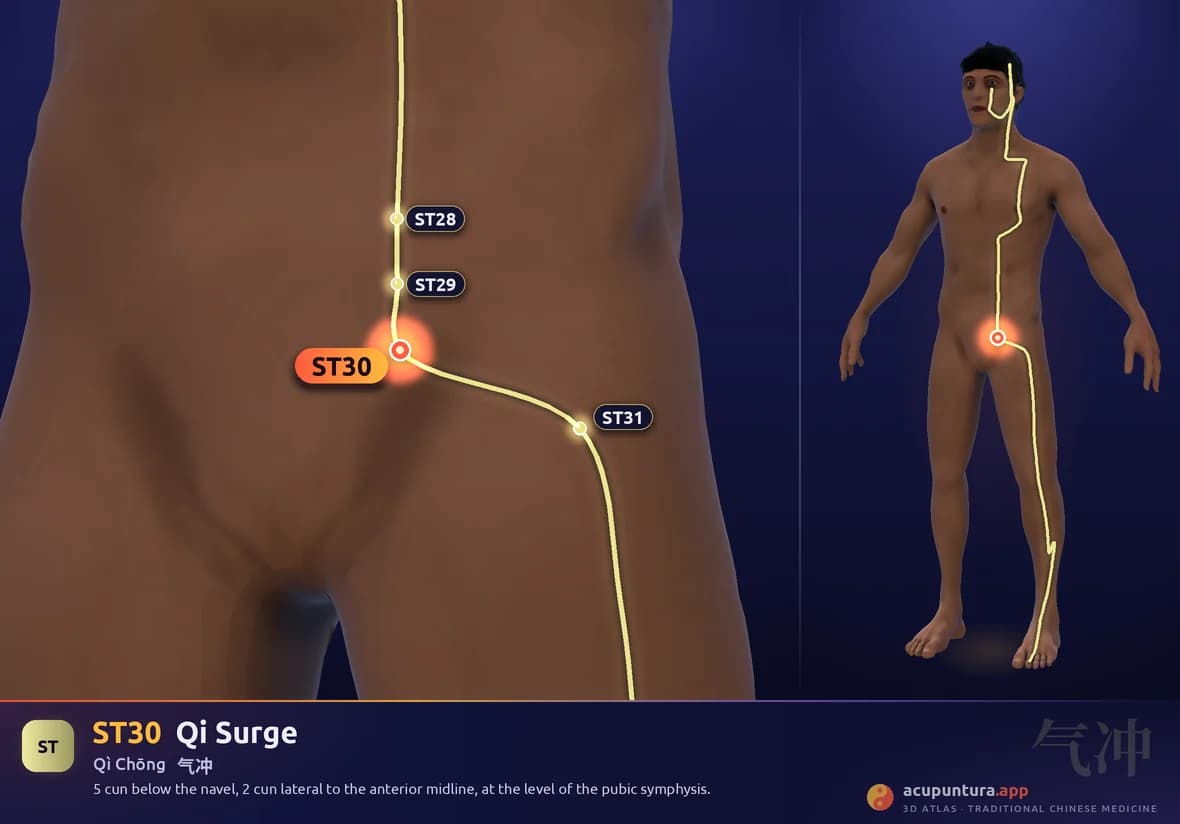
Stomach Channel
Qi Surge
气冲Qì ChōngContraindicated during pregnancy
Point of the Chong Mai (Penetrating Vessel) in the groin, directly related to the uterus.
Anatomical location
5 cun below the navel, 2 cun lateral to the anterior midline, at the level of the pubic symphysis.
Main function
Regulates Qi, promotes the circulation of Qi and Blood, relieves pain, regulates menstruation.
- Sea of Nourishment point
- Crossing point with the Chong Mai
Therapeutic indications
- Abdominal pain
- dysmenorrhea
- amenorrhea
- leukorrhea
- hernia
- testicular pain
- genital pain
- irregular menstruation
- infertility
- impotence
- abdominal distension
- hypogastric pain
Name and classical tradition
Qichong (气冲) is the “thoroughfare of Qi.” 气 (氣) is Qi; 冲 (衝) is the path along which something rushes through, the main route. What is most interesting is that the point has had two names from the beginning. The Zhenjiu Jiayi Jing (Systematic Classic of Acupuncture and Moxibustion) calls it 氣衝; the Suwen (Basic Questions) uses 氣街, “street of Qi,” for the same region. They are not a name and a late alias, but two parallel terms in two different classics.
Its importance is explained by two texts. The Lingshu (Spiritual Pivot), in the chapter Hai Lun (海論), makes the Stomach the sea of grain and says that its upper transport point is at the qijie and its lower one at Sanli: “胃者,水穀之海,其輸上在氣街,下至三里.” And the Nanjing (Classic of Difficulties), in Difficulty 28, says of the Chong Mai: “衝脈者,起於氣衝,並足陽明之經,” the Penetrating Vessel begins at Qichong and runs alongside the Stomach channel. The point is therefore the origin of one of the eight Extraordinary Vessels.
The Zhenjiu Jiayi Jing lists it among the points where moxibustion is not applied, with a warning: “氣街禁不可灸(灸之不幸不得息),” if moxa is applied, the misfortune is losing one’s breath. The reference works also attribute to it an alternate name with a very rustic flavor: 羊屎, “goat dung.”