Stomach Channel
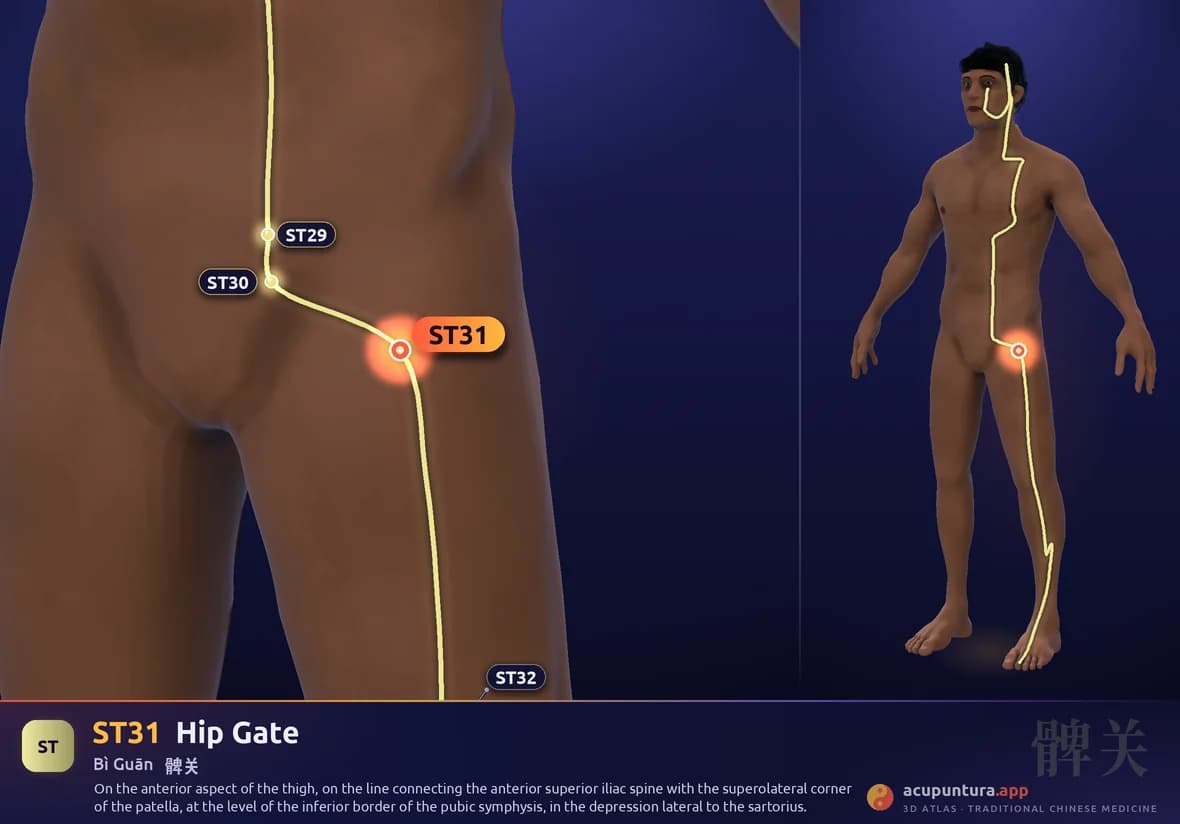
Hip Gate
髀关Bì GuānAnatomical location
On the anterior aspect of the thigh, on the line connecting the anterior superior iliac spine with the superolateral corner of the patella, at the level of the inferior border of the pubic symphysis, in the depression lateral to the sartorius.
Main function
Disperses Wind-Dampness, benefits the hip and thigh, relieves pain.
Therapeutic indications
- Hip pain
- thigh pain
- paralysis of the lower limb
- sciatica
- thigh pain and weakness
- low back pain
- numbness of the leg
Name and classical tradition
Biguan (髀关) is the “thigh pass.” 髀 is the thigh or femur; 关 (關) is a pass or joint. The name is anatomical and describes the region of the hip, where the thigh articulates with the pelvis. It needs no energetic gloss.
A secondary source attributes its origin to the Lingshu (Spiritual Pivot), chapter Jing Mai, but it has not been possible to confirm that this chapter names it as a point. The quotation that has been verified is the one from the Zhenjiu Jiayi Jing (Systematic Classic of Acupuncture and Moxibustion), which places it “膝上伏兔後交分中,” above the knee, behind Futu, in the separation between muscles. The same work assigns it the treatment of “膝寒痹不仁,” Cold Bi of the knee with loss of sensation. Until something else is verified, the Jiayi Jing is its documented origin. Its neighbor, ST32, serves as the reference in that same location.