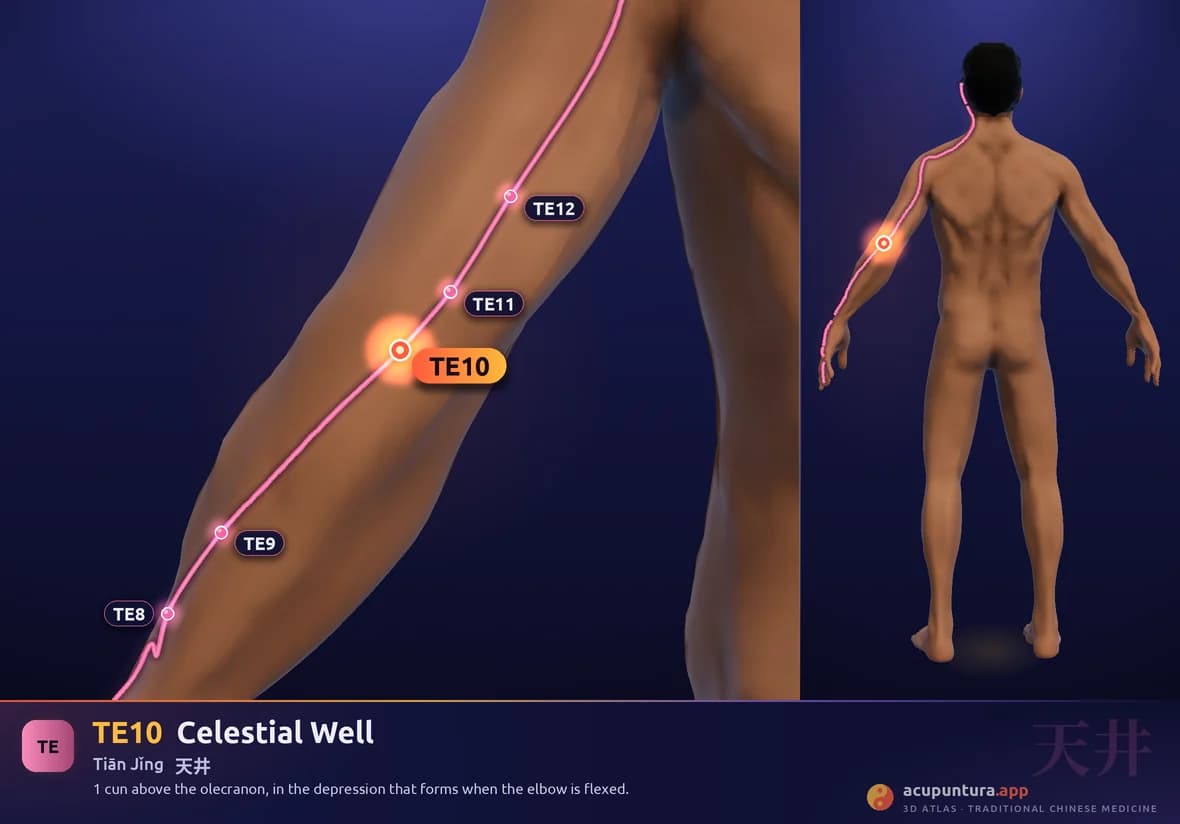
Triple Energizer Channel
Celestial Well
天井Tiān JǐngAnatomical location
1 cun above the olecranon, in the depression that forms when the elbow is flexed.
Main function
He-Sea point (Earth), benefits the ears, relieves pain, resolves Dampness.
- He-Sea point (Earth)
- Sedation Point
Therapeutic indications
- Ear pain
- deafness
- pain in the elbow and arm
- swelling of the neck
- goiter
- epilepsy
- elbow pain
- scrofula
- migraine
- chest and costal pain
- cervical lymph nodes
Ryodoraku
- Sedation of Triple Energizer
Name and classical tradition
Tianjing, 天井, is the “well of heaven.” 天 marks the upper part, here the arm relative to the forearm; 井 is the well. The point lies in a deep hollow above the olecranon, which feels like a well when the elbow is bent. The modern gloss adds that the channel's Qi, after rising along the arm, falls here like water into a heavenly well.
The Lingshu (Spiritual Pivot), in the chapter Ben Shu (本輸), closes the channel's sequence with this point: “入於天井,天井,在肘外大骨之上陷者中也,為合,屈肘乃得之”. The Qi enters Tianjing, in the depression above the large bone on the outer side of the elbow; it is the He-Sea point; it is found by bending the elbow. On the Yang channels, the He-Sea point (合穴) corresponds to Earth.
The channel has two other points with 天: TE15, Tianliao, on the scapula, and TE16, Tianyou, on the neck, in regions and with functions that are very different. The 井 in the name is unrelated to the Jing-Well points (井穴) at the tips of the fingers: here it is only the image of a hollow.