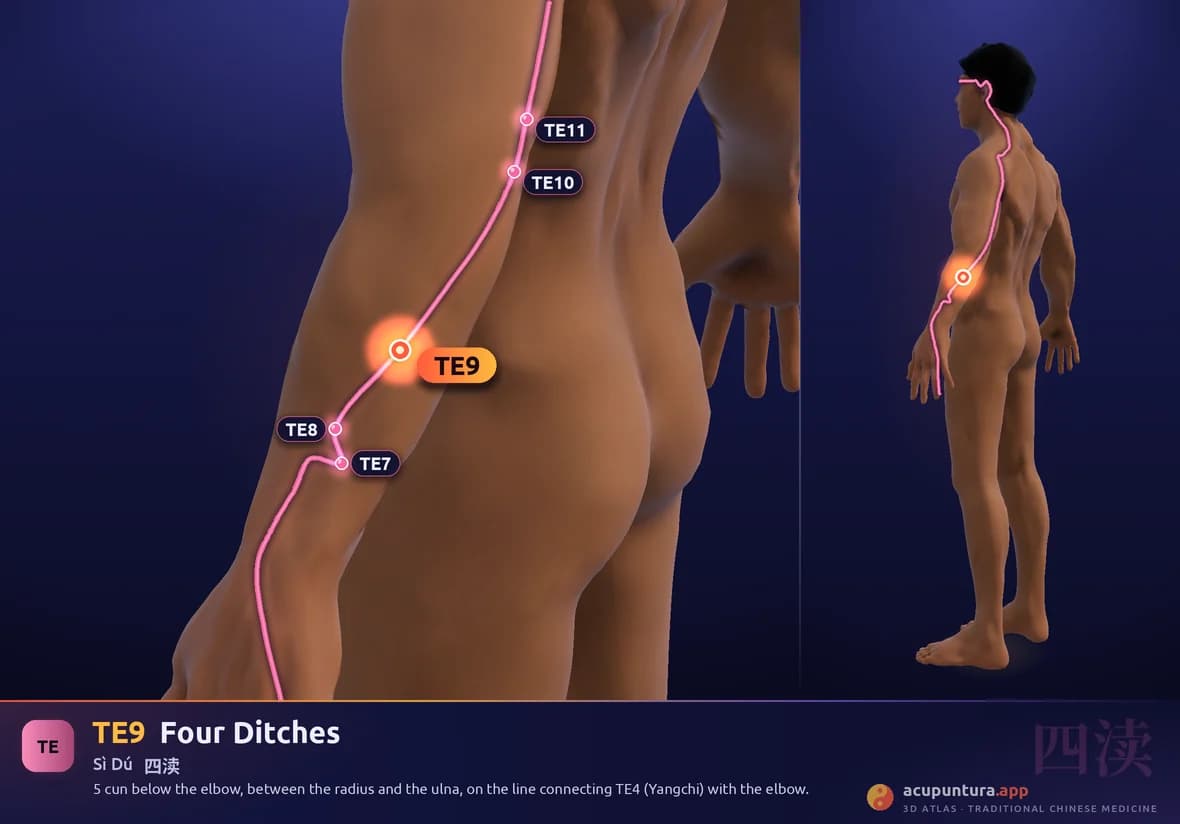
Triple Energizer Channel
Four Ditches
四渎Sì DúAnatomical location
5 cun below the elbow, between the radius and the ulna, on the line connecting TE4 (Yangchi) with the elbow.
Main function
Benefits the ears, relieves pain, regulates Qi.
Therapeutic indications
- Deafness
- ear pain
- toothache
- arm pain
- elbow pain
- sore throat
- Tooth pain
- Sudden aphonia
- Forearm pain
- Migraine
Name and classical tradition
Sidu, 四渎, means the “four rivers.” In classical Chinese geography, the Si Du (四渎) were the four great rivers of the country: the Yangtze, the Yellow River, the Huai, and the Ji; the term also named an asterism in ancient astronomy. The anatomical gloss reads the point as the channel through which the Qi of the four limbs flows.
The sources record a more elaborate explanation as well. The Suwen (Basic Questions), in the chapter Ling Lan Mi Dian Lun (靈蘭秘典論), calls the Triple Energizer “決瀆之官,水道出焉”, the official who opens the channels, from whom the waterways emerge. A modern commentary derives the name from this: “手足少陽上下同氣,故上肢有四渎,下肢有中渎”, that is, because the hand and foot Shaoyang share the same Qi, the arm has Sidu and the leg has GB32, Zhongdu. The Suwen quotation is genuine; its connection to the name of the point is a reasonable hypothesis, not an ancient commentary.
The sources attribute Sidu to the Zhenjiu Jiayi Jing (Systematic Classic of Acupuncture and Moxibustion), in the third book, which is devoted to locating points by region, though no literal citation has been found.