Triple Energizer Channel
Celestial Assistance
天牖Tiān YǒuAnatomical location
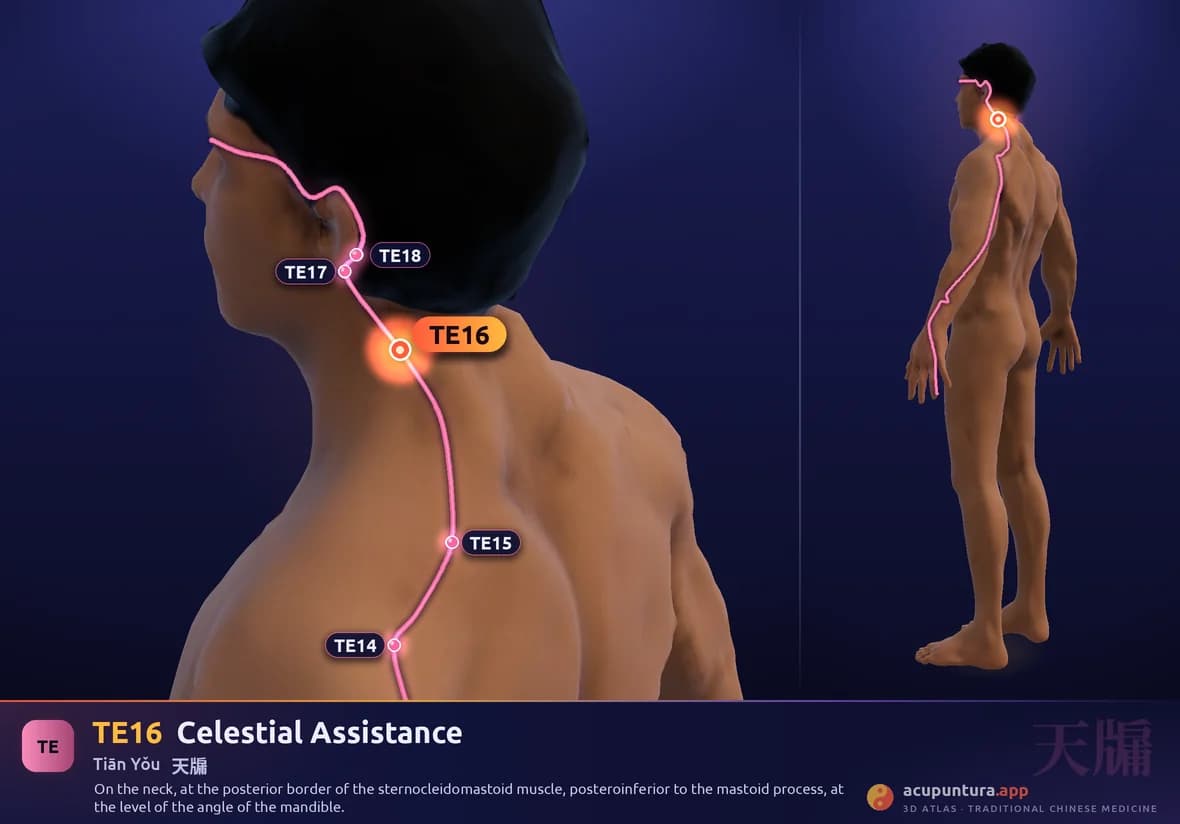
On the neck, at the posterior border of the sternocleidomastoid muscle, posteroinferior to the mastoid process, at the level of the angle of the mandible.
Main function
Benefits the ears and eyes, expels Wind, relieves pain.
- Window of Heaven point
Therapeutic indications
- Deafness
- tinnitus
- ear pain
- headache
- neck stiffness
- sore throat
- facial pain
- sudden deafness
- blurred vision
- stiffness in the nape of the neck
- facial edema
- dizziness
- insomnia
Name and classical tradition
Tianyou, 天牖, is the “window of heaven.” In ancient architecture, 牖 was a window opened in a side wall, as distinct from 窗, which was more of a skylight in the roof. The point is on the side of the neck, and the usual reading describes it as a window onto the sense organs, the eyes and ears.
The name has notable classical support. The Lingshu (Spiritual Pivot), in the chapter Han Re Bing (寒熱病), groups five points of the neck and arm under the name 天牖五部, the “five regions of the window of heaven”: ST9, Renying; LI18, Futu; Tianyou; BL10, Tianzhu; and LU3, Tianfu. For Tianyou, the indication is precise: “暴聾氣蒙,耳目不明,取天牖”, in sudden deafness, with the Qi clouded and the ears and eyes unclear, take Tianyou.
The Zhenjiu Jiayi Jing (Systematic Classic of Acupuncture and Moxibustion) locates it through a chain of references: “在頸筋間,缺盆上,天容後,天柱前,完骨後,髮際上”, between the tendons of the neck, above the supraclavicular fossa, behind SI17, Tianrong, in front of Tianzhu, behind GB12, Wangu, and above the hairline. The citation confirms that these neighboring points are distinct and were used as references for one another.