Triple Energizer Channel
Spasm Vessel
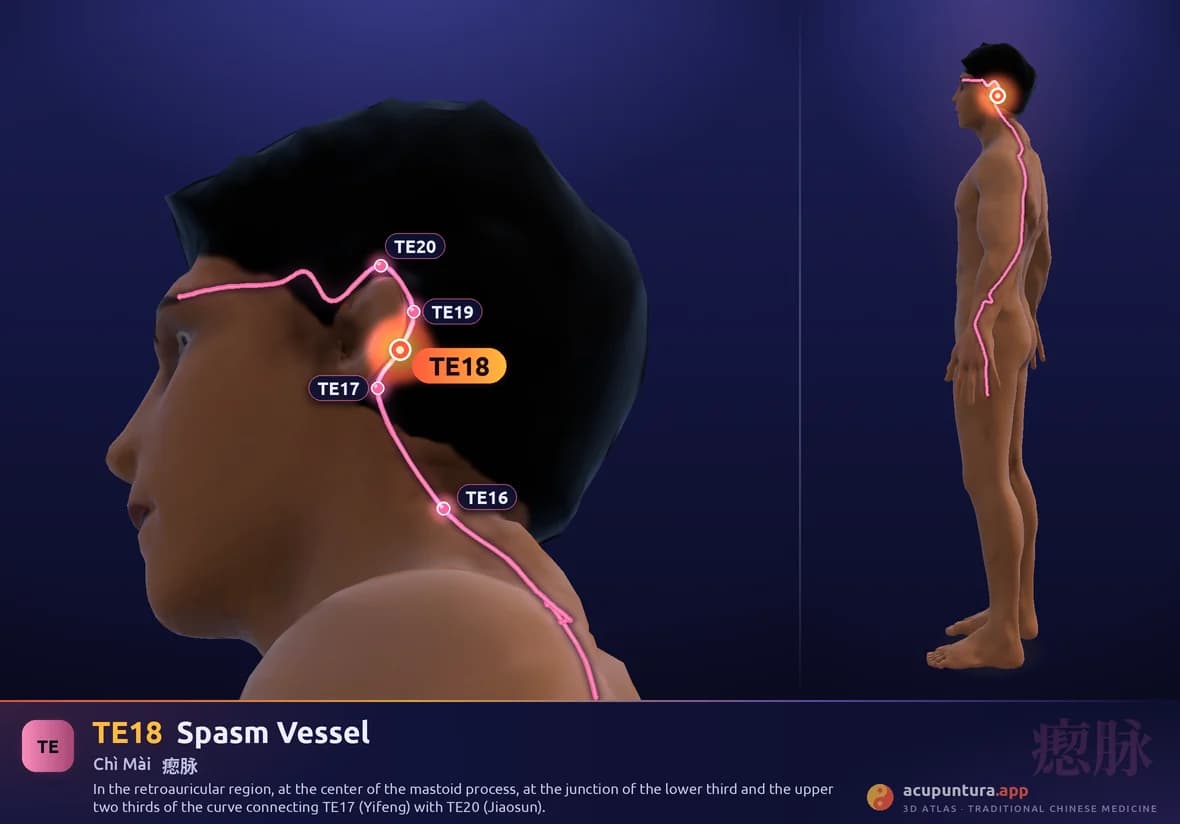
瘛脉Chì MàiAnatomical location
In the retroauricular region, at the center of the mastoid process, at the junction of the lower third and the upper two thirds of the curve connecting TE17 (Yifeng) with TE20 (Jiaosun).
Main function
Calms Internal Wind, benefits the ears, relieves headache.
Therapeutic indications
- Headache
- migraine
- ear pain
- tinnitus
- facial pain
- facial spasms
- deafness
- cephalalgia
- infantile convulsions
- vomiting
- infantile diarrhea
Name and classical tradition
Chimai, 瘛脉, is the “vessel of convulsions.” 瘛 is spasm, convulsion, as in 瘛瘲, the classical term for infantile convulsions; 脉 (脈) is the vessel. The name is clinical and direct: the point has traditionally been used for convulsions in children (小兒驚風), and the name says so without metaphor. It lies behind the ear, over a small visible vein.
The character has an old variant, 瘈, and the name is written 瘈脈 in many sources, a genuine orthographic variation. The Zhenjiu Jiayi Jing (Systematic Classic of Acupuncture and Moxibustion) gives it the alternative name 資脈, and the compendia add 資生. The Zhenjiu Jiayi Jing is the oldest work to include it.
Other names
- 資脈Jiayi Jing