Triple Energizer Channel
Fluid Gate
液门Yè MénAnatomical location
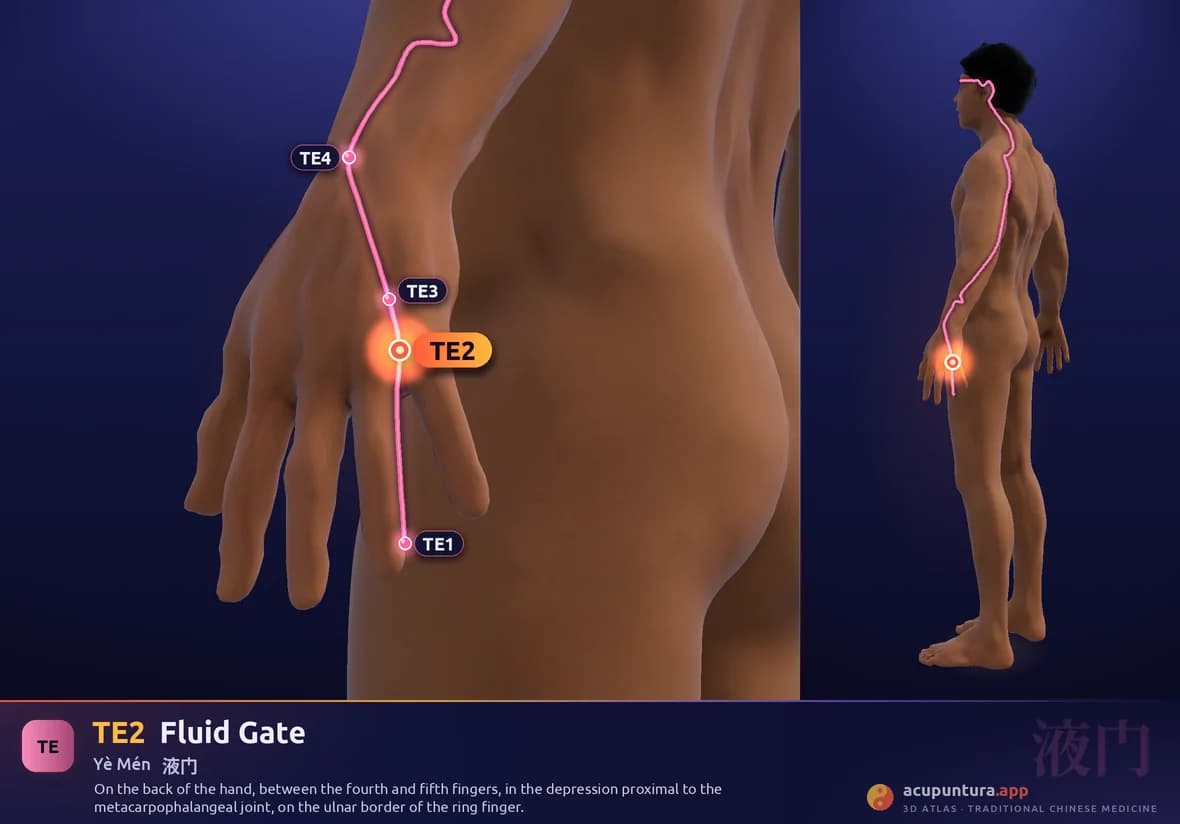
On the back of the hand, between the fourth and fifth fingers, in the depression proximal to the metacarpophalangeal joint, on the ulnar border of the ring finger.
Main function
Ying-Spring point (Water), clears Heat, benefits the ears, regulates the Triple Energizer.
- Ying-Spring Point (Water)
Therapeutic indications
- Ear pain
- deafness
- sore throat
- pain on the back of the hand
- fever
- Headache
- Red eyes
- Tinnitus
- Malaria
- Pain in the fingers and the back of the hand
Name and classical tradition
Yemen, 液门, is the «gate of fluids». 液 means the body's fluids; 门, the gate, the threshold through which things enter and exit. The modern gloss holds that the channel's Qi cools here and condenses into water. The point lies in the web between the ring and little fingers, and it is the Ying-Spring point (滎穴) of the channel, which in the yang channels corresponds to Water, lending coherence to the image.
What is most interesting is the history of how it is written. Three characters pronounced identically, yè, have alternated in its name. The Zhenjiu Jiayi Jing (Systematic Classic of Acupuncture and Moxibustion) records it as 腋門, «gate of the armpit»; Sun Simiao's Qianjin Yaofang (Essential Prescriptions Worth a Thousand Gold), as 掖門, and the current form is 液門, that of the Lingshu (Spiritual Pivot), which in the Ben Shu chapter places it «小指次指之間也», between the little finger and the next one. They are variants of a single name, not three different points.
The Jiayi Jing itself confirms its spelling in the book on fevers: «瘧項痛,因忽暴逆,腋門主之», intermittent fevers with pain in the nape of the neck and a sudden reversal of Qi are treated with Yemen, written with 腋.