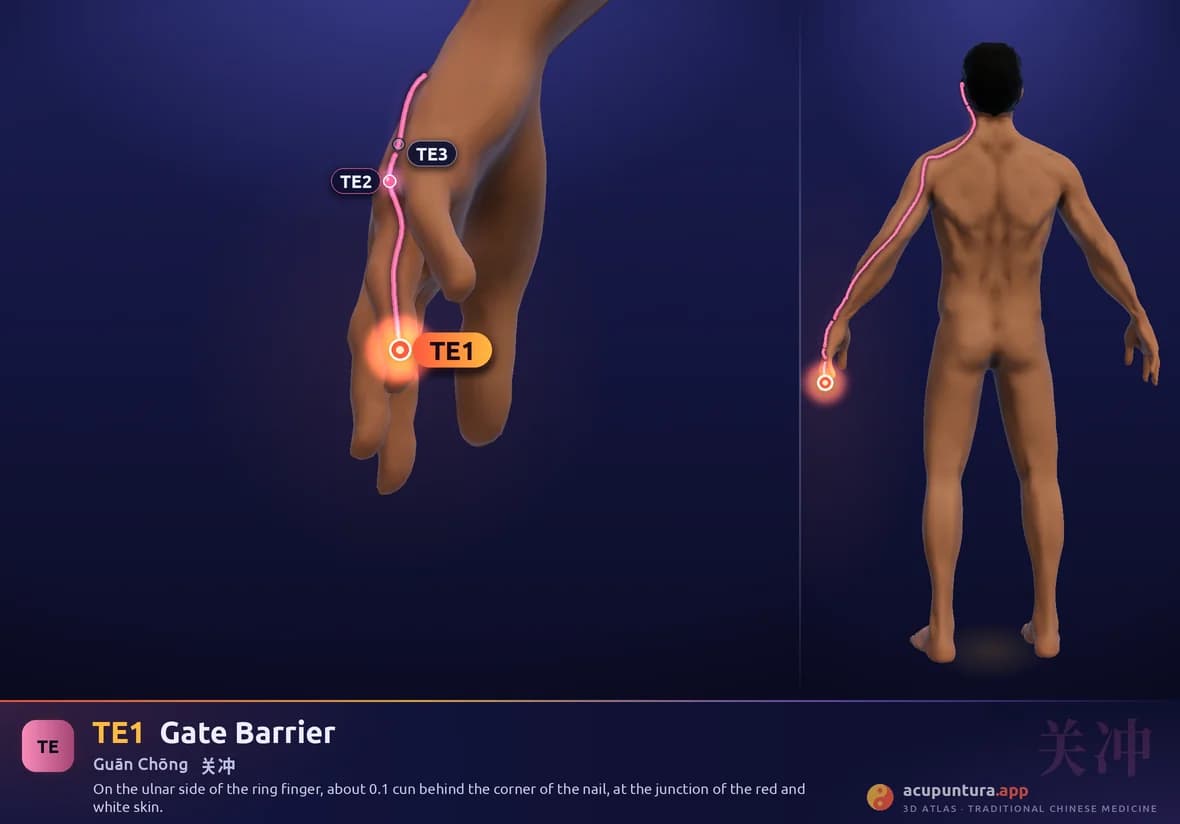
Triple Energizer Channel
Gate Barrier
关冲Guān ChōngAnatomical location
On the ulnar side of the ring finger, about 0.1 cun behind the corner of the nail, at the junction of the red and white skin.
Main function
Jing-Well point (Metal), exit point, clears Heat, benefits the throat, awakens the Shen.
- Jing-Well point (Metal)
- Exit Point
Therapeutic indications
- Sore throat
- headache
- fever
- loss of consciousness
- irritability
- insomnia
- pain in the ring finger
- Headache
- Red eyes
- Loss of consciousness
- Stiff tongue
- Tinnitus
- Deafness
- Heatstroke
- High fever
Name and classical tradition
Guanchong, 关冲, opens the Triple Energizer channel at the tip of the ring finger. 关 (關) is the pass, the barrier, the place where one enters and exits; 冲 (衝), the thrust, a forceful outlet. The most widely cited reading ties it to its position in the channel system. It is the Jing-Well point (井穴) of the hand Shaoyang, the channel that the doctrine regards as the hinge (樞) between the exterior and the interior. The Qi arriving from the Pericardium, the hand Jueyin, exits here with force into the yang channel. Another, less common reading takes 關 as a variant of 彎, «curved», referring to the finger. Both are modern glosses.
The Lingshu (Spiritual Pivot), in the Ben Shu chapter (本輸), opens the channel's sequence with it: «三焦者,上合手少陽,出於關衝,關衝者,手小指次指之端也,為井金». The Triple Energizer joins above with the hand Shaoyang; its Qi exits at Guanchong, at the tip of the finger next to the little finger; it is the Well point, of Metal nature. As in all the yang channels, the Well corresponds to Metal.
The structure of its name is repeated on the other fingers: HT9, Shaochong, on the little finger, and PC9, Zhongchong, on the middle finger, carry the same 冲 in their Well points.