Gallbladder Channel
Central Synchronization
中渎Zhōng DúAnatomical location
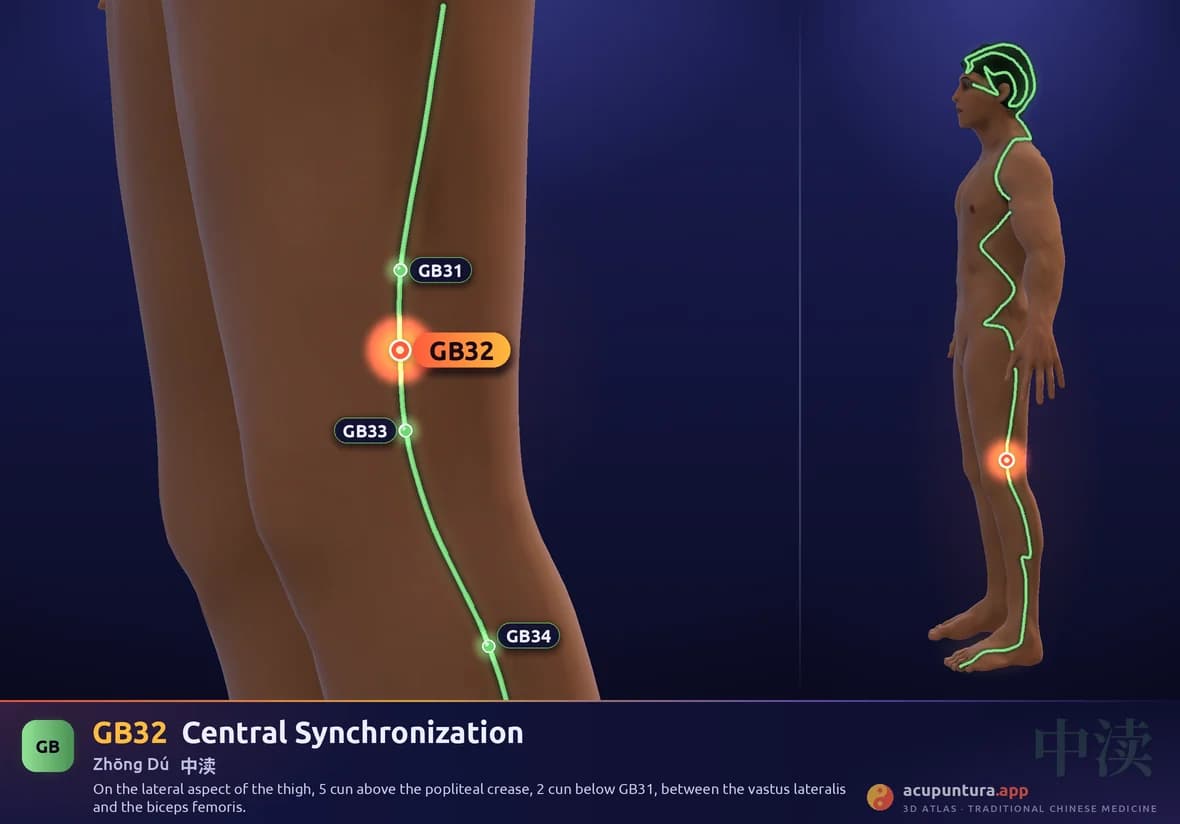
On the lateral aspect of the thigh, 5 cun above the popliteal crease, 2 cun below GB31, between the vastus lateralis and the biceps femoris.
Main function
Expels Wind-Dampness and relieves pain.
Therapeutic indications
- Leg pain
- sciatica
- lumbago
- thigh pain and numbness
- paralysis of the lower limb
- lateral leg pain
Name and classical tradition
Zhongdu, 中渎, means “the middle channel.” 中 is middle, between; 渎, a large watercourse. In classical Chinese geography, the four great rivers of the country were called the Si Du (四渎): the Yangtze, the Yellow River, the Huai, and the Ji. The point lies on the outer side of the thigh, between two muscle masses, and the reference works imagine it as a channel running between them.
The name has a counterpart on the arm: TE9, Sidu, “the four rivers,” on the forearm of the hand Shaoyang. The two Shaoyang channels, hand and foot, thus each have a “river” point at the same relative height of the limb, a symmetry of nomenclature that has been pointed out as an example of the correspondence between arm and leg. The sources trace Zhongdu to the Zhenjiu Jiayi Jing (Systematic Classic of Acupuncture and Moxibustion), with no literal citation.