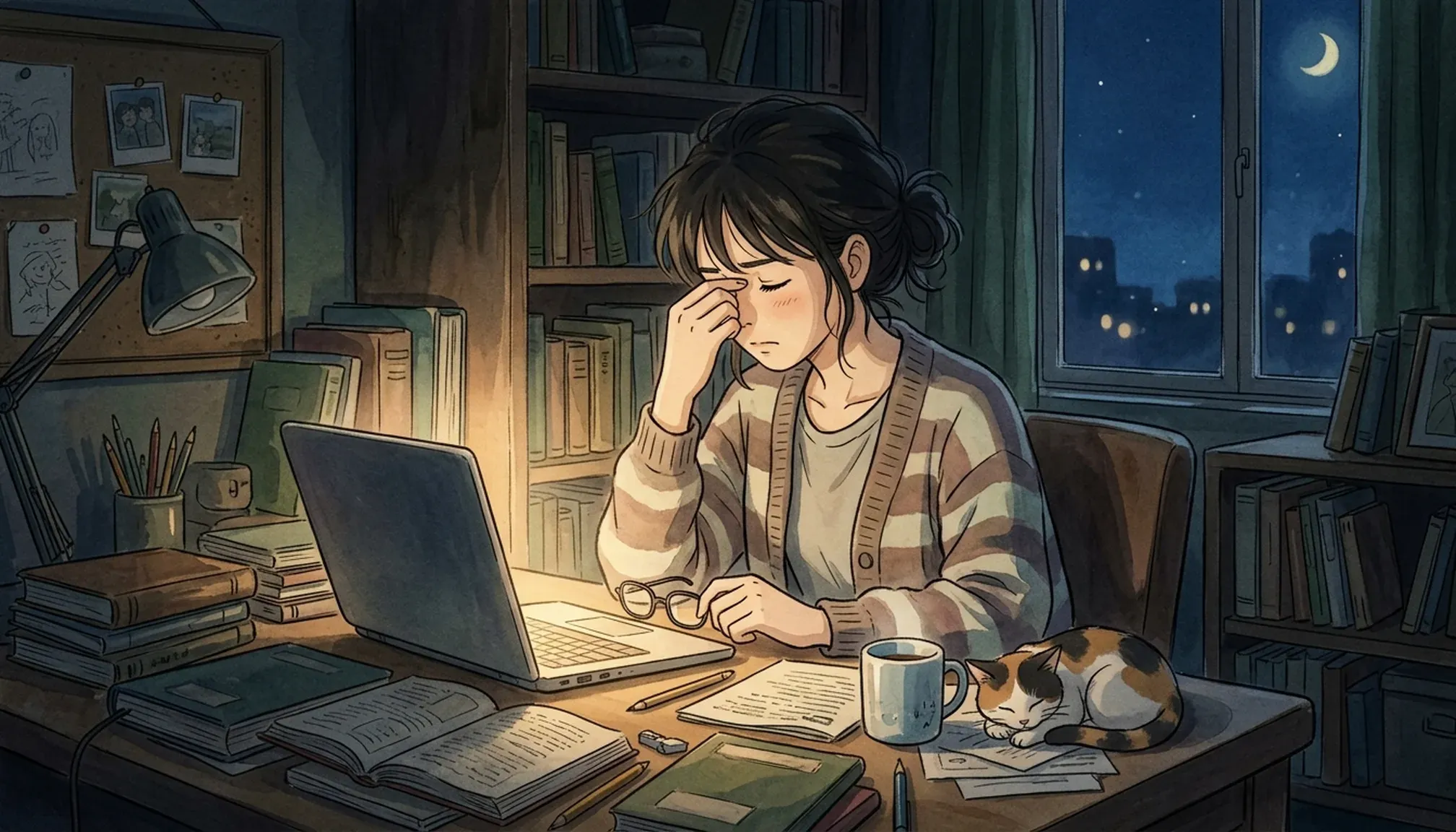
You spend hours in front of the computer, then check your phone, then watch TV or use a tablet at night… and by the end of the day your eyes are dry and irritated, and you may even have a headache. If that feels familiar, you're not alone: digital eye strain is one of the most common problems of our time. In this article we explain what digital eye strain is, how to prevent it with simple habits like the 20-20-20 rule, which foods support healthy vision, and how Traditional Chinese Medicine and acupuncture can help as a complementary approach.
What is digital eye strain?
Digital eye strain, also known as computer vision syndrome, is the group of eye and vision complaints that appear after spending a lot of time in front of screens: computers, phones, tablets, or televisions. In most cases it is not a serious condition, but it is very uncomfortable and increasingly common, in adults as well as in children and teenagers.
When you look at a screen, you blink less than normal. Blinking is the natural mechanism that spreads tears across the surface of the eye and keeps it moist; if you blink half as often, the eye dries out and discomfort sets in. On top of that come screen brightness, glare, poor posture, inadequate lighting, and keeping your gaze fixed at a short distance for hours.
Most common symptoms
Warning signs usually show up at the end of the day, although in intense cases you may notice them first thing in the morning. These are the most frequent symptoms:
Dry, gritty, or itchy eyes: a feeling of having sand in your eye, closely tied to reduced blinking.
Red, irritated eyes: the blood vessels dilate from strain and dryness.
Blurry or fluctuating vision: especially when you shift from looking at the screen to looking into the distance, because of fatigue in the muscle that focuses the eye.
Headache and forehead pain: sustained focusing effort tenses the muscles around the eyes.
General tiredness and difficulty concentrating: tired eyes wear out the whole body too.
Light sensitivity and discomfort when driving at night: a sign that your eyes are overworked.
Tense shoulders and neck: poor posture in front of the screen almost always goes along with eye strain.
The 20-20-20 rule and other habits that rest your eyes
Prevention is the most powerful tool you have. You don't need to change jobs or live without technology, just build in a few small, consistent habits:
Follow the 20-20-20 rule: for every 20 minutes of screen time, look at something about 6 meters (20 feet) away for 20 seconds. This lets the focusing muscle relax. Set a reminder on your phone until it becomes a habit.
Blink consciously: if your eyes feel dry, take a few slow, complete blinks every few minutes.
Adjust your screen: the top edge of the monitor should be at or slightly below eye level, about 50-70 cm (20-28 inches) away, and the brightness should be similar to the surrounding light (no bright screen in a dark room, and no dim screen in a bright one).
Avoid glare: place the monitor perpendicular to windows and avoid direct light on the screen.
Use your phone wisely: hold it farther from your face (at least 30-40 cm, or 12-16 inches), increase the text size, and try not to look at it for long stretches. Never use it in bed in the dark.
Humidify the air: air conditioning and heating dry out the air; a humidifier can make a difference.
Alternate tasks: if your job allows it, mix screen work with tasks that don't require one.
Sleep hygiene: rest is also eye care
Your eyes don't recover just by closing them for a moment: they need restorative sleep. Poor sleep increases dry eye, irritation, and light sensitivity, and makes visual effort greater the next day.
A few guidelines that help a lot:
Sleep 7 to 8 hours: it is during sleep that the eyes are lubricated and truly recover.
Turn off screens an hour before bed: blue light delays the production of melatonin, the sleep hormone, and a bad night shows in your eyes the next day.
Don't use your phone in bed: if you use it in the dark, your pupil dilates and a lot of intense light enters all at once, which overworks your eyes.
Air out and darken the bedroom: a cool environment without light supports deeper sleep.
Nutrition to care for your eyes
What you eat also affects eye health. A varied diet rich in fruits, vegetables, fish, and nuts provides the nutrients your eyes need to work well. There are no miracle foods, but there are eating habits that help keep your eyes in good shape:
Orange and dark green vegetables and fruits: carrots, pumpkin, spinach, broccoli, or kale are rich in carotenoids, antioxidants that help protect the retina.
Oily fish: sardines, mackerel, or salmon provide omega-3, healthy fats linked to good health of the ocular surface.
Nuts and seeds: walnuts, almonds, and pumpkin seeds provide vitamin E and zinc, antioxidant nutrients.
Eggs: they contain lutein and zeaxanthin, two pigments that concentrate in the macula and help filter harmful light.
Stay well hydrated: dry eye gets worse if you drink little water; try to stay well hydrated throughout the day.
Cut back on excess ultra-processed foods and sugars: an unbalanced diet is good for neither your vision nor your overall health.
The Traditional Chinese Medicine view
If you're not familiar with Traditional Chinese Medicine (TCM), it may sound exotic, but its ideas are simpler than they seem. In the Chinese tradition, the eyes are considered to depend on the good condition of the Blood and on vital energy, which is called Qi (pronounced "chee"), and the Liver, understood as a set of functions and not only as the organ, has a special relationship with vision. That is why, when the eyes tire easily, Chinese medicine interprets it as the energy that nourishes them being scarce or not flowing smoothly, something that is also often linked to lack of rest, excess mental work, and sustained stress.
TCM also pays close attention to imbalances of Cold and Heat and to the rhythm of the seasons: spending many hours indoors, with dry air and artificial light, is seen as a factor that drains the body's energy. That is why TCM practitioners tend to work holistically, not only on the symptoms in the eyes but on the whole person: rest, diet, digestion, and stress levels.
Acupuncture is used in this context as a complementary tool to promote relaxation, improve the circulation of energy, and reduce accumulated tension, including the neck and shoulder tension that so often accompanies eye strain. It's important to understand that it does not replace an exam with an eye doctor or the treatment of any eye disease: conventional medicine should always be the reference.
Acupressure for tired eyes: points you can try
In addition to the 20-20-20 rule, acupressure—pressing with your finger, without needles—on some classic points around the eyes can offer gentle relief for eye pain and blurry vision from fatigue:
Jingming (BL1), "Bright Eyes": at the inner corner of the eye, next to the tear duct. Press very gently, with your eyes closed.
Zanzhu (BL2): at the inner end of the eyebrow, right where it begins. Useful for heaviness in the forehead and blurry vision.
Sizhukong (TE23): at the outer end of the eyebrow, at the temple. Helps with the tension that builds up there after hours of screen time.
Taiyang (EX-HN5), "Sun": at the temple, in the hollow you can feel when you clench your teeth. A point widely used for the headache associated with tired eyes.
Press with the pad of your finger, very gently, for 20 to 30 seconds on each point, with your eyes closed. Important: acupressure relieves fatigue and dryness, but it does not correct nearsightedness or astigmatism, which are refractive disorders of the eye and require corrective lenses, not pressure points.
What does the research say?
Being honest matters. Research on acupuncture and eye health is still limited. Some studies suggest that acupuncture may help improve dry eye and eye strain, and there is preliminary evidence that it promotes relaxation and reduces tension headache, one of the associated symptoms. However, the available studies tend to be small and of varying quality, so more research is needed before drawing firm conclusions.
What is well supported by evidence is the basics: the 20-20-20 rule, sleep hygiene, good ergonomics, and a balanced diet work. Acupuncture can be a useful complement for overall well-being, never a substitute for basic care or for medicine.
When to see an eye doctor
The symptoms of eye strain usually improve with rest and good habits, but there are signs you shouldn't ignore. See an ophthalmologist or your doctor if you have:
- Sudden or progressive vision loss.
- Severe eye pain, significant light sensitivity, or persistent redness.
- Double vision, halos around lights, or spots in your field of vision.
- Symptoms that don't improve after several weeks of good habits.
- Eye strain that clearly interferes with your work or daily life.
It's also a good idea to have a regular eye exam, even if you have no symptoms, to rule out prescription problems or silent diseases such as glaucoma.
Frequently asked questions
Does acupuncture help tired eyes?
It can be a useful complement. Some studies suggest that acupuncture helps reduce dry eye, eye strain, and the associated neck tension. In Traditional Chinese Medicine, the work is holistic, aiming to improve energy and overall rest, not only the symptom in the eyes.
How many acupuncture sessions are needed?
It depends on each person and on how intense the symptoms are. Practitioners usually propose an initial plan of several weekly or biweekly sessions and then assess progress with you. What matters is that you are always treated by a qualified, licensed professional.
Does acupuncture hurt?
Generally, no. The needles are very thin, much thinner than those used for injections, and the most common sensation is a slight pressure or a feeling of warmth at the point. Many people relax and even fall asleep during the session.
Can I do anything at home to relieve eye strain?
Yes. Follow the 20-20-20 rule, blink consciously, humidify the air, adjust your screen brightness, and sleep well. These habits resolve most mild cases. If symptoms persist, see a professional.
Can eye strain from screens permanently damage your vision?
In most cases, no. Digital eye strain is reversible with rest and good habits. That said, untreated chronic dry eye or spending years with the wrong prescription can make discomfort worse, so an eye exam is a good idea if symptoms continue.
Take care of your eyes, even with small steps
Your eyes work many hours a day for you; they deserve rest, good light, and good habits. The 20-20-20 rule, proper sleep hygiene, and a diet that looks after your vision are the best starting point. And if tension, tiredness, or stress build up, acupuncture and Traditional Chinese Medicine can support you as a complement, helping you relax and regain your balance. We encourage you to see a qualified professional who can assess your case personally and, if you have persistent symptoms, to see your eye doctor as well. Your eyes will thank you.