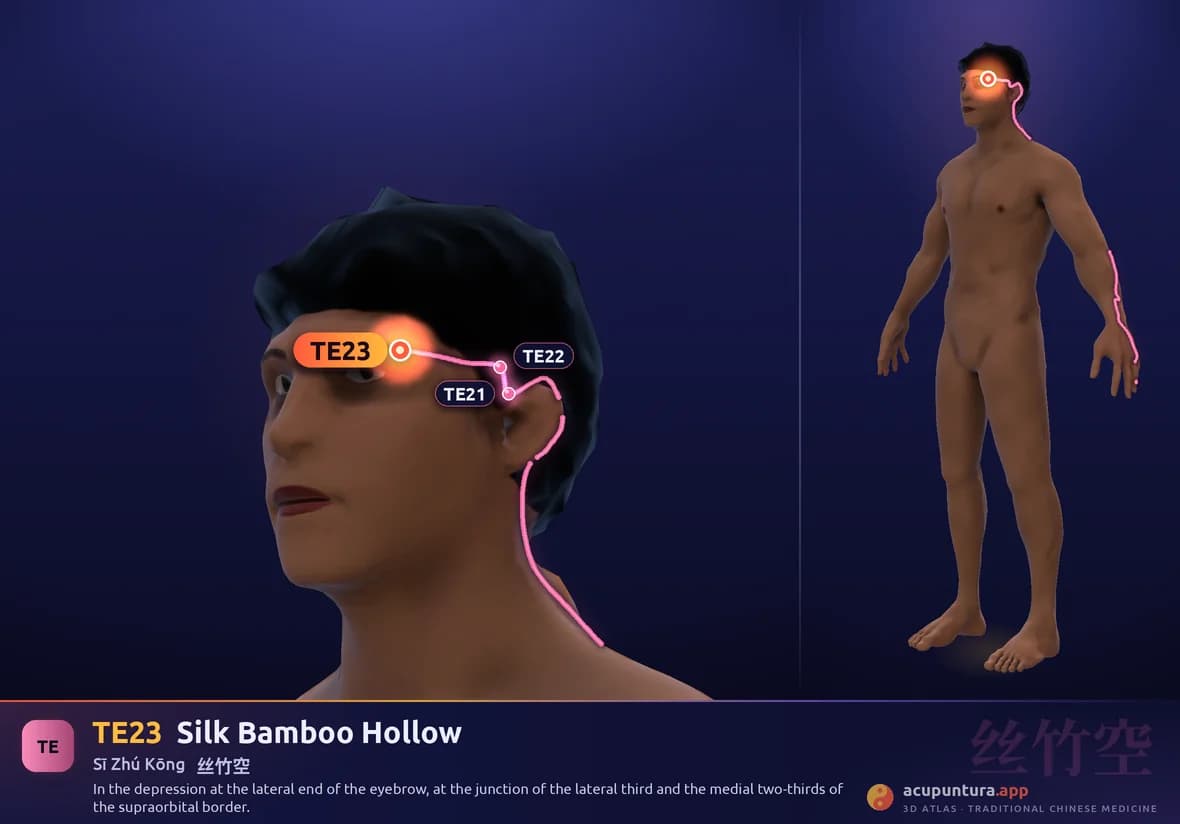
Triple Energizer Channel
Silk Bamboo Hollow
丝竹空Sī Zhú KōngAnatomical location
In the depression at the lateral end of the eyebrow, at the junction of the lateral third and the medial two-thirds of the supraorbital border.
Main function
Expels Wind-Heat, benefits the eyes, relieves headache, calms the Shen.
- Crossing point with the Du Mai
Therapeutic indications
- Headache
- migraine
- eye pain
- blurred vision
- eyelid spasm
- toothache
- epilepsy
- mania
- Cephalalgia
- Ocular pain
- Eyelid tic
- Facial paralysis
- Vertigo
Name and classical tradition
Sizhukong (丝竹空) is one of the most poetic names in the Atlas. 絲竹, “silk and bamboo,” is a classical Chinese way of naming music: silk for the stringed instruments and bamboo for the wind instruments. Bai Juyi, in his Song of the Pipa, laments spending the whole year without hearing 絲竹. 空 is emptiness, a hollow. The point is in the depression at the tail of the eyebrow. One modern gloss describes it as the place where Qi arrives sparsely, like a sound floating out of the void; another, aesthetic reading compares the fine lines of the temple to the strings of an instrument. Neither has support in an ancient commentary.
It is the last point of the channel. From here the Triple Energizer hands its Qi over to the Gallbladder, which begins very close by, at GB1, Tongziliao, at the outer corner of the eye.
It has two alternative names. 目髎, “cleft of the eye,” is transparent. 巨髎 calls for care, because it is the name of ST3, Juliao, a point on the Stomach channel in the cheek, which is completely different. When 巨髎 appears in a text, it is worth specifying which channel is meant. The first work to record Sizhukong is the Zhenjiu Jiayi Jing (Systematic Classic of Acupuncture and Moxibustion), which includes it among the points forbidden to moxa with a very specific warning: “灸之不幸令人目小或盲”: if it is applied, the misfortune is that the eye shrinks or sight is lost.
Other names
- 巨髎Jiayi Jing