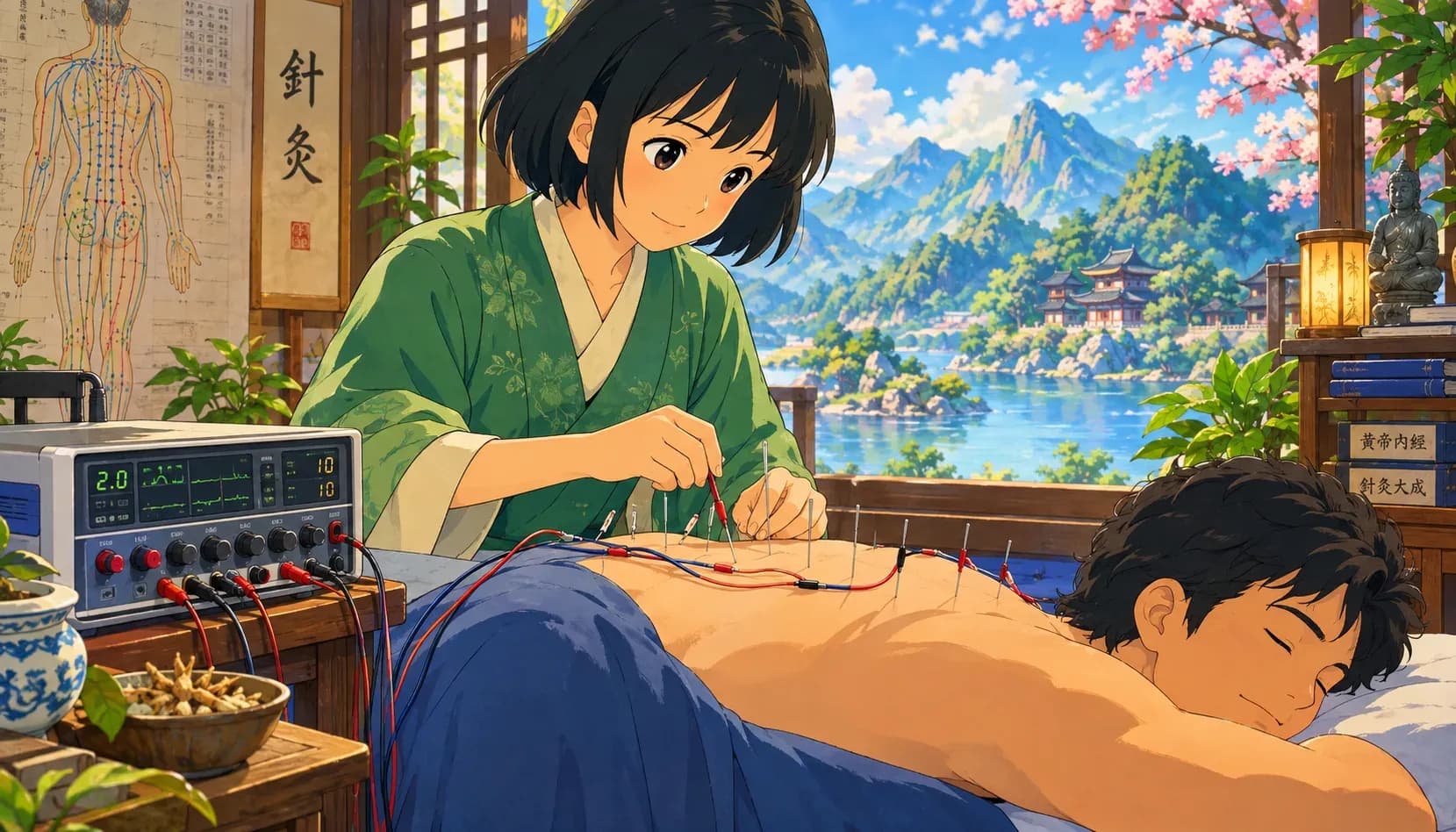
Can you imagine combining the ancient technique of needling with gentle electrical stimulation? That is exactly what electroacupuncture is: a variant of acupuncture that has become popular in clinics around the world over recent decades. Although the name may sound complicated or even intimidating, the reality is much simpler: it is classical acupuncture with a small, controlled, very low-intensity electrical current added, which strengthens the sensation of stimulation at the point. In this article we explain what electroacupuncture is, what a session feels like, when it is typically used, and how it differs from traditional acupuncture.
What is electroacupuncture?
Electroacupuncture is a technique that grew out of classical acupuncture. In a conventional session, the practitioner inserts very fine needles into certain areas of the body and manipulates them by hand to stimulate the area and support the body's balance. In electroacupuncture the process is the same, but once the needles are in place, they are connected to a small device that delivers very low-intensity electrical pulses.
It is important to make this clear from the start: the current used is not the electricity from a household outlet. It is a current of very low frequency and voltage, similar to the kind used in other physical therapy treatments, and its intensity is adjusted at every moment to what each person tolerates comfortably. The goal is to maintain steady, even stimulation throughout the session, which is harder to sustain by manipulating the needles by hand.
The World Health Organization recognizes acupuncture as a widely used traditional practice, and there are currently many lines of research underway studying these types of stimulation and their possible applications, especially in the field of pain.
What does electroacupuncture involve, step by step?
Knowing what the technique is helps, but what really puts your mind at ease is knowing what electroacupuncture involves from start to finish, from the moment you walk into the office until you get up from the treatment table. Although every practitioner has their own way of working, a session usually follows a similar path.
1. The initial assessment
Before placing any needle, the practitioner asks you about the reason for your visit, your health history, the medication you take, and whether you have any implanted electronic device. From the perspective of Chinese medicine, they also observe how the imbalance shows up: whether the pain is fixed or moves around, whether it gets worse with cold or fatigue, whether there is stiffness or a feeling of blockage. In traditional Chinese medicine, many pains are understood to appear when Qi, the vital energy that flows through the body, and Blood do not circulate freely through the channels (meridians), the pathways through which that energy is distributed.
2. Choosing the points and inserting the needles
With that information, the points are chosen. Practitioners often combine points close to the painful area with others located farther away along the same channel. For example, for low back discomfort, Dàcháng Shū (BL25), in the lower back, is often used; for tension in the legs and tendons, Yáng Líng Quán (GB34), below the knee, frequently appears; and points such as Hé Gǔ (LI4), on the hand, or Zú Sān Lǐ (ST36), on the leg, are part of many classic combinations. The needles, which are sterile and single-use, are inserted just as in a conventional session.
3. Connecting the device
Once the needles are in place, the practitioner attaches some of them, usually in pairs, to the leads of the electroacupuncture device using small clips. The current flows between the two needles of each pair, so the stimulation stays limited to the area being treated.
4. Adjusting the frequency and intensity
The device is always switched on at zero, and the intensity is raised gradually until you feel a clear but comfortable tingling. The practitioner also chooses the frequency, that is, the rhythm of the pulses: slower and deeper, faster and finer, or alternating between the two. That choice depends on the goal of the session and on how your body responds.
5. Resting and removal
For the length of the session you lie still and at rest, while the practitioner keeps an eye on how you are feeling. At the end, the intensity is lowered, the device is switched off, the clips are disconnected, and the needles are removed. Afterward you can go about your normal day, although it is a good idea to drink water and avoid strenuous effort that same day.
What does an electroacupuncture session feel like?
One of the most common questions is whether electroacupuncture hurts. The reassuring answer is no. The needles used are so fine that insertion is usually felt as a slight prick or barely at all, just as in conventional acupuncture.
When the device is turned on, the typical sensation is a gentle tingling, a light prickling, or a localized vibration around the needle. Some people describe it as a feeling of "running water" or of deep movement in the area. It is normal for this sensation to feel pleasant and relaxing, and in many cases it never even reaches the point of discomfort. In fact, some people use the minutes of the session to rest or even doze off.
The key is communication with the practitioner: before starting, you are always asked what intensity feels comfortable, and during the session the level is adjusted according to your sensations. If anything bothers you, just say so and the therapist will lower the intensity or remove the needle.
When is electroacupuncture typically used?
Electroacupuncture is not a miracle treatment and it is not meant for everything, but within traditional Chinese medicine it is frequently used in specific situations, especially when the goal is to work on pain or muscle tension. These are the most common cases:
Muscle pain and muscle knots
This is probably the most widespread use. Muscle pain in the neck, shoulders, and back, as well as knots that appear from stress, poor posture, or long hours in front of a screen, are a common reason for visiting acupuncture clinics. The continuous, rhythmic stimulation of electroacupuncture may help relax that tension and ease the feeling of heaviness.
Support during rehabilitation
It is also often used as support during rehabilitation after injuries or after discharge from physical therapy, to care for areas that still have discomfort or stiffness. In these cases, it is essential that electroacupuncture be part of a complete plan, coordinated with your doctor and other health professionals, and never a replacement for it.
Chronic pain and accumulated tension
People who live with persistent back, low back, or neck pain often look for alternatives that complement medical treatment. Traditional Chinese medicine, with techniques like this one, is presented as a complementary option that some patients find useful for managing discomfort and improving their quality of life day to day.
In any case, and we stress this because it matters: if you suffer from persistent or intense pain, or if new symptoms appear, the first step is to see your doctor for a proper diagnosis. Electroacupuncture is a complement, not a substitute for medical care.
Is electroacupuncture safe?
Electroacupuncture is a safe technique when it is performed by a qualified, trained practitioner who uses single-use materials and follows proper hygiene and safety protocols. As with any needle-based technique, mild redness or a small bruise may appear at the insertion point, and it usually disappears within a few days without treatment.
That said, there are situations in which electroacupuncture is contraindicated or requires caution, for example:
People with pacemakers or implanted electronic devices: the electrical current could interfere with how the device works, so this technique is not appropriate in these cases.
Pregnancy: acupuncture can be used during pregnancy, but with much more caution and never in certain areas; the decision must always be made by the practitioner after assessing each case.
Epilepsy, open wounds, or local infections in the treatment area: the practitioner will assess whether it is appropriate or not.
Anticoagulants or other medications: it is important to always tell your therapist everything you take, since certain needles can slightly increase the risk of bruising.
A good practitioner will always ask about your health history before the first session and explain why the technique is suitable for you, or why a different alternative is better in your case.
Differences between electroacupuncture and classical acupuncture
If you are wondering which one to choose, this comparison will help you understand them better:
Stimulation: in classical acupuncture the practitioner manipulates the needles by hand, intermittently; in electroacupuncture the stimulation is continuous, steady, and very well controlled thanks to the device.
Sensation: traditional acupuncture produces a subtler, more localized sensation; electroacupuncture is usually felt as a more noticeable tingling or vibration, though still comfortable.
Typical use: both are used in many contexts, but electroacupuncture is used especially often for pronounced muscle pain, muscle knots, and support during rehabilitation.
Session: in essence, the length, preparation, and atmosphere of the session are very similar in both techniques.
Neither technique is "better" than the other: they are simply different tools that the practitioner chooses according to each person and each situation. It is even possible to combine both within a single session.
Frequently asked questions
Does electroacupuncture hurt?
No. The needle insertion is barely noticeable, just as in conventional acupuncture, and the current produces only a gentle, pleasant tingling. The intensity is adjusted at every moment to your tolerance.
How long does an electroacupuncture session last?
In general, between 20 and 40 minutes with the needles in place and the device on, in addition to the time for the initial assessment. The practitioner decides the exact length based on your case.
How many sessions are needed?
It depends on each person and each situation. Some people notice improvement within a few sessions, while other conditions require longer support. The practitioner will propose a plan tailored to you after the first visit.
What exactly does electroacupuncture involve?
It involves inserting fine needles into acupuncture points chosen after an assessment and connecting them, in pairs, to a device that delivers very low-intensity electrical pulses. The current flows only between those needles and produces a gentle tingling. The practitioner adjusts the intensity and frequency to your comfort and removes everything at the end of the session.
Can I have electroacupuncture if I have a pacemaker?
No. The electrical current can interfere with how the pacemaker works, so this technique is contraindicated. The practitioner can offer you other safe alternatives.
Is electroacupuncture a medical treatment?
It is a traditional Chinese medicine technique used as a complement, never as a substitute for medical diagnosis or treatment. If you have persistent or serious symptoms, the first step is to consult your doctor.
Who should you see for electroacupuncture?
Electroacupuncture is an interesting and versatile technique within traditional Chinese medicine, especially valued for work with muscle pain, muscle knots, and support during rehabilitation. Its safety and effectiveness depend largely on a good prior assessment and on a qualified practitioner with formal training.
If you are interested in trying it, look for a reputable clinic with licensed practitioners who are willing to explain openly what the technique involves, what you can expect from it, and when it is not the right option. And remember: for any symptom that worries you, your first visit should always be with your doctor.