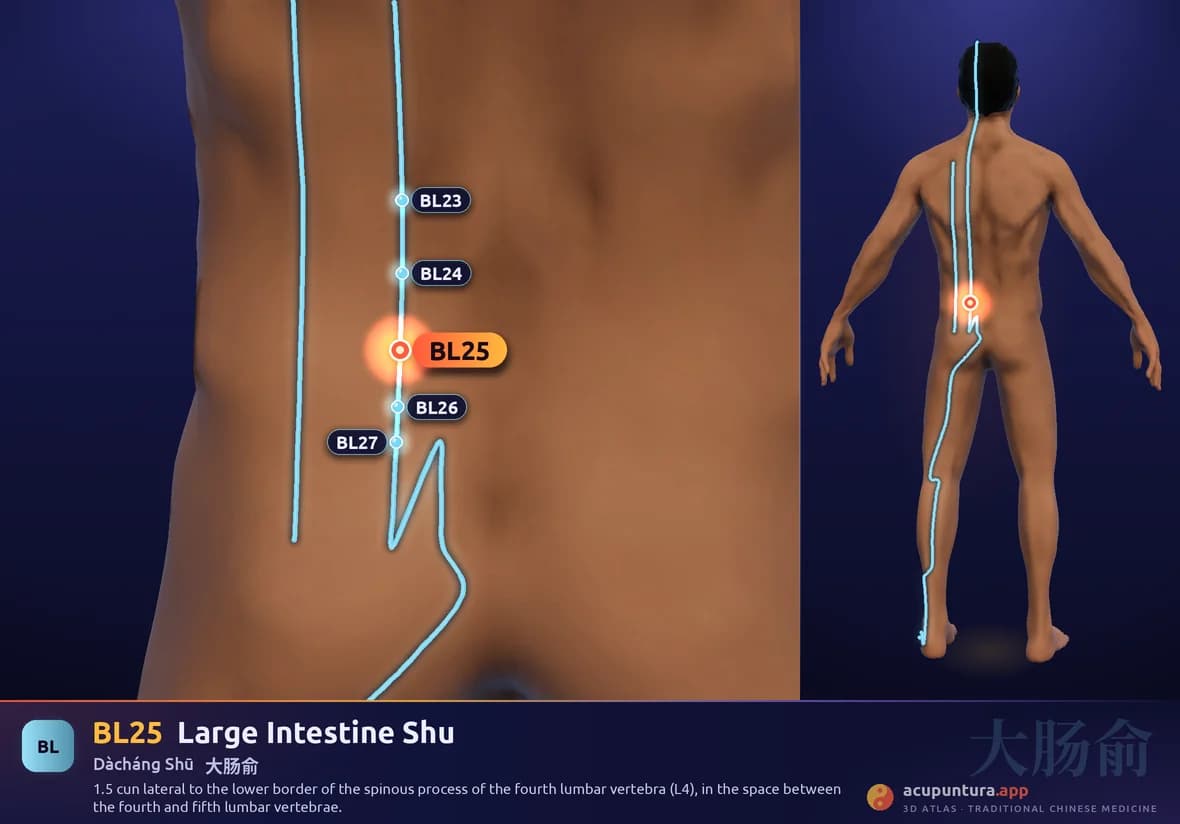
Bladder Channel
Large Intestine Shu
大肠俞Dàcháng ShūUse caution during pregnancy
Lumbosacral band; avoid strong stimulation.
Anatomical location
1.5 cun lateral to the lower border of the spinous process of the fourth lumbar vertebra (L4), in the space between the fourth and fifth lumbar vertebrae.
Main function
Regulates the Large Intestine, promotes bowel movement, relieves constipation, regulates Qi, relieves pain, strengthens the lumbar region, eliminates Damp-Heat.
- Back-Shu point of the Large Intestine
Therapeutic indications
- Constipation
- diarrhea
- dysentery
- abdominal pain
- abdominal distension
- hemorrhoids
- low back pain
- sciatica
- pain in the sacral region
- colitis
- enteritis
- rectal prolapse
- Low back pain
- Borborygmi
- Paralysis of the lower limb
- Irritable bowel syndrome
- Ulcerative colitis and Crohn's disease
- Kidney stones and renal colic
- Lumbar disc herniation
Name and classical tradition
Dachangshu, 大肠俞, is the Back-Shu point of the Large Intestine. 大肠 (大腸) is the large intestine; 俞 is the transport point. The Zhenjiu Jiayi Jing (Systematic Classic of Acupuncture and Moxibustion) places it «在第十六椎下兩傍各一寸五分», one and a half cun to each side below the sixteenth vertebra, which corresponds to the fourth lumbar.
It belongs to the core of the Back-Shu points of the Fu organs documented in the Jiayi Jing. On the abdomen, its counterpart is ST25, Tianshu, the Front-Mu point of the same Fu organ. No ancient alternative names or classical commentaries are known for it.