If you have ever walked into an acupuncture clinic and noticed a peculiar smell, a bit like gently burning grass, chances are you have come across moxibustion, even if you didn't know its name at the time. Moxibustion, also known simply as moxa, is one of the oldest and most cherished techniques in traditional Chinese medicine, and yet it remains largely unknown to most people. In this article, we explain what moxa is, where it comes from, how it is applied in the treatment room, what it feels like, and the kinds of situations in which it is commonly used. If you have never heard of it, here you will find a clear, honest explanation without the jargon.
What Is Moxibustion, or Moxa?
Moxibustion is a therapeutic technique of traditional Chinese medicine that involves applying heat to specific areas of the body by the controlled burning of a plant: mugwort (Artemisia vulgaris), an aromatic herb that grows wild in many regions of the world, including the Iberian Peninsula.
The word "moxa" has an interesting origin. It comes from the Japanese term mogusa (艾), which literally means "burning herb." The Portuguese missionaries and merchants who reached Japan in the 16th and 17th centuries adopted the word, shortened it to "moxa," and carried it back to Europe, where it is still used today.
To prepare it, mugwort leaves are harvested, dried, and ground into a soft, woolly material, greenish or brownish in color, that burns slowly and gives off a gentle, penetrating, steady heat. That heat is precisely the key to the technique: in traditional Chinese medicine, heat is considered to help move the body's energy, activate circulation, and restore balance in situations of cold, stiffness, or weakness.
How Is Moxa Applied in a Treatment Session?
There are several ways to apply moxibustion, and the practitioner will choose one or another depending on each person's situation. These are the most common:
Moxa Sticks (Moxa Cigars)
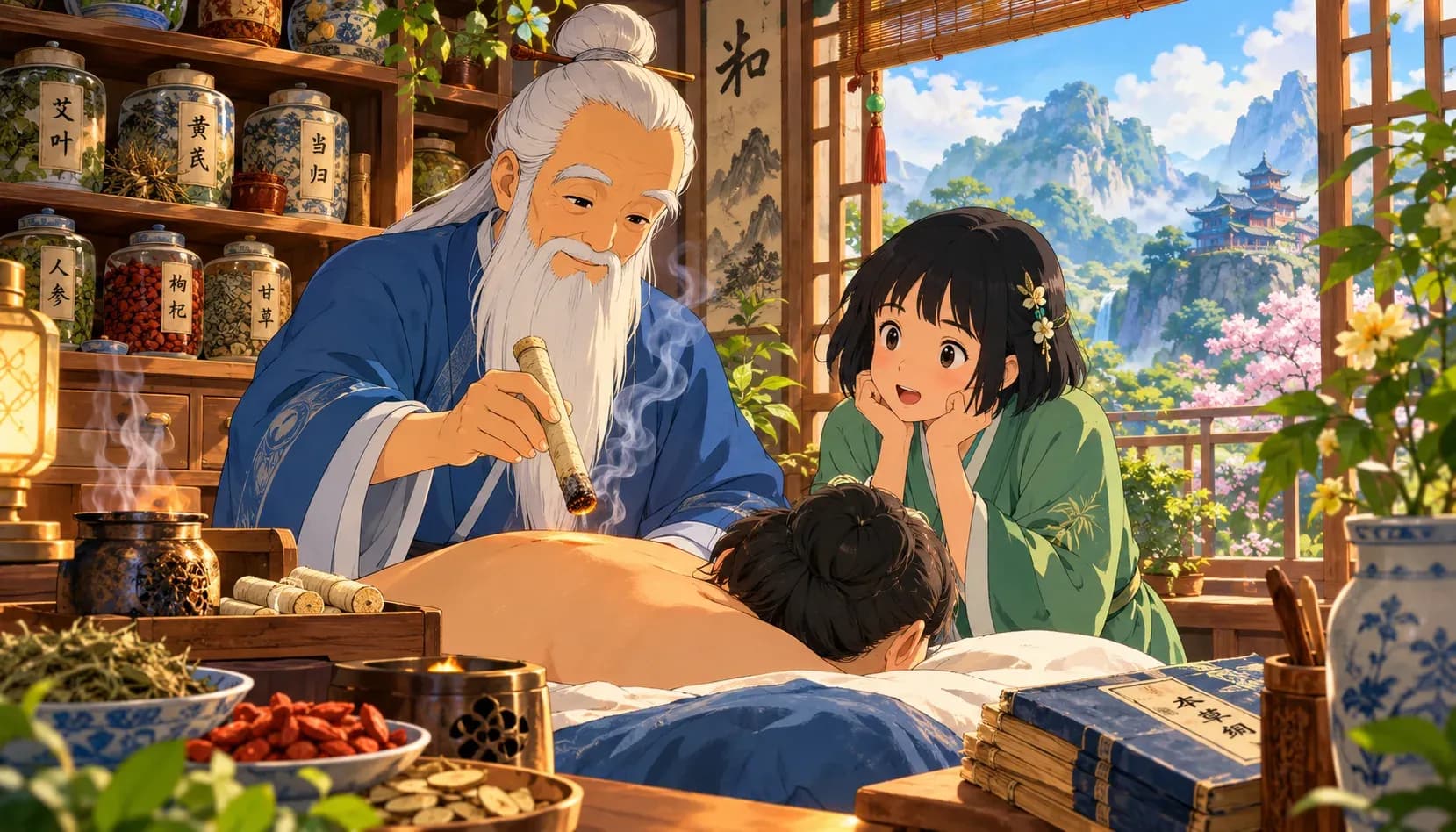
This is the most common form today, and the one you would probably see in a modern practice. A moxa stick is a cylinder of pressed mugwort, similar in appearance to a cigar or a thick incense stick. The practitioner lights one end and brings it close to the area being treated, a few centimeters from the skin, without touching it.
The person feels a pleasant, deep warmth in the area. The practitioner may hold the stick still, move it in circles, or bring it closer and move it away gently (like the fluttering of a bird's wings) to regulate the intensity of the heat. A session with a moxa stick usually lasts between ten and twenty minutes per area.
Moxa Cones
In the most traditional form of the technique, loose mugwort is shaped by hand into small cones, which are placed directly on the skin or, more often, on a substance that protects the skin, such as a slice of fresh ginger, a layer of salt, or garlic. The cone is lit at the tip and burns slowly. The practitioner removes it before the heat becomes uncomfortable.
This method demands a great deal of skill and experience, which is why it is less common in Western clinics today.
Moxa Box
A moxa box is a small wooden container with a mesh base, inside of which burning mugwort is placed. It is set on the area to be treated, such as the lower back or the abdomen, and provides a broad, even, and very comfortable warmth. It is a very pleasant option for warming large areas of the body and is especially appealing during the colder months.
Moxa Combined with Acupuncture
In many practices, moxibustion is combined with acupuncture. In this case, a small piece of moxa is placed on the handle of a needle that has already been inserted, so that the heat travels down through the metal into the tissue. It is a highly valued way of combining the benefits of both techniques.
How Moxa Is Done, Step by Step
Knowing the different methods helps, but many people want something more concrete: what exactly happens from the moment the practitioner picks up the stick until they put it out. We walk you through the most common form, the moxa stick, because it is the one you are most likely to encounter in a practice and the one usually recommended when a professional teaches someone to continue at home.
How Moxa Is Done with a Stick in the Treatment Room
Initial assessment. The practitioner asks how you are feeling, whether you tend to feel cold or hot, whether there are any wounds or sensitive areas, and whether you are taking medication or are pregnant. Based on this, they decide whether moxa is appropriate and on which areas.
Comfortable position and bare skin. You lie down or sit so that the area is accessible and relaxed. The skin should be clean and dry, with no creams or oils, which could trap the heat.
Lighting. The practitioner lights one end of the stick with a lighter or a candle until it forms an even, red ember with no flame.
Application. They bring the ember to within a few centimeters of the skin, at the distance where the heat feels pleasant, and hold it still, move it in circles, or use a pecking motion so that the heat doesn't concentrate too much. From time to time they tap the ash into an ashtray so it doesn't fall on you.
Constant listening. As soon as you say it burns or the heat is too intense, they pull the stick away for a few seconds and bring it back from a greater distance. The skin should normally end up slightly pink and warm, never red or blistered.
Extinguishing. When finished, the stick is put out by smothering the ember, for example by placing it in a metal extinguisher or a container of sand or salt, and the practitioner checks that no embers remain.
Moxa: How It Is Used on the Most Common Points
Moxa is not applied at random. In traditional Chinese medicine, it is directed at specific points on the channels (meridians), the pathways through which qi, or vital energy, is considered to flow. Some of the most classic points for moxibustion are:
Zú Sān Lǐ (ST36), "Leg Three Miles," below the knee, on the outer side of the leg. It is one of the points most commonly used to support fatigue and digestive discomfort.
Qì Hǎi (CV6), "Sea of Qi," and Guān Yuán (CV4), "Gate of Origin," on the midline of the abdomen, below the navel. They are often warmed with a moxa box in people who feel cold and weak.
Shén Què (CV8), "Spirit Gate Tower" (the navel). This point is never needled; traditionally it is warmed with moxa placed on a layer of salt or a slice of ginger, never directly.
Which points to choose, for how long, and how often depends on the individual, which is why it is best to have a professional decide after assessing you.
What Does a Moxibustion Session Feel Like?
What Does a Moxibustion Session Feel Like?
If you are worried that moxibustion might hurt, rest assured: when applied correctly, the sensation is one of gentle, deep, and very pleasant warmth. Many people describe it as similar to lying in the sun on a mild day, or to the warmth of an electric blanket, but more penetrating.
What you will notice is the smell. Burning mugwort gives off a characteristic herbal aroma, which most people find relaxing, though it is good to know about it beforehand. There are also "smokeless" or low-smoke versions of moxa, designed for enclosed spaces or for people who are sensitive to smells.
It is important to stress that properly applied moxibustion does not burn the skin. A qualified practitioner monitors the distance, the temperature, and the person's reactions at all times, and removes the heat as soon as it becomes intense. Before and during the session, they will ask about your sensations to adjust the application.
What Is Moxibustion Used For?
From the perspective of traditional Chinese medicine, the heat of moxa is used to bring warmth, activate the circulation of energy and Blood, and strengthen the body in situations of weakness or chilling. In everyday practice, moxibustion is commonly used in situations such as the following:
People who get cold easily. Cold hands and feet, a feeling of never getting warm, or discomfort that worsens in winter are some of the most common reasons moxa is recommended.
Fatigue and lack of energy. The heat of moxibustion is considered tonifying: it brings a sense of vitality and general well-being that many people welcome during periods of exhaustion or convalescence.
Muscle and joint discomfort that improves with heat. Stiffness, tight muscles, or dull aches that ease when you apply a hot water bottle tend to respond well to moxa, according to traditional clinical experience.
Mild digestive discomfort associated with cold, such as a feeling of a cold or heavy stomach, especially when it gets worse with cold foods or in cold environments.
Menstrual discomfort that improves with heat, a very widespread use in the tradition.
In the clinical history of moxibustion, its traditional use in pregnant women also stands out, in the context of certain situations described by Chinese medicine; in any case, during pregnancy any intervention must first be assessed with the appropriate health professional.
It is worth remembering that moxibustion is a complement to health care, not a substitute for conventional medicine. If you have symptoms that are persistent, intense, or worrying, the first step is to see your doctor.
A Little History: Thousands of Years of Therapeutic Warmth
Moxibustion is one of the oldest therapeutic practices still in use. Its origins go back to ancient China, where it is already mentioned in medical texts more than two thousand years old. In fact, some historians believe that the use of heat on the body may even predate acupuncture itself: before needles, there was already fire applied with care.
Over the centuries, the technique traveled from China to Korea and Japan, where it became enormously popular. In Japan, it became so common that there were practitioners devoted exclusively to moxibustion, and it was frequent for families to apply it at home as part of their daily care.
Starting in the 16th and 17th centuries, Europeans trading with Asia learned about moxa and brought it to the West. For a time it was also used in Europe for various purposes, although it later fell into oblivion. Today, with the growing interest in traditional therapies, moxibustion has regained its place in acupuncture and traditional Chinese medicine practices around the world. The World Health Organization recognizes acupuncture and its associated techniques, including moxibustion, as widely used traditional practices, and scientific research on their effects and mechanisms is ongoing.
Is Moxibustion Safe? Precautions to Keep in Mind
Moxibustion is a safe technique when applied by a qualified practitioner who knows the indications, the precautions, and each person's physiology. Even so, there are some situations in which it is applied with special care or not at all:
- Over areas of irritated skin, wounds, or acute inflammation.
- In people with altered skin sensation, who may not perceive heat well.
- During pregnancy, unless a professional has expressly assessed it.
- In feverish states or with an intense feeling of heat.
In addition, if you have any relevant medical condition, it is advisable to tell your practitioner and keep your doctor informed. Caution and communication are the foundation of good practice.
Frequently asked questions
Does moxibustion burn or hurt?
No. When performed by a professional, moxibustion produces a pleasant, deep sensation of warmth, never pain. The practitioner controls the distance and the temperature at all times and removes the heat if it becomes intense.
How long does a moxa session last?
It depends on the technique and the area treated, but moxa is usually applied for ten to twenty minutes, often as part of a broader acupuncture or traditional Chinese medicine session.
Does moxa smell strong?
Yes, burning mugwort gives off a characteristic herbal smell. Most people find it pleasant and relaxing, but if you are sensitive to smells, mention it at your appointment: low-smoke varieties of moxa are available.
Can I use moxa at home?
Moxa kits for home use exist, but it is best to learn first with a professional, who will show you how to apply it safely and on which areas. Careless use of heat on the skin can cause burns.
How do you put out a moxa stick?
Never with water, because the stick gets soaked and can no longer be used. The right way is to smother the ember: place it in a metal extinguisher, in a jar of sand or salt, or in a container that doesn't let air in. Before storing it, check that no embers are still glowing.
Does moxibustion replace medical treatment?
No. Moxibustion and traditional Chinese medicine in general are understood as a complement to health care. For any symptom that is persistent, serious, or worrying, you should always see your doctor.
Discover Moxibustion with a Qualified Professional
Moxibustion is a technique that seems simple, but it comes with centuries of tradition and an application that requires knowledge and experience. If you are interested in trying its benefits, that deep, comforting warmth that so many people describe, the best thing to do is visit an acupuncture and traditional Chinese medicine practice with qualified professionals, who will assess your situation individually and explain whether moxa might be right for you. Your well-being deserves expert hands.