Ren Mai (Conception Vessel) Channel
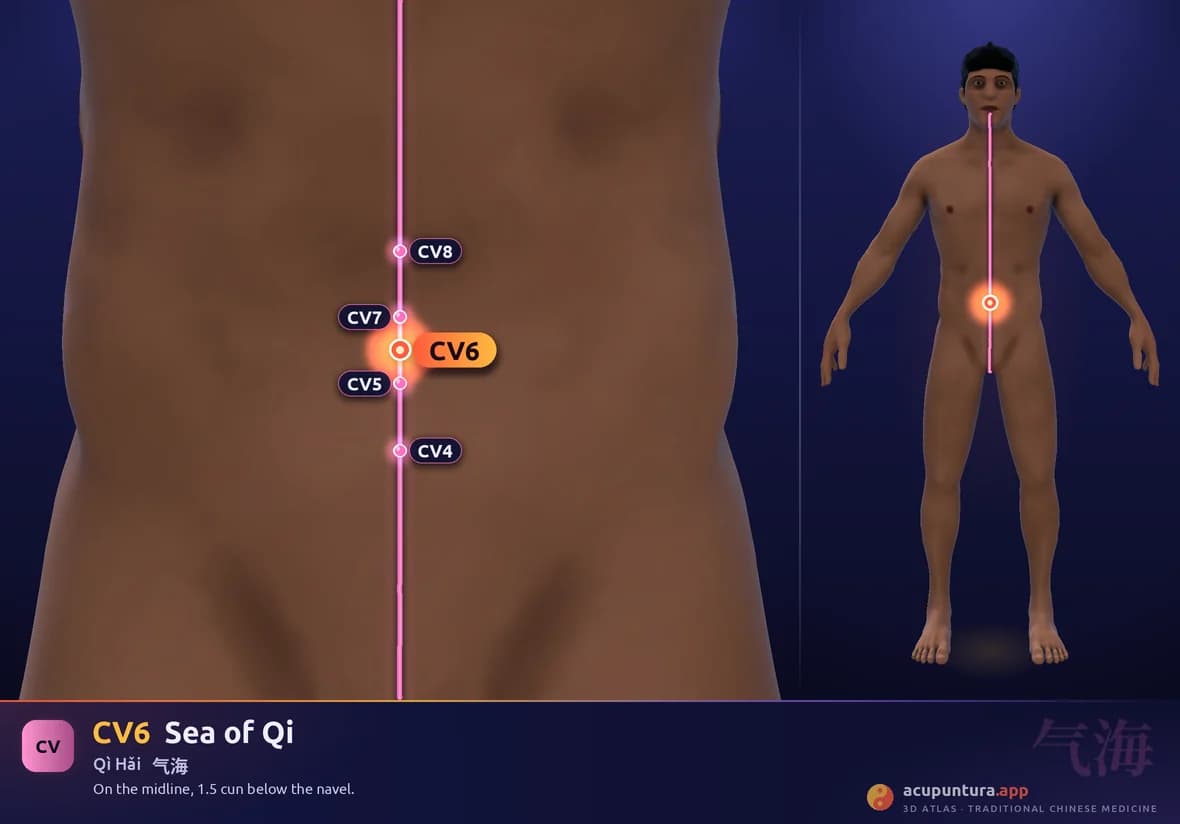
Sea of Qi
气海Qì HǎiContraindicated during pregnancy
Sea of Qi; strongly mobilizes the Lower Jiao.
Anatomical location
On the midline, 1.5 cun below the navel.
Main function
Tonifies the Original Qi, strengthens deficiency.
Therapeutic indications
- General weakness
- fatigue
- abdominal pain
- constipation
- exhaustion
- abdominal distension
- diarrhea
- irregular menstruation
- dysmenorrhea
- enuresis
- impotence
- hernia
- collapse
- prolapse
- obesity and overweight
- hypothyroidism
- irritable bowel syndrome
- ulcerative colitis and Crohn's disease
- COPD and chronic bronchitis
- low blood pressure
- endometriosis
Name and classical tradition
Qihai, 气海, is the "Sea of Qi." 气 (氣) is qi; 海 is the sea, the place where all rivers end up. The usual reading describes it as the spot below the navel where the body's Qi gathers, and later tradition made it one of the great moxibustion points for strengthening the body and prolonging life (灸氣海).
Its oldest name is probably 脖胦. The Lingshu (Spiritual Pivot), in the chapter Jiu Zhen Shi Er Yuan (九針十二原), lists the Yuan-Source points of the organs and adds two more: "膏之原,出於鳩尾……肓之原,出於脖胦." The Yuan-Source of the gao emerges at Jiuwei, CV15, and that of the huang at Boyang, which is Qihai. Thus both terms of the old expression gao and huang, which gives BL43, Gaohuang, its name, have their point on the Ren Mai. Hence also its aliases 肓原, "origin of the huang," and 下肓.
The sources are divided between the Lingshu and the Zhenjiu Jiayi Jing (Systematic Classic of Acupuncture and Moxibustion) as the first mention under this name. Like CV4 and CV5, Qihai is also called 丹田. Its name is mirrored on the back at BL24, Qihaishu, the Back-Shu point of the sea of Qi.
Other names
- 脖胦Jiayi Jing
- 下肓Jiayi Jing