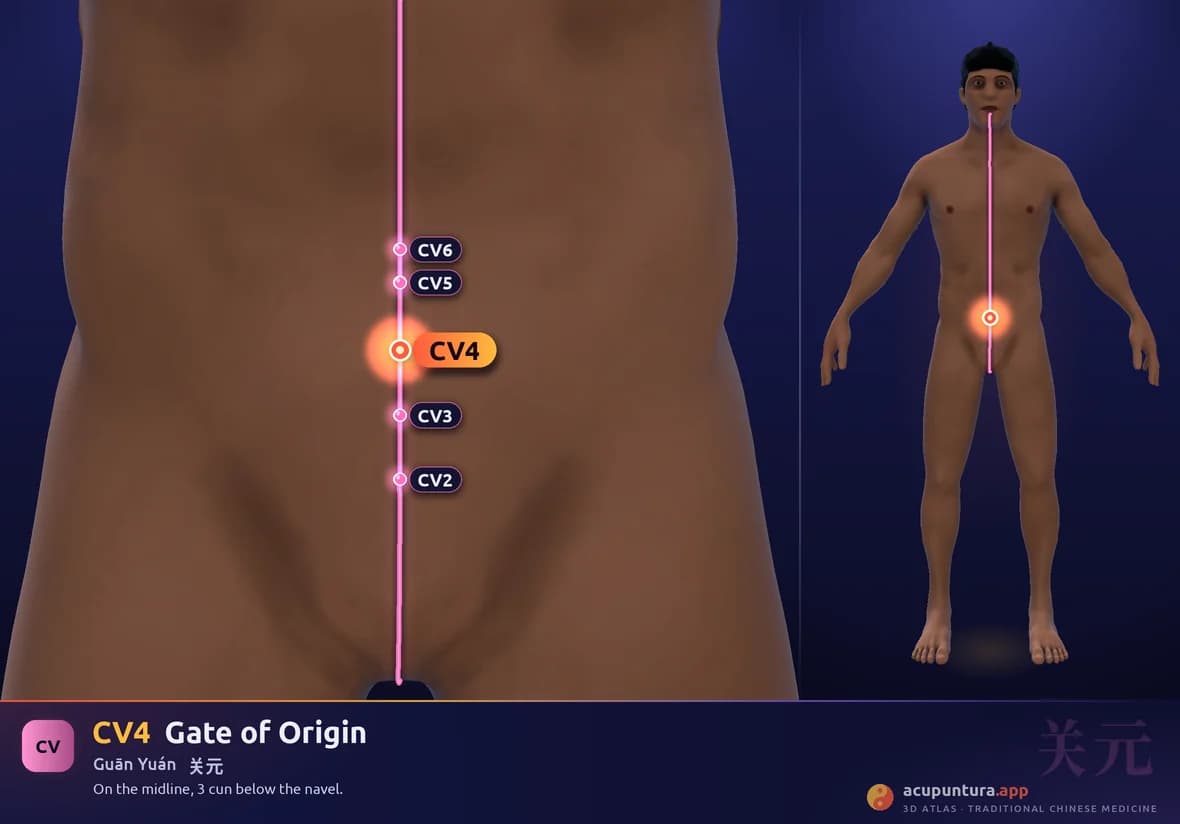
Ren Mai (Conception Vessel) Channel
Gate of Origin
关元Guān YuánContraindicated during pregnancy
Front-Mu point of the Small Intestine, over the uterus. Its action on the Lower Jiao rules it out entirely.
Anatomical location
On the midline, 3 cun below the navel.
Main function
Tonifies the Original Qi, strengthens the Kidney, nourishes Yin.
- Small Intestine Front-Mu point
- Crossing point with the Spleen, Liver, and Kidney
Therapeutic indications
- General weakness
- infertility
- impotence
- diarrhea
- fatigue
- exhaustion
- chronic diarrhea
- irregular menstruation
- dysmenorrhea
- nocturnal emission
- enuresis
- urinary frequency
- pain in the hypogastrium
- collapse
- cold extremities
- hernia
- panic attacks (Ben Tun Qi)
- diabetes mellitus (Xiao Ke)
- hypothyroidism
- ulcerative colitis and Crohn's disease
- kidney stones and renal colic
- COPD and chronic bronchitis
- low blood pressure
- prostatitis and benign prostatic hyperplasia
- polycystic ovary syndrome
- endometriosis
- osteoporosis
- chemotherapy-induced leukopenia
- anemia
Name and classical tradition
Guanyuan, 关元, is the “gate of origin.” 关 (關) is the bolt, the door that closes; 元 is the origin, the primordial, the Original Qi. The usual reading describes it as the gate behind which the body's Original Qi is kept. Hence its identification with the dantian (丹田), the “field of cinnabar” of Taoist internal alchemy, a well-documented tradition, but of Taoist rather than ancient medical lineage.
The highest-quality citation on the point comes from a named commentator. Wang Zhizhong, in the Zhenjiu Zisheng Jing (Classic of Nourishing Life with Acupuncture and Moxibustion), in the Song period, explains one of its aliases: «亦名大中極,言取人身之上下四向最為中也», it is also called the “great central pole,” because it lies at the center of the body in all four directions. The Zhenjiu Jiayi Jing (Systematic Classic of Acupuncture and Moxibustion) places it «在臍下三寸», three cun below the navel. The textual origin of the name is uncertain: some sources place it in the Suwen (Basic Questions) and others in the Lingshu (Spiritual Pivot).
Guanyuan is the Front-Mu point (募穴) of the Small Intestine and a crossing point of the Ren Mai with the Kidney, Spleen, and Liver channels. Hence another of its aliases, 三結交, “where three are knotted together.” 下紀, 次門, and 丹田 are also added. It shares the name dantian with CV5 and CV6, and the schools debated for centuries which of the three was the true one.
Other names
- 次門Jiayi Jing