Bladder Channel
Mid-Back Shu
中膂俞Zhōnglǚ ShūAnatomical location
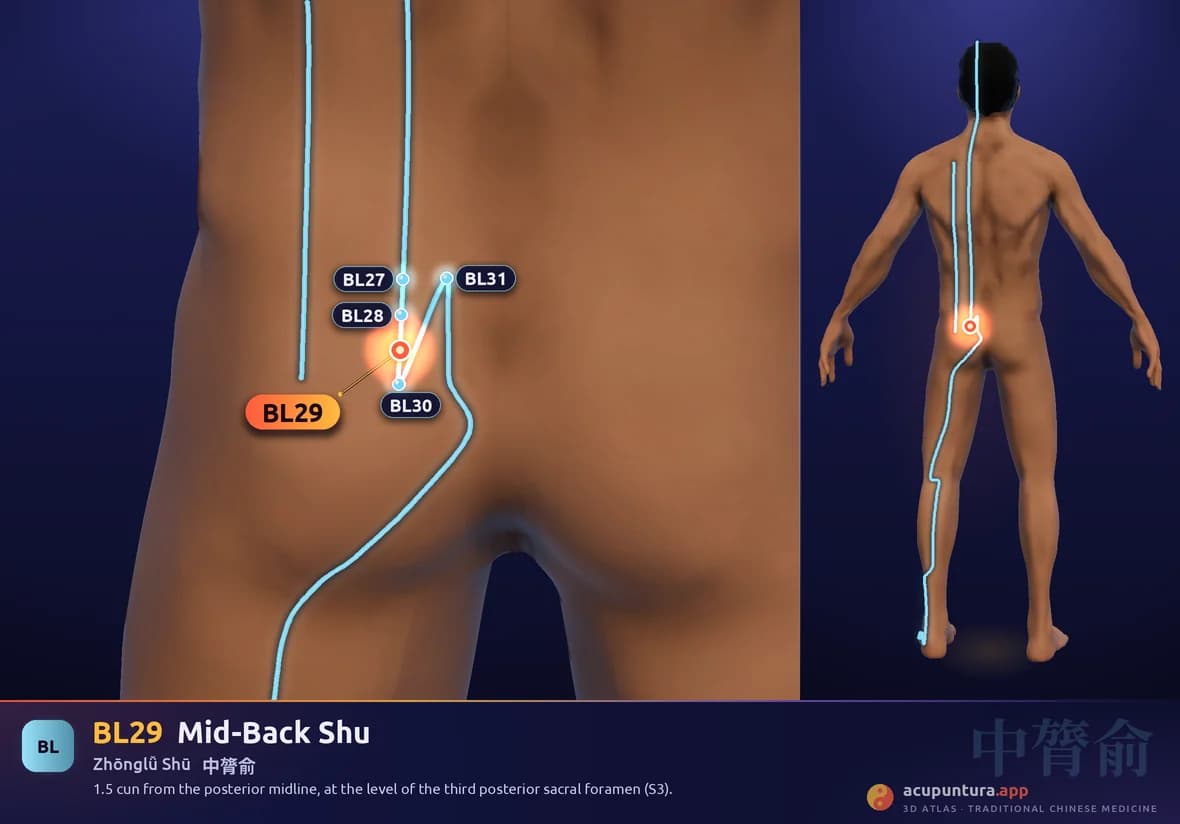
1.5 cun from the posterior midline, at the level of the third posterior sacral foramen (S3).
Main function
Strengthens the Kidney, benefits the lumbar and sacral region, regulates Qi and Blood, strengthens the muscles and tendons, benefits the bladder, regulates urination, regulates the Large Intestine.
Therapeutic indications
- Low back pain
- sciatica
- dysuria
- enuresis
- urinary retention
- diarrhea
- dysentery
- constipation
- leukorrhea
- dysmenorrhea
- impotence
- sterility
- Low back pain
- Hernia
- Lumbar stiffness
Name and classical tradition
Zhonglüshu, 中膂俞, is one of the few points in the sacral region with a direct citation from the Lingshu (Spiritual Pivot), and its name shows a documented evolution. 膂 refers to the thick musculature that runs alongside the spine, the erector muscles; 中 means center. The point sits within that muscle mass, in the sacral area.
The Lingshu, in the chapter Ci Jie Zhen Xie (刺節真邪), calls it simply 中膂. The Zhenjiu Jiayi Jing (Systematic Classic of Acupuncture and Moxibustion) names it 中膂內俞, adding the “inner transport point.” The current name, 中膂俞, falls between the two. Reference works also record 脊內俞, “inner transport point of the spine.” Between the Lingshu and the Jiayi Jing, the name was expanded and then fixed, a verifiable example of how terminology evolved.