Bladder Channel
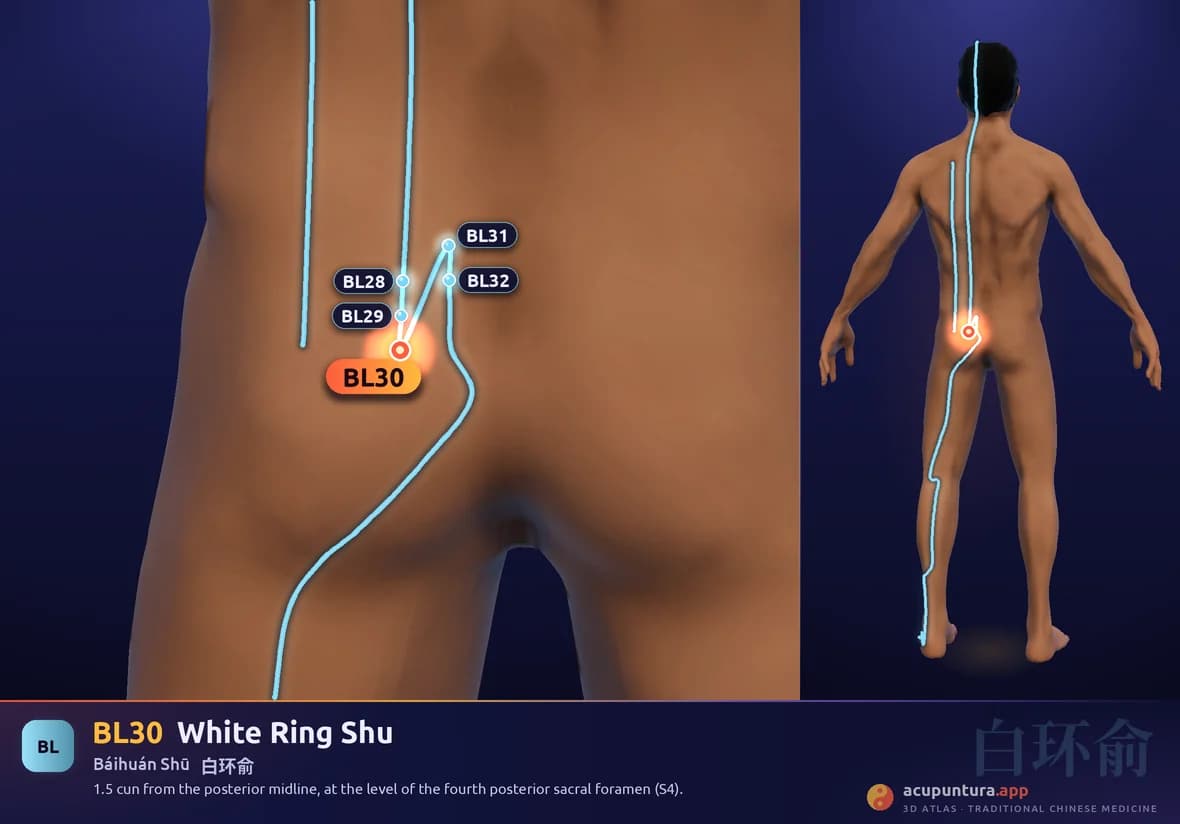
White Ring Shu
白环俞Báihuán ShūAnatomical location
1.5 cun from the posterior midline, at the level of the fourth posterior sacral foramen (S4).
Main function
Regulates Qi and Blood, strengthens the Kidney, benefits the lumbar and sacral region, regulates urination, treats gynecological disorders, strengthens the pelvic region, eliminates Damp-Heat.
Therapeutic indications
- Low back pain
- sciatica
- dysuria
- enuresis
- urinary incontinence
- leukorrhea
- dysmenorrhea
- amenorrhea
- infertility
- impotence
- uterine prolapse
- hemorrhoids
- genital pain
- Sacral low back pain
- Rectal prolapse
- Irregular menstruation
- Nocturnal emission
Name and classical tradition
Baihuanshu, 白环俞, is the “transport point of the white ring.” 白環 is a term that, according to a gloss recorded in the reference works, designated the gluteal region: «白環,指臀部。以與環跳穴相近而名», the white ring refers to the buttocks, and the point takes its name from its proximity to GB30, Huantiao. The 環 would thus be that of the hip joint. The exact origin of this gloss has not been identified, and it does not seem to be modern, but it should be treated with caution.
The Zhenjiu Jiayi Jing (Systematic Classic of Acupuncture and Moxibustion) locates it «在第二十一椎下兩傍各一寸五分處», one and a half cun to each side, below the twenty-first vertebra. The Jiayi Jing also includes it in its list of points where moxibustion is not applied. It is the last point in the series of the Back-Shu points in descending order. Below it, the channel enters the eight sacral foramina, beginning with BL31.