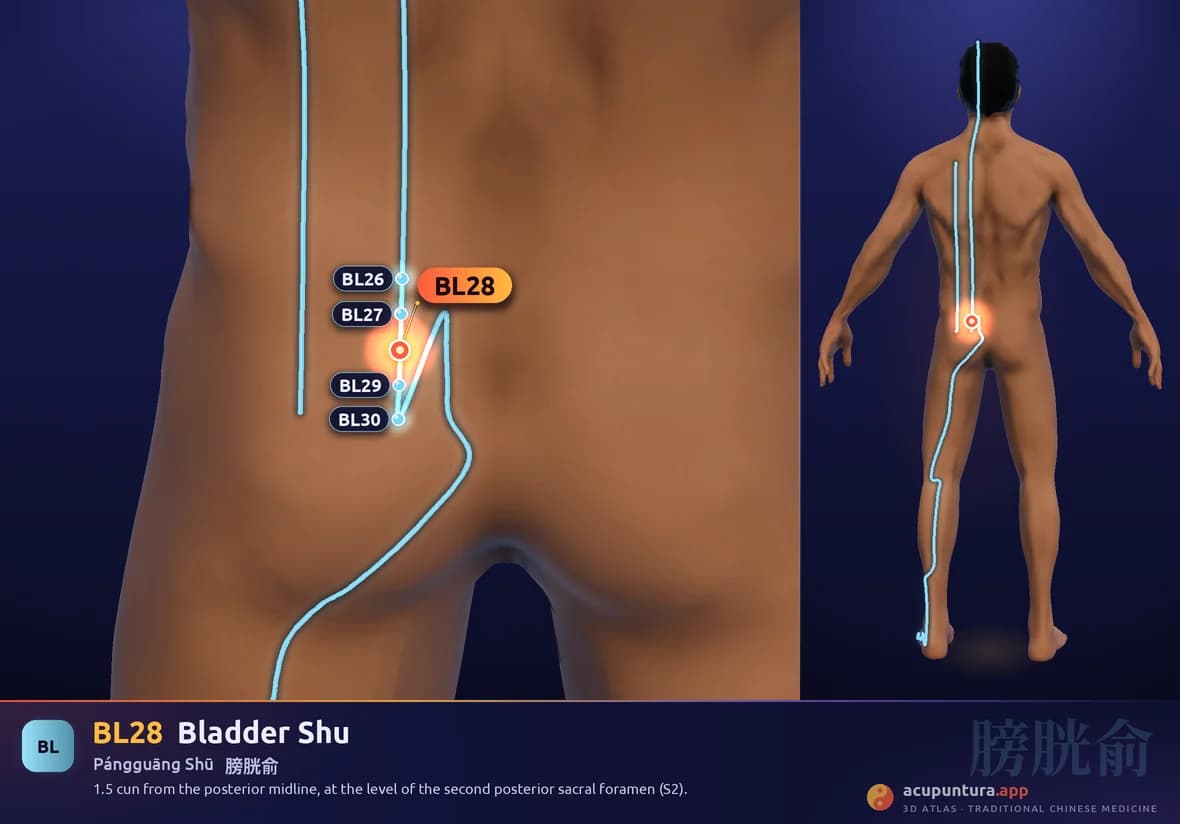
Bladder Channel
Bladder Shu
膀胱俞Pángguāng ShūUse caution during pregnancy
Bladder Back-Shu point over the sacrum; avoid.
Anatomical location
1.5 cun from the posterior midline, at the level of the second posterior sacral foramen (S2).
Main function
Regulates the Bladder, transforms and drains Dampness, regulates the passage of water, strengthens the lumbar region, eliminates Damp-Heat, strengthens the Kidney and Bladder.
- Bladder Back-Shu point
Therapeutic indications
- Urinary disorders (dysuria
- urinary retention
- enuresis
- incontinence
- frequent urination
- hematuria)
- low back pain
- sciatica
- leukorrhea
- dysmenorrhea
- impotence
- sterility
- abdominal pain
- diarrhea
- constipation
- Dysuria
- Sacral low back pain
- Lumbar stiffness
- Kidney stones and renal colic
- Prostatitis and benign prostatic hyperplasia
Name and classical tradition
Pangguangshu, 膀胱俞, is the Back-Shu point of the Bladder, and it has a particularity: it is the Shu point of the organ that gives its name to the very channel on which it lies. 膀胱 is the bladder; 俞 is the transport point. The Zhenjiu Jiayi Jing (Systematic Classic of Acupuncture and Moxibustion) places it «第十九椎下兩傍各一寸五分», one and a half cun to each side below the nineteenth vertebra, at the level of the second sacral foramen.
No ancient aliases or commentators' glosses are attributed to it. Beside it, on the outer line, is BL53, Baohuang, whose first character, 胞, can also refer to the bladder.