Bladder Channel
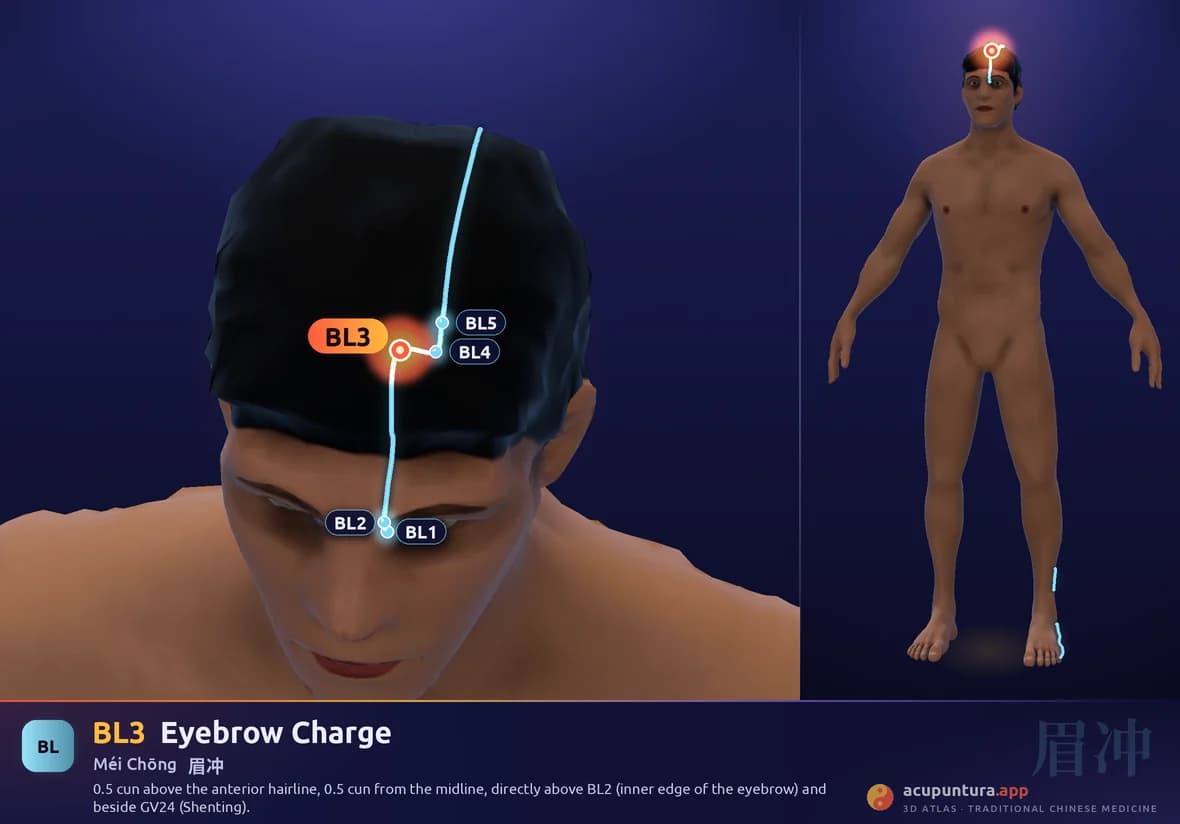
Eyebrow Charge
眉冲Méi ChōngAnatomical location
0.5 cun above the anterior hairline, 0.5 cun from the midline, directly above BL2 (inner edge of the eyebrow) and beside GV24 (Shenting).
Main function
Expels Wind, clears the head and eyes, relieves headache, calms the Shen (Spirit).
Therapeutic indications
- Frontal headache
- vertigo
- dizziness
- blurred vision
- nasal congestion
- chronic nasal congestion
- epilepsy
- convulsions
- eye pain
- frontal sinus congestion
- Headache
- Nasal obstruction
- Epistaxis
Name and classical tradition
Meichong, 眉冲, combines 眉, the eyebrow, which indicates its location, on the vertical line from the inner end of the eyebrow, within the hairline, and 冲 (衝), to charge, to rise forcefully. A modern gloss speaks of the Qi of the channel surging upward at this point. It has no classical citation.
Its textual origin is uncertain. Some secondary sources trace it to Wang Shuhe's Maijing (Pulse Classic), from the third century, and others to the Zhenjiu Jiayi Jing (Systematic Classic of Acupuncture and Moxibustion), although the passage has not been verified in either. The reference works attribute to it the alternative names 小竹, "small bamboo," which links it to its neighbor BL2, the gathered bamboo, and 星, "star."