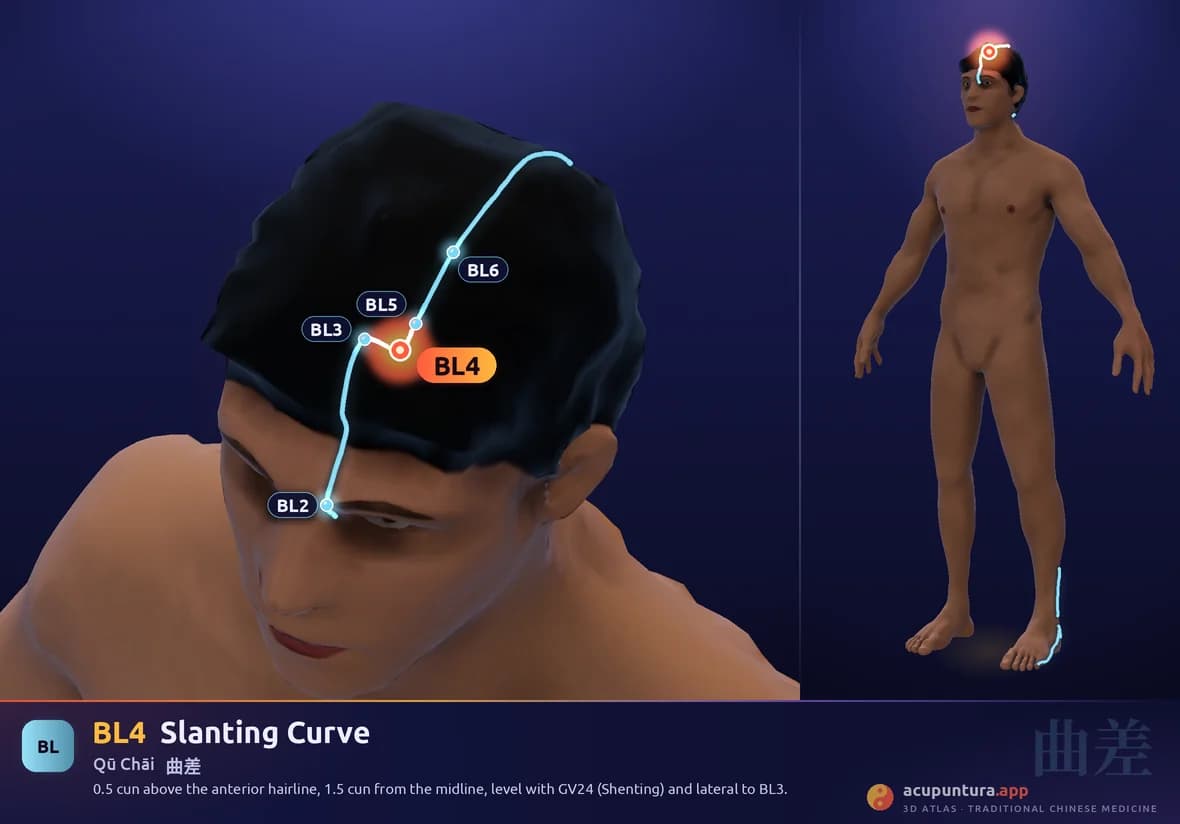
Bladder Channel
Slanting Curve
曲差Qū ChāiAnatomical location
0.5 cun above the anterior hairline, 1.5 cun from the midline, level with GV24 (Shenting) and lateral to BL3.
Main function
Expels Wind, clears the head and eyes, opens the nasal orifices, relieves headache.
Therapeutic indications
- Headache
- vertigo
- dizziness
- nasal congestion
- epistaxis
- blurred vision
- eye pain
- facial paralysis
- stiff neck
- pain in the upper body
- Nasal obstruction
Name and classical tradition
Qucha, 曲差, combines 曲, curve, and 差, which can be read as "marked" or "prominent," or as a fork. The reading the reference works propose concerns the course of the channel: the Bladder channel, rising across the forehead, makes a sharp turn here near the hairline, in a winding area. It is a reasonable gloss, but no ancient text supports it.
The alternative name has a more concrete reference. According to a secondary work, the Zhenjiu Jiayi Jing (Systematic Classic of Acupuncture and Moxibustion) records it as 鼻衝, "nose thrust," because the point lies on the vertical line of the nose, where it rises to the hairline: "指穴當鼻旁直上入前際處." The Jiayi Jing passage on the name 曲差 has not been directly verified.
Other names
- 鼻沖Jiayi Jing