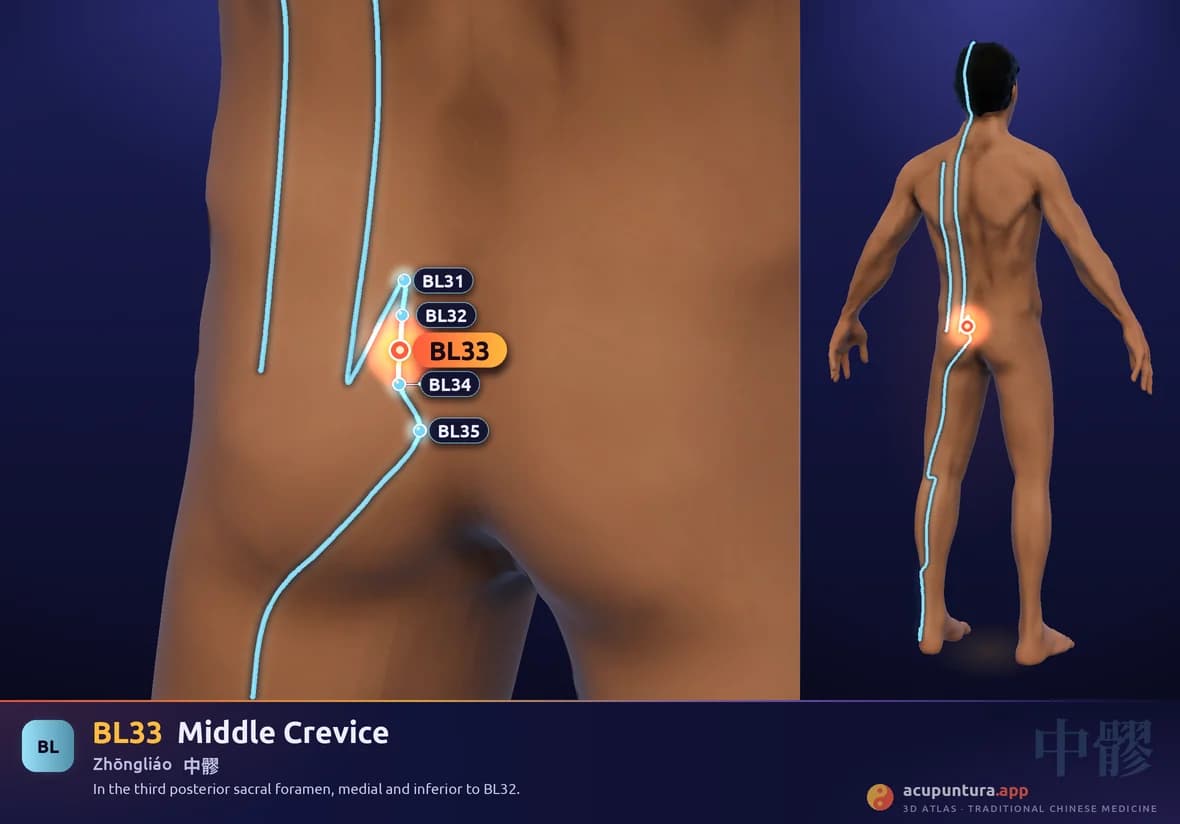
Bladder Channel
Middle Crevice
中髎ZhōngliáoContraindicated during pregnancy
Third sacral Liao; direct action on the uterus.
Anatomical location
In the third posterior sacral foramen, medial and inferior to BL32.
Main function
Regulates Qi and Blood, strengthens the Kidney, benefits the lumbar and sacral region, regulates urination, treats gynecological disorders, strengthens the pelvic region, regulates the Chong Mai and the Ren Mai, benefits the uterus.
- One of the Eight Liao (middle)
Therapeutic indications
- Low back pain
- sciatica
- dysuria
- enuresis
- urinary incontinence
- leukorrhea
- dysmenorrhea
- amenorrhea
- infertility
- impotence
- uterine prolapse
- hemorrhoids
- ovarian cysts
- uterine fibroids
- endometriosis
- menopausal symptoms
- Irregular menstruation
- Constipation
- Sacral low back pain
- Prostatitis and benign prostatic hyperplasia
Name and classical tradition
Zhongliao, 中髎, is the “middle foramen,” the third of the four sacral foramina. 中 means middle, and in a series of four it designates here the third place, below BL32 and above BL34. The graphic variant 中窌 alternates 髎 with 窌, as throughout the series.
The Zhenjiu Jiayi Jing (Systematic Classic of Acupuncture and Moxibustion) locates it «在第三空,俠脊陷者中», in the third foramen, beside the spine. The Zhenjiu Jicheng (Compendium of Acupuncture and Moxibustion) adds a cross-reference: «在次髎下,直中膂俞», below Ciliao, in line with Zhonglüshu, BL29. This correspondence between the foramina and the neighboring Shu points of the inner line is a good example of how the texts relied on some points to locate others.