Bladder Channel
Lower Hole
下髎XiàliáoContraindicated during pregnancy
Fourth sacral Liao; direct action on the uterus.
Anatomical location
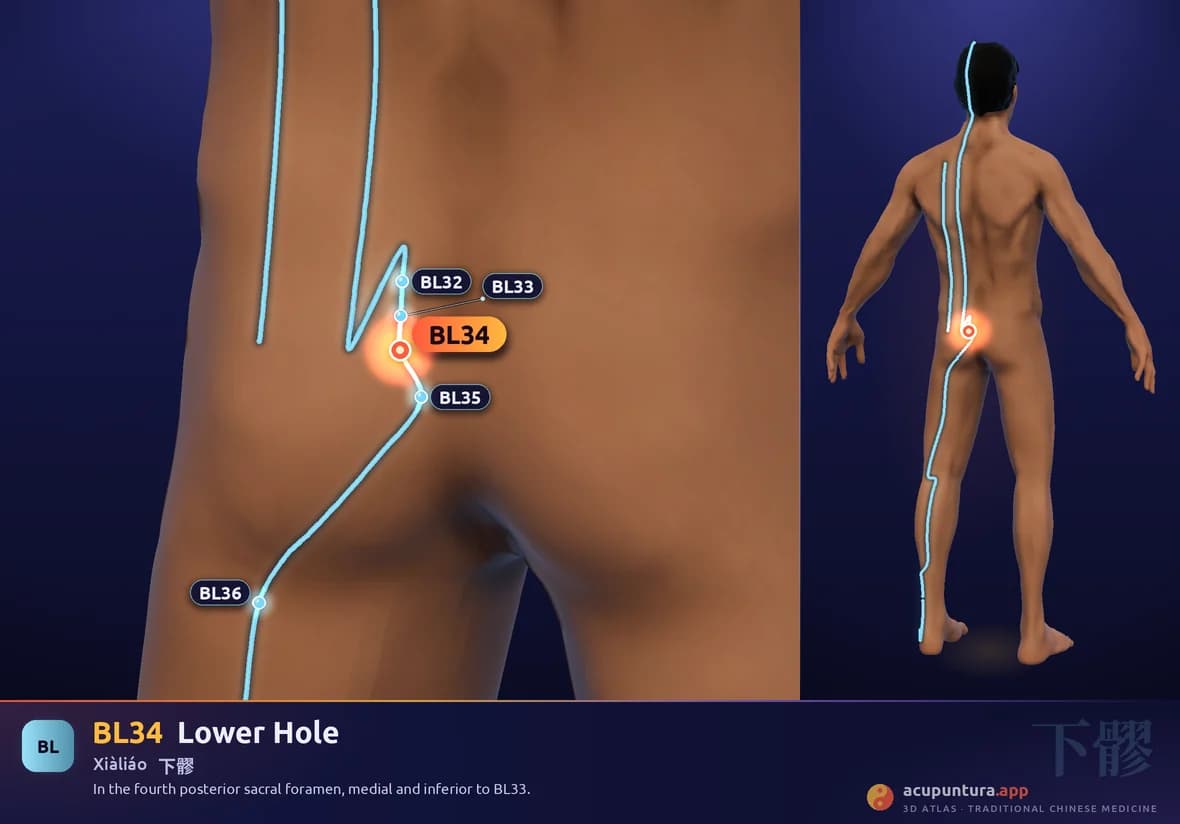
In the fourth posterior sacral foramen, medial and inferior to BL33.
Main function
Regulates Qi and Blood, strengthens the Kidney, benefits the lumbar and sacral region, regulates urination, treats gynecological disorders, strengthens the pelvic region, regulates the Chong Mai and the Ren Mai, benefits the pelvic floor.
- One of the Eight Liao (lower)
Therapeutic indications
- Low back pain
- sciatica
- dysuria
- enuresis
- urinary incontinence
- leukorrhea
- dysmenorrhea
- amenorrhea
- infertility
- impotence
- uterine prolapse
- hemorrhoids
- ovarian cysts
- uterine fibroids
- endometriosis
- fecal incontinence
- rectal prolapse
- Lumbosacral pain
- Constipation
- Abdominal pain
Name and classical tradition
Xialiao, 下髎, is the “lower foramen,” the fourth and last of the sacral foramina, below BL33. The graphic variant 下窌 alternates 髎 with 窌, as throughout the series of the eight foramina.
What sets Xialiao apart from its neighbors is an ancient commentary. Wang Bing, annotating the chapter Miu Ci Lun (繆刺論) of the Suwen (Basic Questions) in the 8th century, describes it as the place where the foot Taiyin, Jueyin, and Shaoyang knot together (足太陰、厥陰、少陽所結). The Tongren Shuxue Zhenjiu Tujing (Illustrated Classic of Acupuncture Points on the Bronze Figure), from the Song dynasty, presents it instead as a meeting of the Taiyang and the Jueyin. The discrepancy between the two sources is a good example of how the doctrine of meeting points changed from one era to another, and the citation from Wang Bing is one of the few from this commentator on the entire channel.