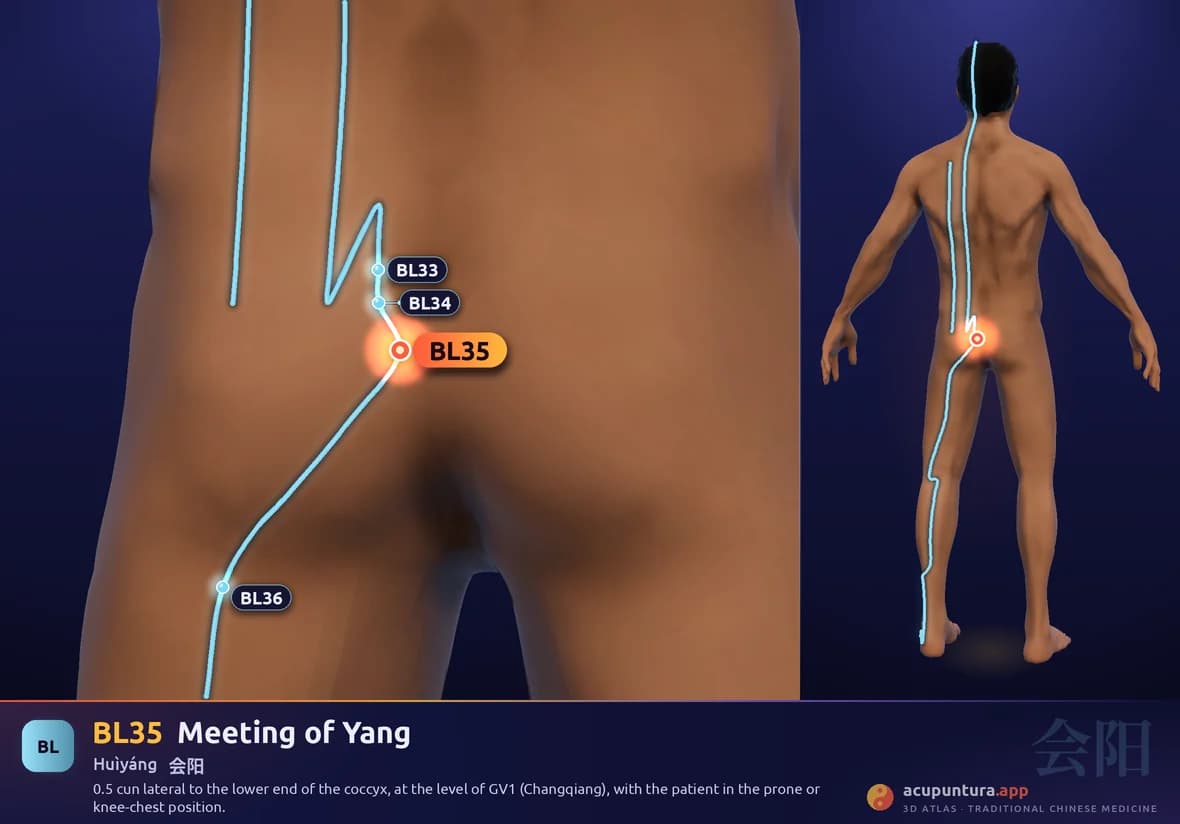
Bladder Channel
Meeting of Yang
会阳HuìyángAnatomical location
0.5 cun lateral to the lower end of the coccyx, at the level of GV1 (Changqiang), with the patient in the prone or knee-chest position.
Main function
Strengthens Kidney Yang, benefits the lumbar and sacral region, regulates urination, treats gynecological disorders, strengthens the pelvic region, regulates the Du Mai.
- Crossing point with the Du Mai
Therapeutic indications
- Low back pain
- sciatica
- dysuria
- enuresis
- urinary incontinence
- leukorrhea
- dysmenorrhea
- infertility
- impotence
- hemorrhoids
- rectal prolapse
- sensation of cold in the lumbar region
- fatigue
- general weakness
- Diarrhea
- Dysentery
- Coccygeal pain
Name and classical tradition
Huiyang, 会阳, is the “meeting of Yang.” 会 (會) means to gather, to converge; 阳 (陽) is Yang. The point is beside the coccyx, and the convergence the name indicates is that of the Bladder channel with the Du Mai, both of a Yang nature. The Zhenjiu Jiayi Jing (Systematic Classic of Acupuncture and Moxibustion) confirms this by describing it as a place «督脈脈氣所發», where the Qi of the Du Mai emerges. It is, then, a point with a dual affiliation, and the name reflects a classical fact, not a late gloss.
The reference works give it the alternative name 利機, “favorable mechanism.” Very close by, on the midline, is GV1, Changqiang, the point where the Du Mai begins.