Bladder Channel
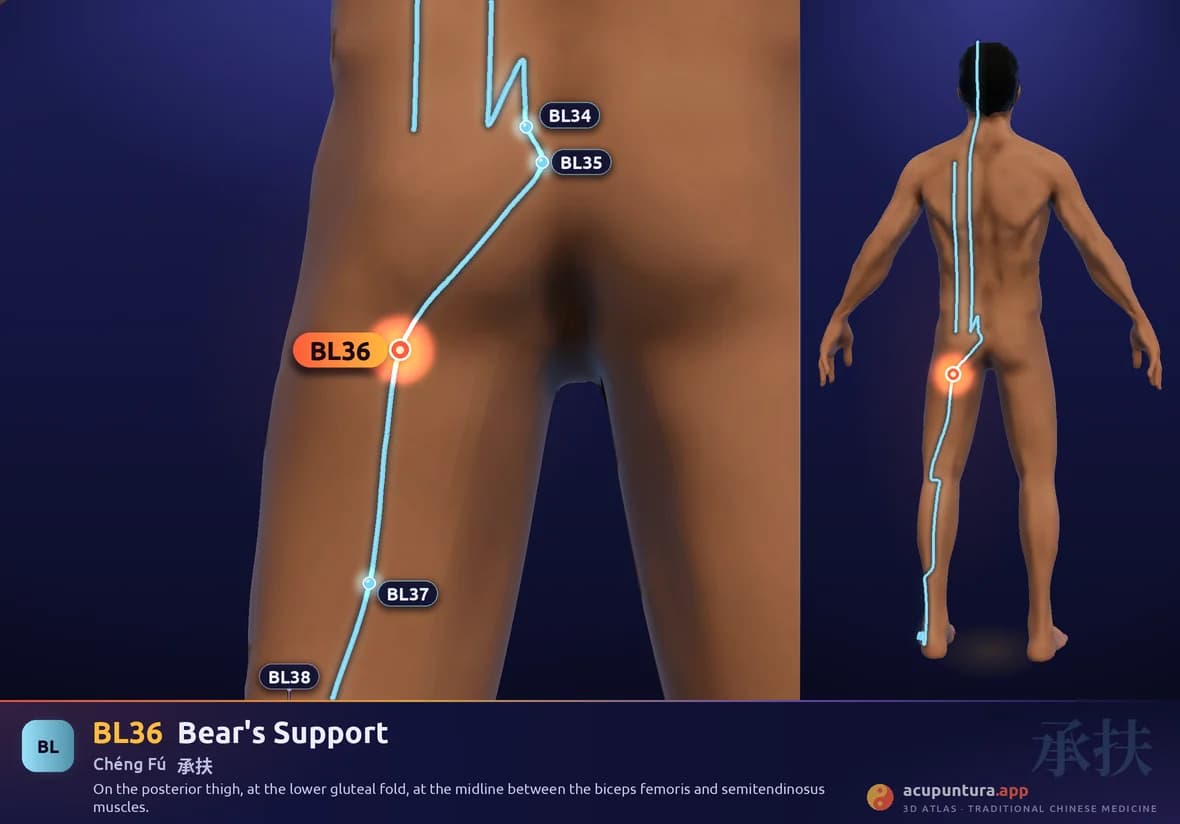
Bear's Support
承扶Chéng FúAnatomical location
On the posterior thigh, at the lower gluteal fold, at the midline between the biceps femoris and semitendinosus muscles.
Main function
Regulates Qi in the Lower Jiao, relieves pain, strengthens the lumbar region and the hips.
Therapeutic indications
- Low back pain
- sciatica
- hip pain
- hemorrhoids
- weakness in the lower extremities
- Lumbago
- Pain and paralysis of the lower limb
- Constipation
Name and classical tradition
Chengfu, 承扶, combines two verbs of support: 承, to bear, to receive, and 扶, to prop up, to hold. The point is at the crease that separates the buttock from the thigh, where the musculature is sturdiest and bears the weight of the trunk. The name describes that supporting function without metaphor.
The Zhenjiu Jiayi Jing (Systematic Classic of Acupuncture and Moxibustion) locates it «在尻臀下,股陰腫上約文中», below the buttock, in the transverse crease. The Waitai Miyao (Arcane Essentials from the Imperial Library), from the Tang dynasty, gives a variant location, «股陰下衝紋中». The Jiayi Jing itself gives it three alternative names, 肉郄, “cleft of the flesh,” 陰關, and 皮部, and the reference works add 皮郄 and 扶承, with the characters reversed. After the long stretch of the back and sacrum, it is the first point of the channel on the thigh.
Other names
- 肉郄Jiayi Jing
- 陰關Jiayi Jing
- 皮部Jiayi Jing