Bladder Channel
Gate of Prosperity
殷门Yīn MénAnatomical location
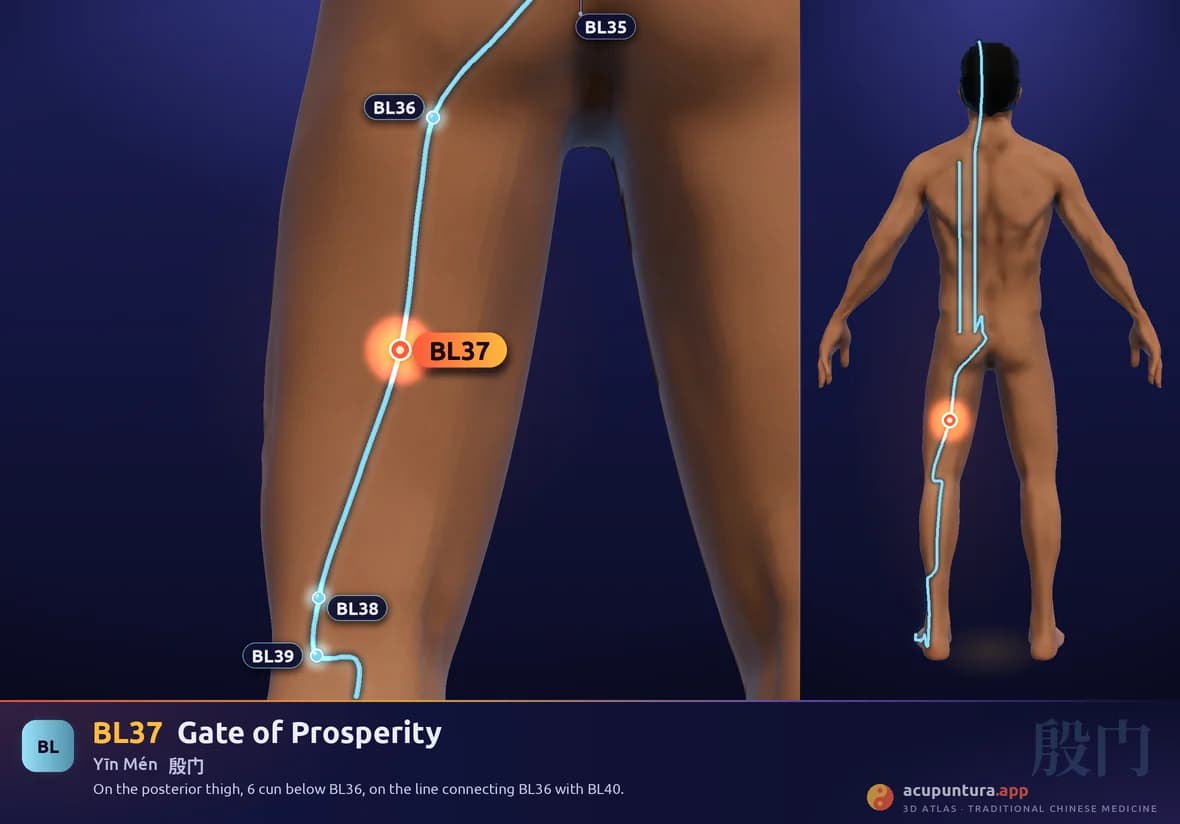
On the posterior thigh, 6 cun below BL36, on the line connecting BL36 with BL40.
Main function
Strengthens the lumbar region, relieves pain, benefits the sinews and muscles of the leg.
Therapeutic indications
- Low back pain
- sciatica
- thigh pain
- weakness in the lower extremities
- Lumbago
- Pain and paralysis of the lower limb
- Stiffness of the back
Name and classical tradition
Yinmen, 殷门, combines 殷, an uncommon character in point names, and 门, the door. A gloss recorded in the reference works explains it this way: «殷,深厚、正中;門,經氣出入之所», 殷 means deep, thick, and central; the door is the place where the channel's Qi enters and exits. The name would allude to the large muscle mass of the posterior thigh, at the center of which the point lies. The source of the gloss has not been identified.
The Zhenjiu Jiayi Jing (Systematic Classic of Acupuncture and Moxibustion) locates it «在肉郄下六寸», six cun below Rouxi, which is the alternative name of BL36, Chengfu. The Leijing Tuyi (Illustrated Supplement to the Classified Classic) by Zhang Jiebin, from the Ming dynasty, adds anatomical details. No alternative names are known for it.