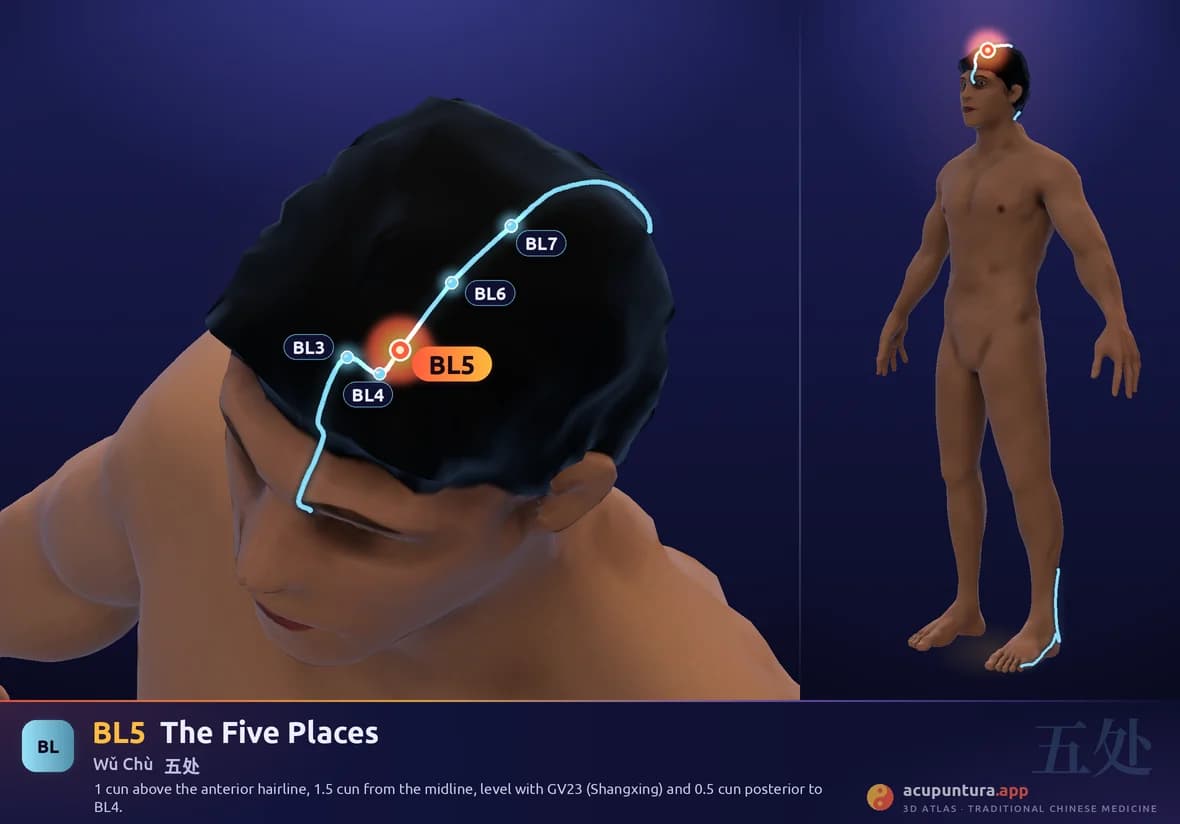
Bladder Channel
The Five Places
五处Wǔ ChùAnatomical location
1 cun above the anterior hairline, 1.5 cun from the midline, level with GV23 (Shangxing) and 0.5 cun posterior to BL4.
Main function
Expels Wind, clears the head and eyes, calms Internal Wind, relieves headache, descends Liver Yang.
Therapeutic indications
- Headache
- vertigo
- dizziness
- blurred vision
- epilepsy
- convulsions
- stiff neck
- pain in the upper body
- insomnia
- agitation
- mania
- Nasal obstruction
Name and classical tradition
Wuchu, 五处, means "the fifth place" or "five places." 處 is a place, a dwelling. The reading the sources give is positional: from this point to BL9, Yuzhen, there are five points in all in the row of the channel over the head.
The context of that reading does have an ancient text behind it. The Suwen (Basic Questions), in the chapter Qi Xue Lun (氣穴論), speaks of the "five rows of the head, five in each row," "頭上五行,行五": a scheme of twenty-five points distributed along five longitudinal lines over the skull, one of which is that of the Bladder channel. The quotation refers to the scheme in general, not to this point in particular, but it explains the numerical logic that seems to lie behind its name. The Zhenjiu Jiayi Jing (Systematic Classic of Acupuncture and Moxibustion) places it "在督脈傍,去上星一寸五分," beside the Du Mai, one and a half cun from Shangxing, GV23.
The same Jiayi Jing adds a warning: "不可灸," no moxibustion at Wuchu.