Bladder Channel
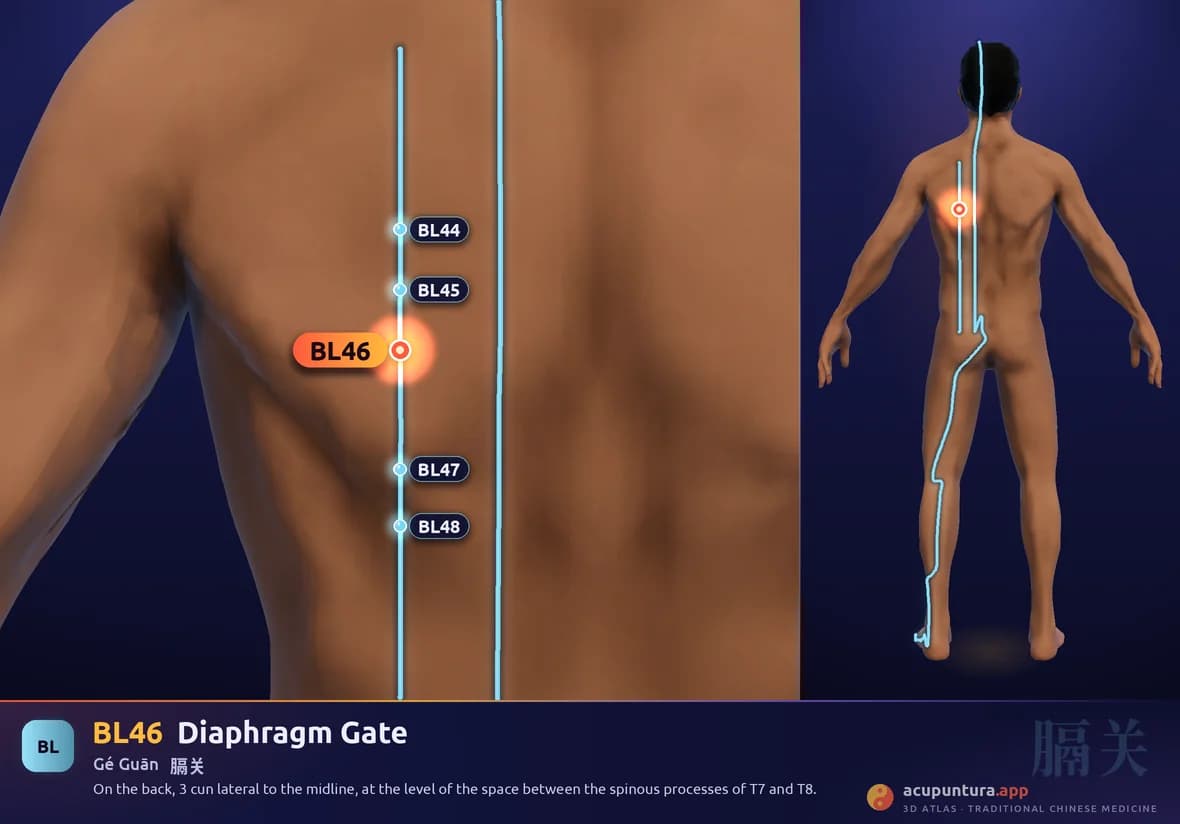
Diaphragm Gate
膈关Gé GuānAnatomical location
On the back, 3 cun lateral to the midline, at the level of the space between the spinous processes of T7 and T8.
Main function
Regulates Qi, relieves chest oppression, strengthens the back, benefits the diaphragm, harmonizes the Stomach.
Therapeutic indications
- Chest pain
- hiccups
- vomiting
- back pain
- spinal stiffness
- abdominal distension
- epigastric pain
- difficulty swallowing
- chest distension
Name and classical tradition
Geguan, 膈关, is the “barrier of the diaphragm.” 膈 is the diaphragm; 关 (關) is the gate, the pass, the barrier. The point is on the outer line of the back, next to BL17, Geshu, the Back-Shu point of the diaphragm, and shares its first character.
The Zhenjiu Jiayi Jing (Systematic Classic of Acupuncture and Moxibustion) locates it below the seventh vertebra, three cun to each side, in a depression. The reference works record the graphic variant 鬲關, with 鬲 in place of 膈. 鬲 is the ancient form of the character, and 膈 the later one, in which the flesh radical specializes the meaning toward the anatomical diaphragm. It is a small point of writing history, common in the classical texts.