Bladder Channel
Yang Union
合阳Hé YángAnatomical location
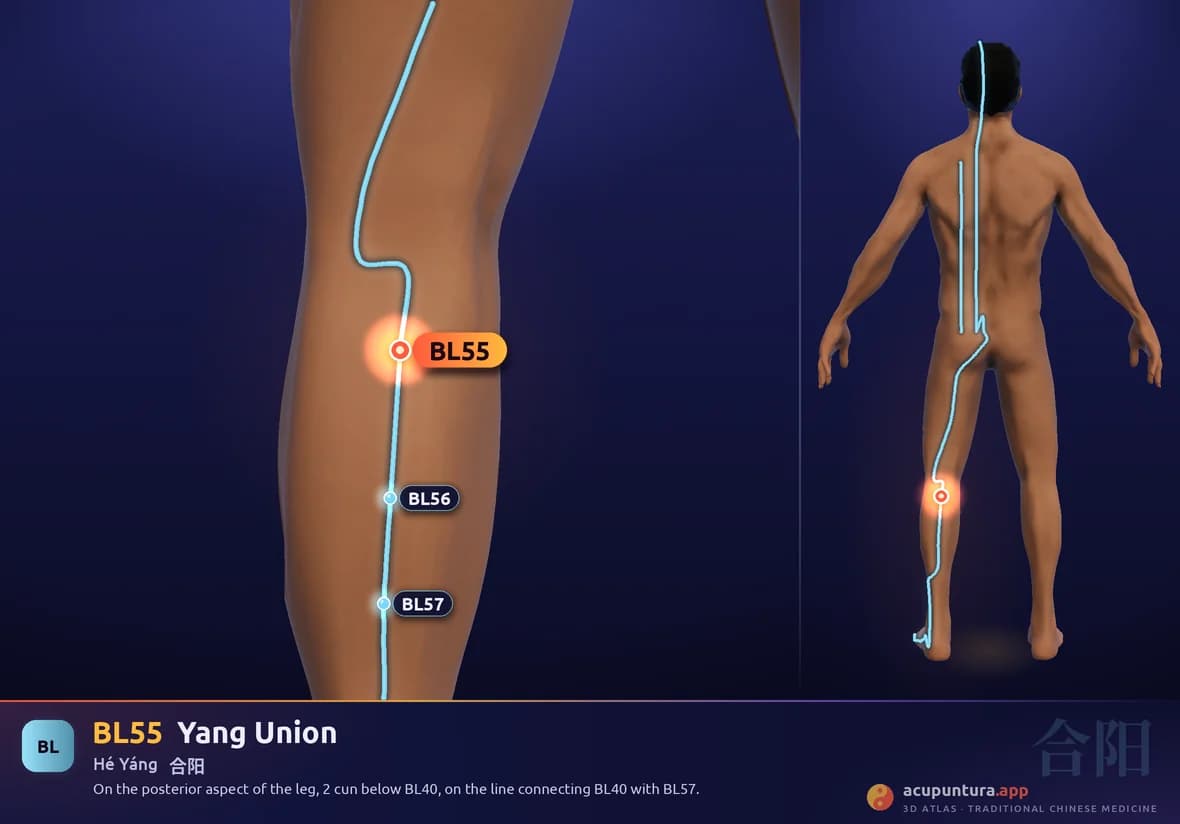
On the posterior aspect of the leg, 2 cun below BL40, on the line connecting BL40 with BL57.
Main function
Strengthens the lumbar region, relieves pain, benefits the sinews and muscles of the leg.
Therapeutic indications
- Low back pain
- sciatica
- leg pain
- muscle spasms
- hemorrhoids
- Lumbago
- Leg pain and paralysis
- Metrorrhagia
- Hernia
Name and classical tradition
Heyang, 合阳, is the “confluence of Yang.” 合 means to come together; 阳 (陽) is the Yang. The explanation given in the reference works is based on the course of the channel: «合,會合。足太陽膀胱經在背和大腿部分為兩支,至委中部會合而下». The Bladder channel, which runs in two branches along the back and thigh, comes together at Weizhong, BL40, and descends as one; Heyang is the point just below that meeting. The reading matches the anatomy of the channel, but we have not been able to confirm that the phrase comes from an ancient text.
The location of the point has varied. The Zhenjiu Jiayi Jing (Systematic Classic of Acupuncture and Moxibustion) places it «在膝約文中央下二寸», two cun below the center of the knee crease. The Qianjin Yaofang (Essential Formulas Worth a Thousand Gold) gives three cun, and the Zhenjiu Daquan (Complete Compendium of Acupuncture and Moxibustion), from the Ming period, just one cun. Three works, three measurements.