Bladder Channel
Center of the Bend
委中Wěi ZhōngAnatomical location
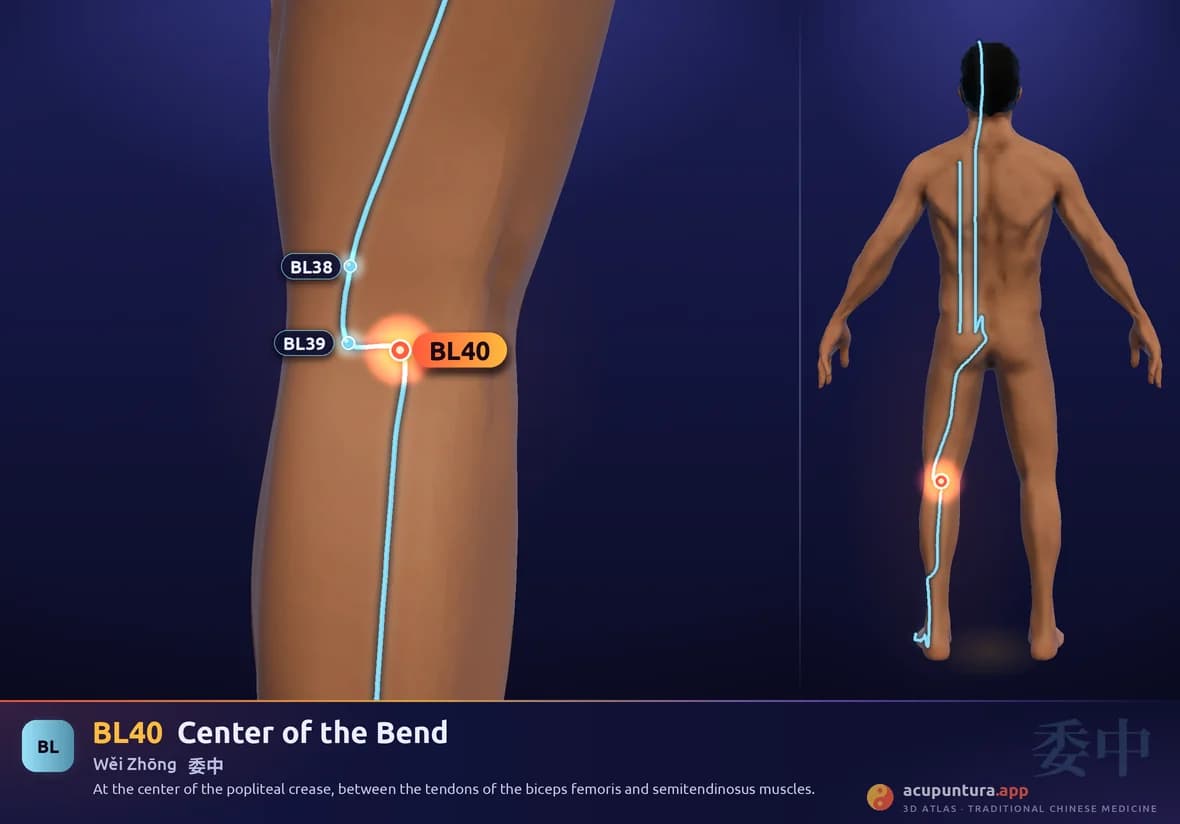
At the center of the popliteal crease, between the tendons of the biceps femoris and semitendinosus muscles.
Main function
He-Sea point (Earth), regulates the Bladder, eliminates Dampness, strengthens the lumbar region, relieves pain, clears Heat.
- He-Sea point (Earth)
- Lower He-Sea point of the Bladder
Therapeutic indications
- Low back pain
- sciatica
- knee pain
- dysuria
- edema
- abdominal pain
- fever
- muscle spasms
- Acute and chronic lumbago
- Knee pain and contracture
- Hemiplegia
- Urticaria
- Eczema
- Heatstroke
- Vomiting
- Diarrhea
- Heat in the Blood
- Back pain
- Hyperuricemia and gout
- Venous insufficiency and varicose veins
- Lumbar disc herniation
- Ankylosing spondylitis
- Knee osteoarthritis
- Plantar fasciitis
- Psoriasis
- Atopic dermatitis
- Herpes zoster and postherpetic neuralgia
Name and classical tradition
Weizhong, 委中, is the “center of the crease.” 委 means to bend, and alludes to the knee flexion needed to find the point; 中 is the center. It lies at the center of the popliteal fossa, and its name tells you where and how to look for it.
Few points on the channel have such firm support. The Lingshu (Spiritual Pivot), in the chapter Ben Shu (本輸), defines it: «委中,膕中央,為合,委而取之», Weizhong, in the center of the hollow of the knee; it is the He point; it is taken by bending the leg. In the chapter Xie Qi Zang Fu Bing Xing (邪氣藏府病形), the second citation confirms it: «膀胱合入于委中央», the Bladder unites at the center of the crease. It is the He point (合穴) of the channel, which on the Yang channels corresponds to Earth, and at the same time the Lower He-Sea point of the Bladder itself.
Its alternative names are 委中央, the long form, 郄中, “center of the cleft,” and 血郄, “cleft of the Blood.” The latter recalls the classical use of the point for bloodletting in patterns of Heat in the Blood. In the song of the four major points, the verse for Weizhong is «腰背委中求», for the lumbar region and the back, seek Weizhong. The other three are ST36, LU7, and LI4.