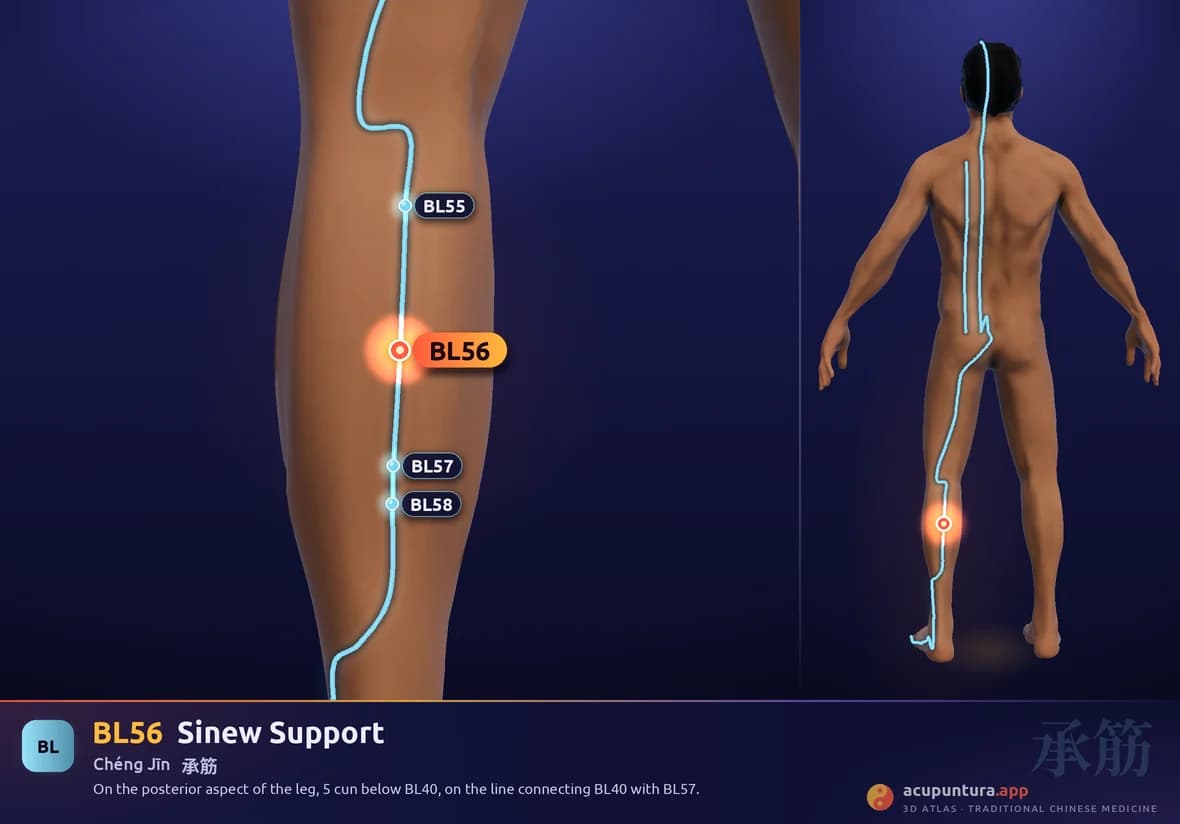
Bladder Channel
Sinew Support
承筋Chéng JīnAnatomical location
On the posterior aspect of the leg, 5 cun below BL40, on the line connecting BL40 with BL57.
Main function
Relaxes the sinews, relieves pain, strengthens the lumbar region, benefits the leg muscles.
Therapeutic indications
- Low back pain
- sciatica
- calf spasms
- leg pain
- hemorrhoids
- Calf cramps
- Lumbago
- Leg pain
Name and classical tradition
Chengjin, 承筋, is “the one that supports the muscle.” 承 means to support, to receive, to connect; 筋 is the sinew, the muscle. The point lies at the center of the belly of the calf. The Zhenjiu Jiayi Jing (Systematic Classic of Acupuncture and Moxibustion) locates it «在腨腸中央陷者中», in the depression at the center of the calf.
The most valuable explanation comes from Wang Bing, in the 8th century, in his commentary on the Ci Yao Tong Lun (刺腰痛論) chapter of the Suwen (Basic Questions), devoted to needling for low back pain: «在膕下同身寸之五寸,上承郄中之穴,下當申脈之位,是謂承筋穴». It lies five cun below the popliteal fossa; above, it connects with Xizhong, which is BL40, and below, it corresponds to the position of BL62, Shenmai; this is what is called Chengjin. The commentary explains the 承 of the name by the position of the point between two reference points. It is one of the few Wang Bing commentaries on the entire channel.
The Zhenjiu Jiayi Jing gives it two alternate names, 腨腸, which is the name for the calf, and 直腸, which has nothing to do with the rectum of modern anatomy, and counts it among the points that must not be needled: «禁不可刺,灸三壯», moxa only. The reference works add 直陽.
Other names
- 腨腸Jiayi Jing
- 直腸Jiayi Jing