Bladder Channel
Soaring Yang
飞扬Fēi YángAnatomical location
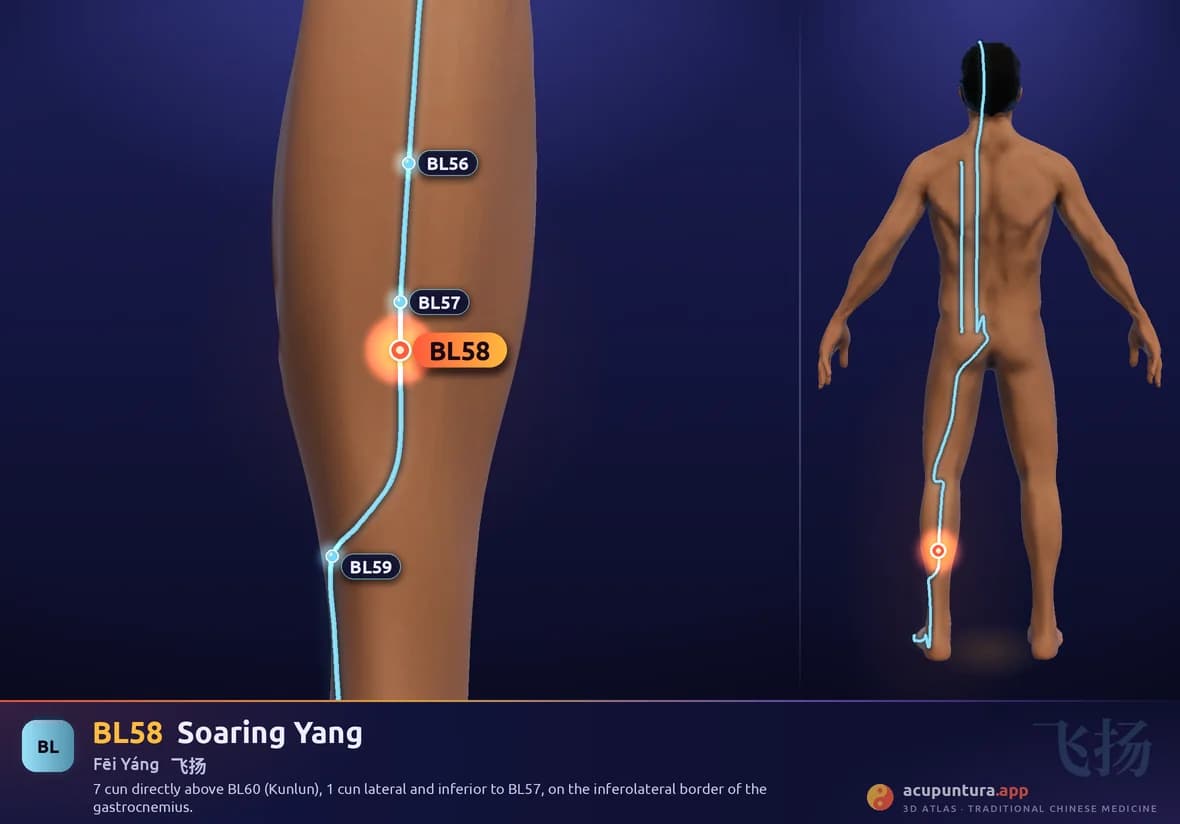
7 cun directly above BL60 (Kunlun), 1 cun lateral and inferior to BL57, on the inferolateral border of the gastrocnemius.
Main function
Luo-Connecting point, strengthens the Kidney, regulates Qi, relieves pain, benefits the bladder.
- Luo (Connecting) point
Therapeutic indications
- Low back pain
- sciatica
- headache
- leg pain
- dysuria
- hemorrhoids
- leg weakness
- Headache
- Vertigo
- Nosebleed
- Lumbago
- Leg pain and weakness
- Mania
- Stiff neck
Name and classical tradition
Feiyang, 飞扬, means “to fly and rise.” 飞 (飛) is to fly; 扬 (揚) is to rise, to disperse. Feiyang is the Luo-Connecting point (絡穴) of the Bladder, the one that links it with its paired channel, the Kidney, and the usual reading describes the Yang Qi that flies from here toward that channel. It is a metaphor for the passage from one channel to another.
The Lingshu (Spiritual Pivot) places it seven cun above the ankle, probably in the Jing Mai (經脈) chapter, the one that lists the collaterals of all the channels, although the exact chapter has not been verified. The Zhenjiu Jiayi Jing (Systematic Classic of Acupuncture and Moxibustion) repeats the measurement and the function in a single sentence: «飛揚,一名厥陽,在足外踝上七寸,足太陽絡,別走少陰者», Feiyang, also called Jueyang, seven cun above the lateral malleolus, the collateral of the foot Taiyang, which splits off toward the Shaoyin. The reference works add the variant 飛陽, which swaps 揚 for 陽 without changing the sound.
Other names
- 厥陽Jiayi Jing