Bladder Channel
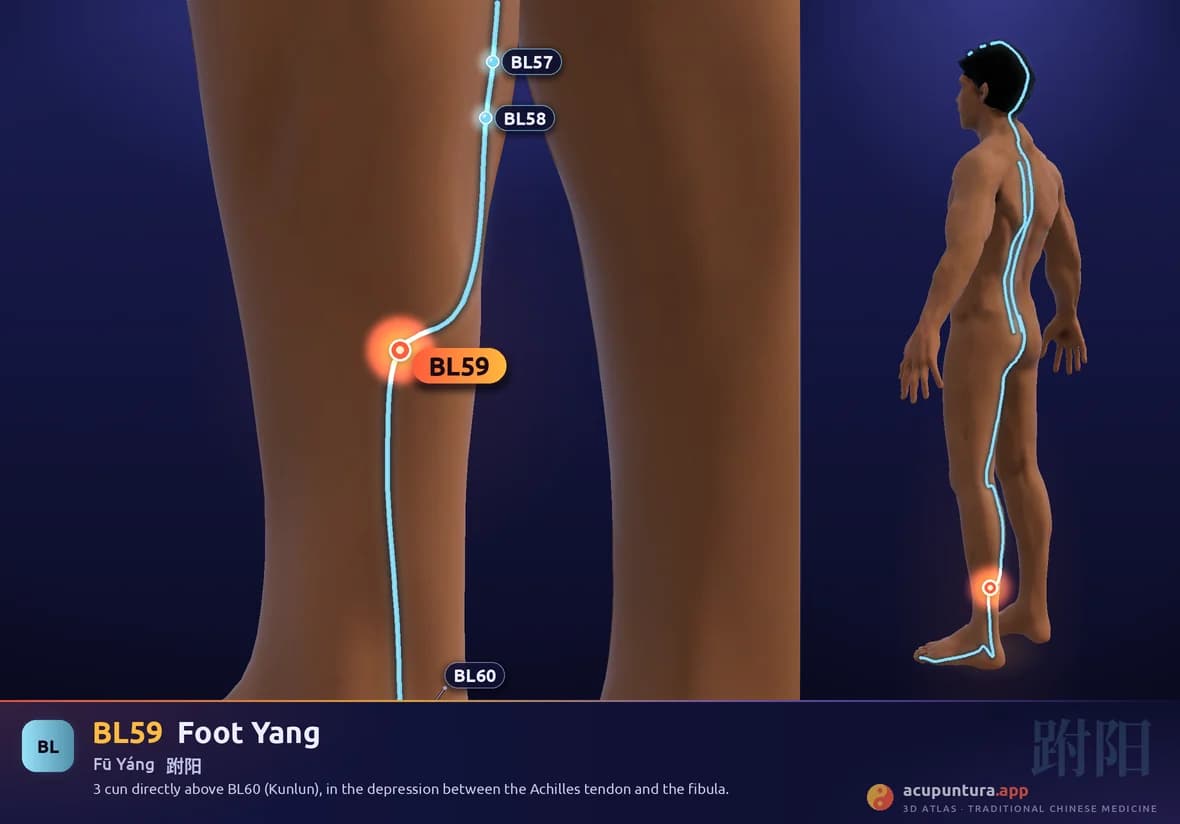
Foot Yang
跗阳Fū YángAnatomical location
3 cun directly above BL60 (Kunlun), in the depression between the Achilles tendon and the fibula.
Main function
Xi-Cleft point of the Yang Qiao Mai, strengthens the lumbar region, relieves pain, benefits the sinews.
- Xi-Cleft point of the Yang Qiao Mai
Therapeutic indications
- Low back pain
- sciatica
- leg pain
- muscle spasms
- headache
- epilepsy
- Headache
- Lumbago
- Ankle pain and swelling
- Lower-limb paralysis
- Stiff neck
Name and classical tradition
Fuyang, 跗阳, is the “Yang of the instep.” 跗 designates the dorsum of the foot and the ankle region; 阳 (陽) is the Yang. The point lies above the lateral malleolus, next to the edge of the Achilles tendon. One gloss reads it differently, «依附於陽脈», attached to the Yang vessel, referring to the Yangqiao, of which Fuyang is the Xi-Cleft point (郄穴).
The formula that locates it, «太陽前,少陽後», in front of the Taiyang and behind the Shaoyang, is already in the Zhenjiu Jiayi Jing (Systematic Classic of Acupuncture and Moxibustion), which places it three cun above the ankle, between tendon and bone. That reading connects with the way Wang Bing, in the 8th century, wrote the name. In his commentary on the Qi Xue Lun (氣穴論) chapter of the Suwen (Basic Questions), he calls it 附陽, with 附, “to adhere,” and places it «太陽前、少陽後», in front of the Taiyang and behind the Shaoyang. The reference works also record the variant 付陽. The Yangqiao, one of the Eight Extraordinary Vessels, opens at BL62, Shenmai, and Fuyang is its Xi-Cleft point.