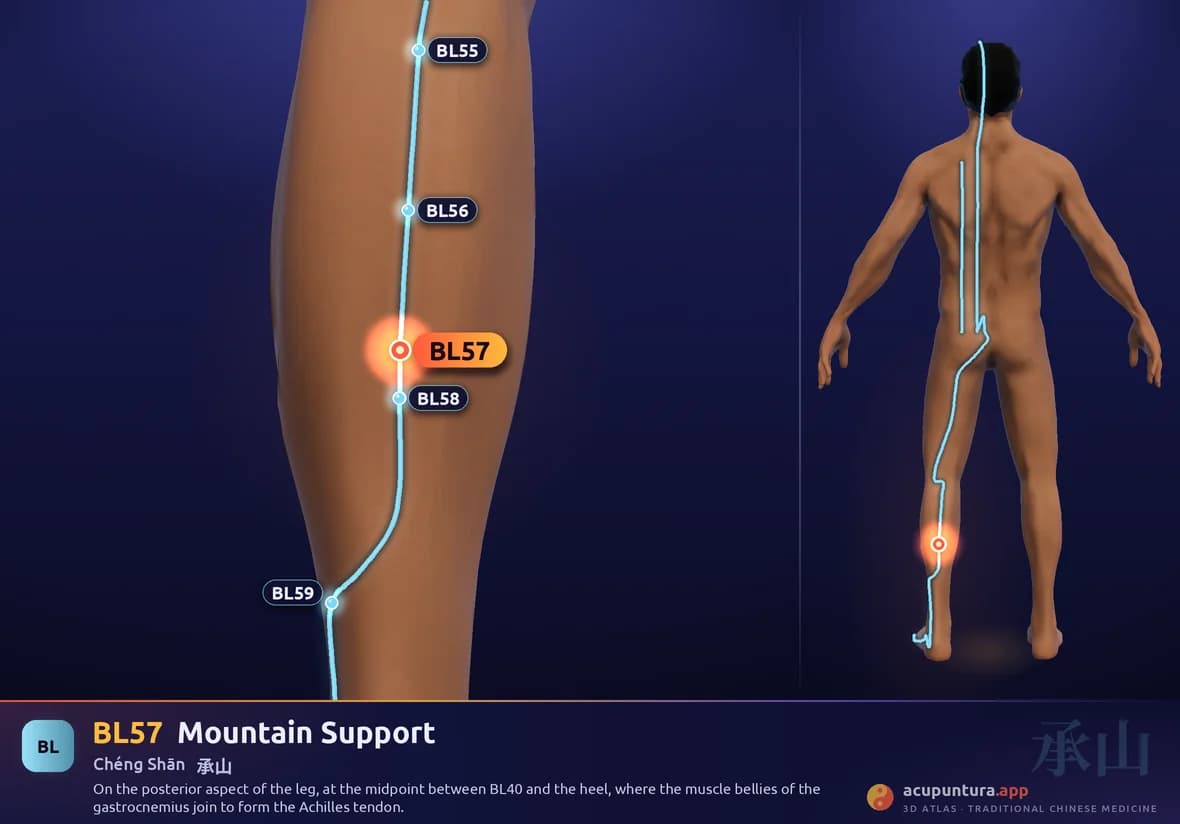
Bladder Channel
Mountain Support
承山Chéng ShānAnatomical location
On the posterior aspect of the leg, at the midpoint between BL40 and the heel, where the muscle bellies of the gastrocnemius join to form the Achilles tendon.
Main function
Relaxes the sinews, relieves spasms, strengthens the lumbar region, benefits the leg muscles, regulates Qi.
Therapeutic indications
- Calf cramps
- low back pain
- sciatica
- leg pain
- hemorrhoids
- constipation
- foot pain
- Calf cramps
- Lumbago
- Leg pain
- Rectal prolapse
- Beriberi
- Venous insufficiency and varicose veins
- Lumbar disc herniation
- Plantar fasciitis
Name and classical tradition
Chengshan, 承山, is “the one that supports the mountain.” 承 means to support; 山 is the mountain. The mountain is the belly of the calf, which rises like a hill when you stand on tiptoe, and the point lies just below it, in the cleft where its two bellies end, as if holding up that mass from below. The image is straightforward and easy to verify.
The Zhenjiu Jiayi Jing (Systematic Classic of Acupuncture and Moxibustion) locates it «在兌腨腸下分肉間陷者中», below the calf, in the depression between the muscles. The Bianque Xinshu (Bian Que's Heart Book), a Song-period text traditionally attributed to the legendary Bian Que but of uncertain authorship, gives a method for finding it: «在腿肚下,挺腳指取之», below the calf, take it with the toes stretched out.
Its alternate names continue the visual metaphors of the calf: 肉柱, “pillar of flesh,” and 魚腹, “belly of fish.” The tradition has used it for calf cramps and hemorrhoids. In modern practice it is also the destination of the needle technique from ST38, Tiaokou, for painful shoulder.
Other names
- 魚腹Jiayi Jing
- 肉柱Jiayi Jing