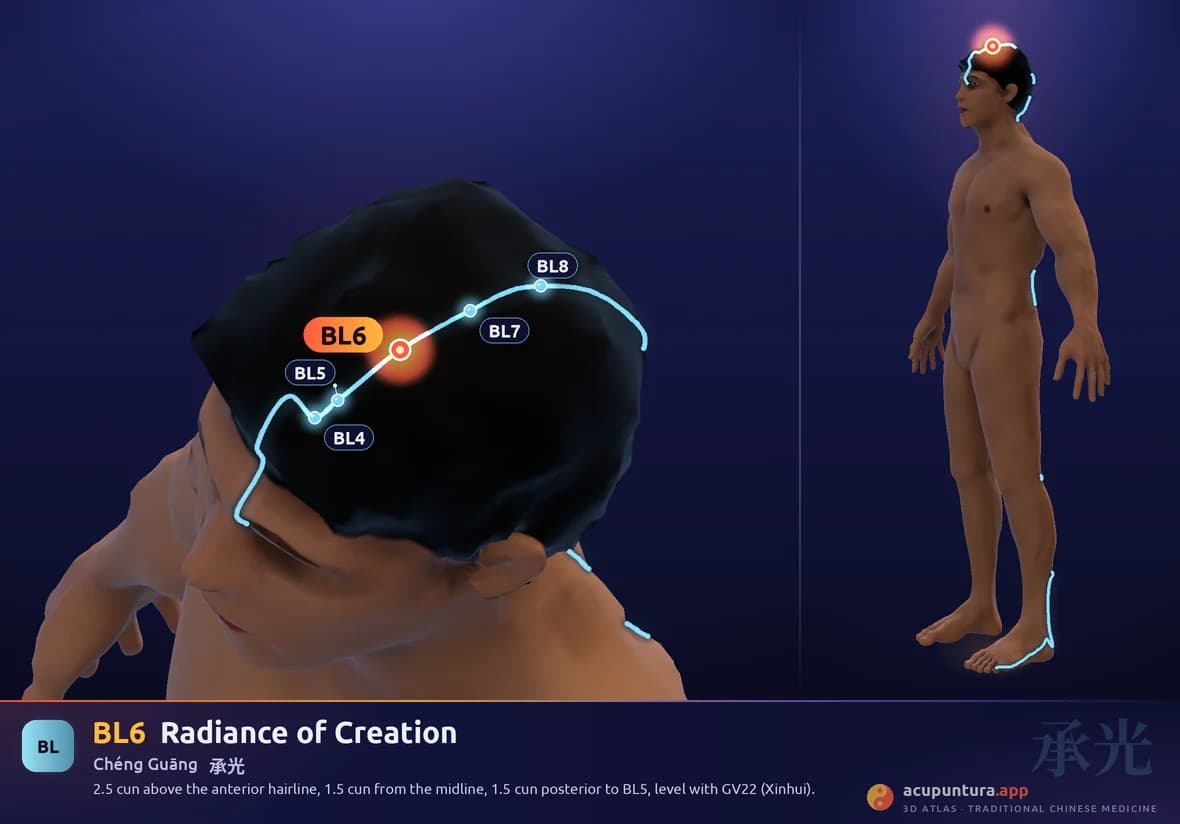
Bladder Channel
Radiance of Creation
承光Chéng GuāngAnatomical location
2.5 cun above the anterior hairline, 1.5 cun from the midline, 1.5 cun posterior to BL5, level with GV22 (Xinhui).
Main function
Expels Wind, clears the head and eyes, relieves nasal congestion, calms headache.
Therapeutic indications
- Headache
- vertigo
- dizziness
- blurred vision
- nasal congestion
- epistaxis
- eye pain
- fever without sweating
- stiff neck
- Nasal obstruction
- Common cold
Name and classical tradition
Chengguang, 承光, is "the one that receives light." 承 is to receive, to bear; 光, light. The point is on the top of the head, and the modern gloss imagines it receiving light at the highest part of the row of points on the skull. It is a poetic reading with no classical citation. With its neighbor BL2, whose aliases speak of light, it forms part of a small family of luminous names at the head of the channel.
The most interesting fact is a different one. The Zhenjiu Jiayi Jing (Systematic Classic of Acupuncture and Moxibustion) places it "在五處後二寸," two cun posterior to BL5. Sun Simiao's Qianjin Yaofang (Essential Prescriptions Worth a Thousand Gold) gives only one cun, and the Song-era Tongren Shuxue Zhenjiu Tujing (Illustrated Manual of Acupuncture Points on the Bronze Figure) one and a half cun. Three works, three measurements: an example of how the location of a point was debated and adjusted from one dynasty to the next. The Jiayi Jing adds a prohibition: "禁不可灸," no moxibustion at this point.