Bladder Channel
Joined Bone
束骨Shù GǔAnatomical location
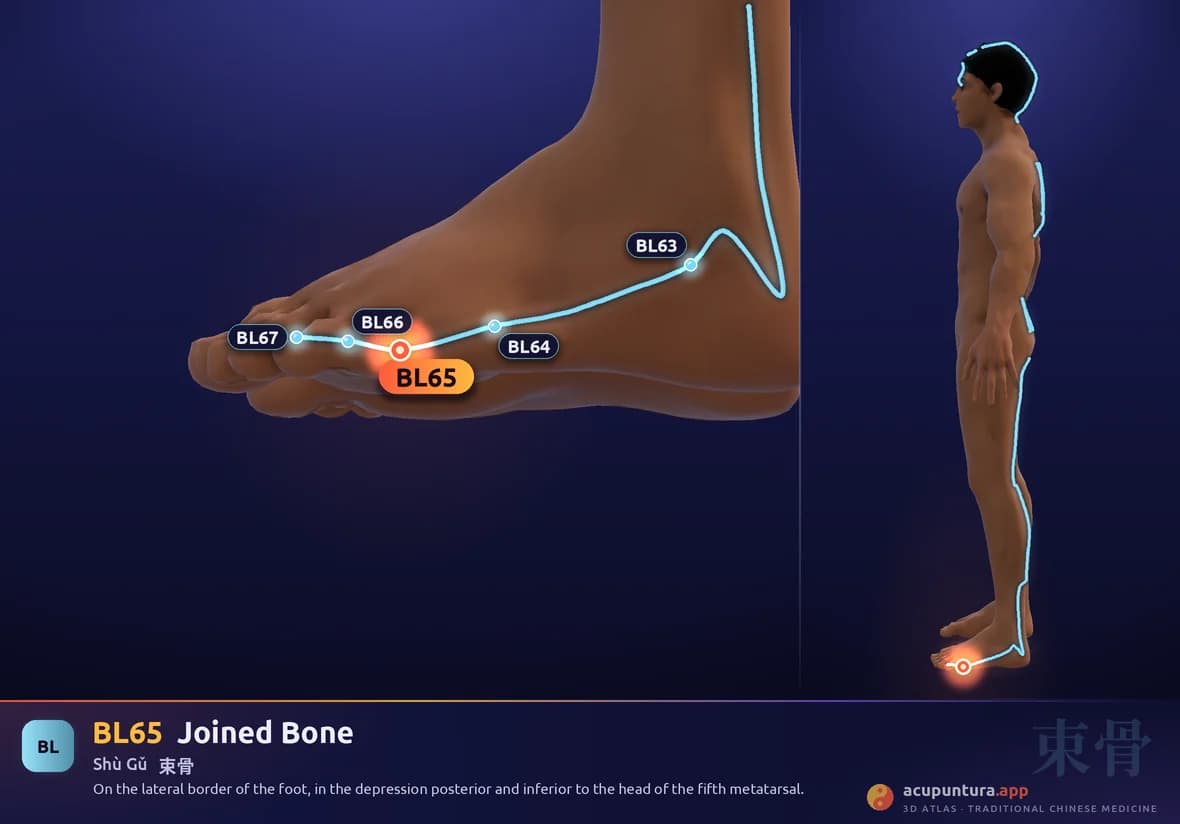
On the lateral border of the foot, in the depression posterior and inferior to the head of the fifth metatarsal.
Main function
Shu-Stream point (Wood), expels Wind, relieves pain, clears the head, benefits the eyes.
- Shu-Stream point (Wood)
- Sedation Point
- Ryodoraku point F4 (Bladder)
Therapeutic indications
- Occipital headache
- stiff neck
- low back pain
- sciatica
- foot pain
- epilepsy
- Occipital headache
- Vertigo
- Back and low back pain
- Red eyes
- Mania
- Boils
- Pain in the fifth toe
Ryodoraku
F4VejigaMeasurement point no. 7
Shu-Stream, not the Yuan-Source (BL64). It is Nakatani's representative point.
- Sedation of Bladder
Name and classical tradition
Shugu, 束骨, is the “bound bone.” 束 means to bind, to cinch, to bundle; 骨 is bone. The name describes the constriction felt behind the joint of the fifth toe with its metatarsal, where the point is located. It is a simple anatomical description.
The Lingshu (Spiritual Pivot), in the Ben Shu chapter (本輸), places it “本節之後陷者中也,” in the depression behind the joint, and names it the Shu point of the channel. The Zhenjiu Jiayi Jing (Systematic Classic of Acupuncture and Moxibustion) adds that it lies on the outer side of the little toe, and Wang Bing, in his commentary on the Suwen (Basic Questions), specifies the boundary between the red and white flesh. It is the Shu-Stream point (輸穴) of the Bladder, which on the yang channels corresponds to Wood. Its neighbor, two cun behind it, is BL64, Jinggu.