Bladder Channel
Foot Connecting Valley
足通谷Zú Tōng GǔAnatomical location
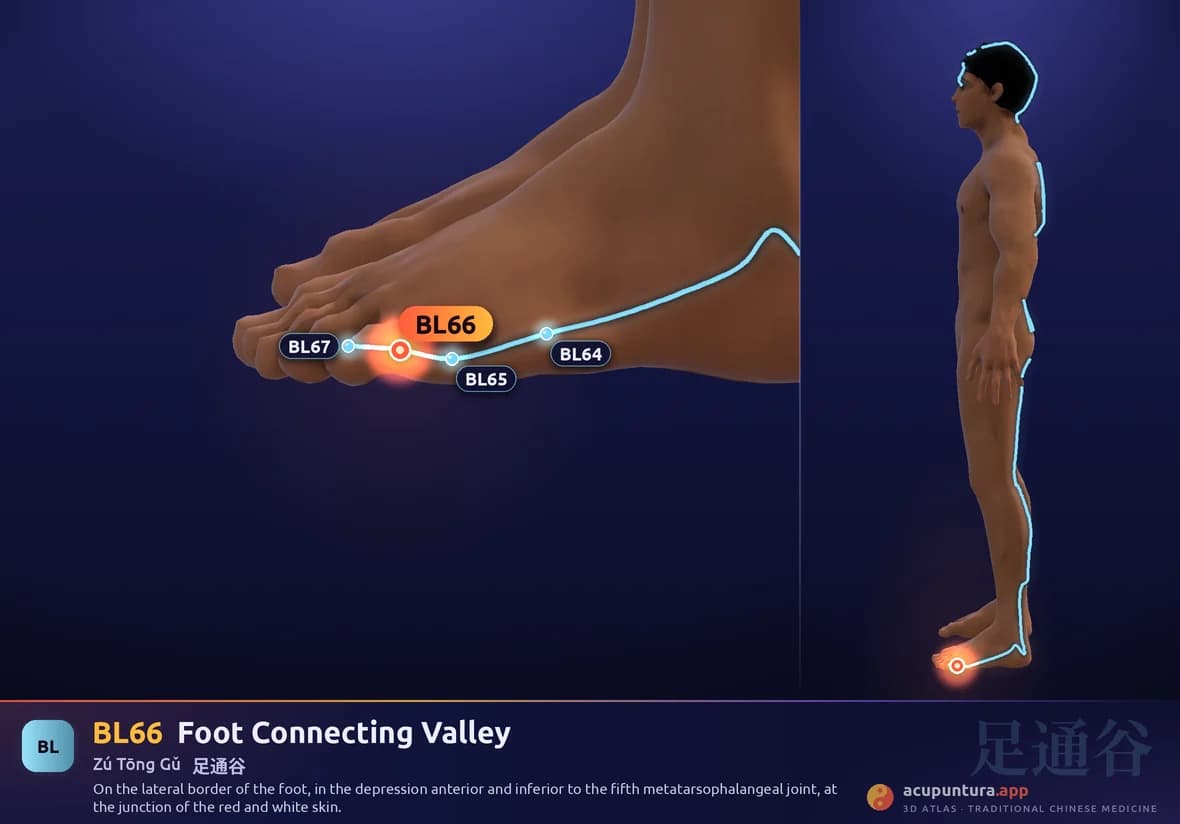
On the lateral border of the foot, in the depression anterior and inferior to the fifth metatarsophalangeal joint, at the junction of the red and white skin.
Main function
Ying-Spring point (Water), clears the head, expels Wind, relieves pain.
- Ying-Spring Point (Water)
Therapeutic indications
- Headache
- stiff neck
- dizziness
- blurred vision
- foot pain
- nosebleed
- Headache
- Vertigo
- Mania
- Eye pain
Name and classical tradition
Zutonggu, 足通谷, is the “valley of passage of the foot.” 通 means to communicate or pass through; 谷 is the valley, the usual metaphor among the Five Shu points for the depressions between prominences through which Qi runs. The 足, “foot,” is not decorative: it distinguishes this point from KI20, Tonggu, the point of the Kidney channel on the abdomen. It is the same device that separates GB11 from GB44, or ST36 from LI10.
The Lingshu (Spiritual Pivot), in the Ben Shu chapter (本輸), places it “本節之前外側,” in front of the joint of the toe, on the outer side; the Zhenjiu Jiayi Jing (Systematic Classic of Acupuncture and Moxibustion) specifies the little toe. It is the Ying-Spring point (滎穴) of the Bladder, which on the yang channels corresponds to Water. When the context leaves no doubt, it is simply called 通谷.