Bladder Channel
Capital Bone
京骨Jīng GǔAnatomical location
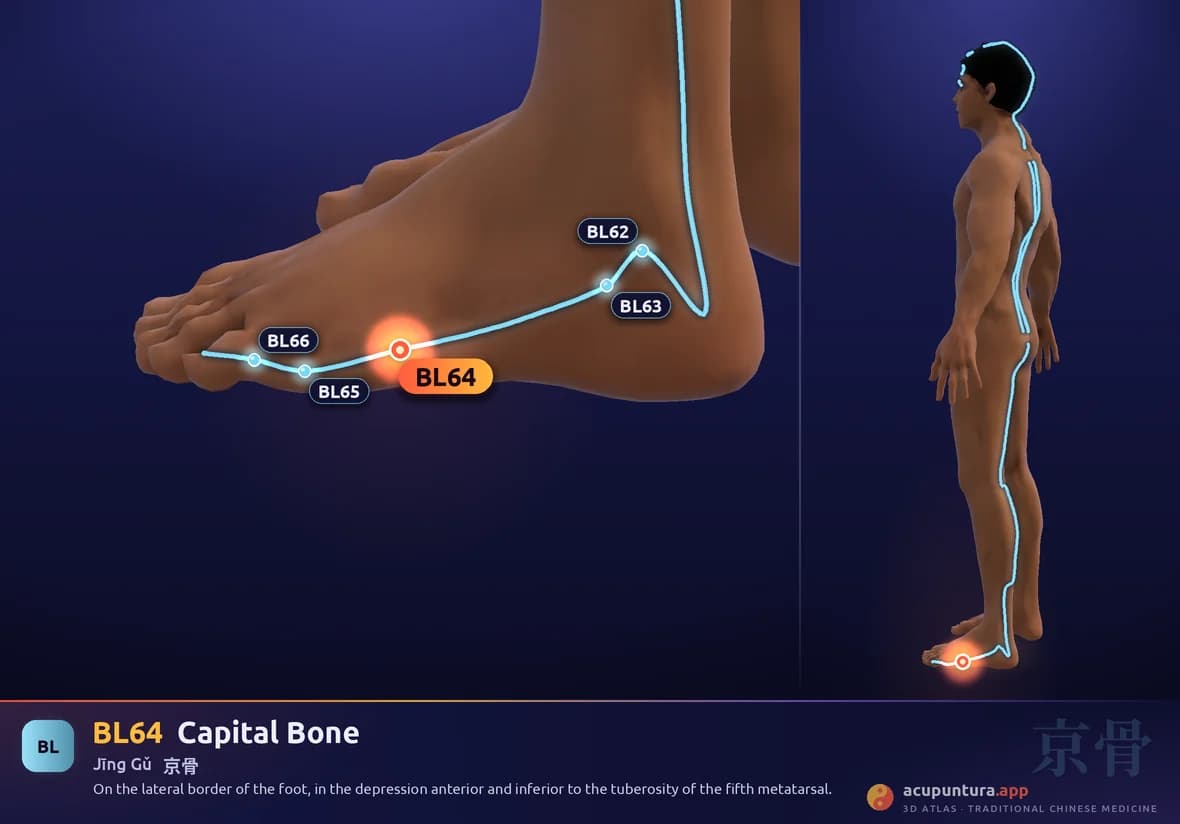
On the lateral border of the foot, in the depression anterior and inferior to the tuberosity of the fifth metatarsal.
Main function
Yuan-Source point, expels Wind, relieves pain, clears the head, benefits the eyes.
- Yuan (Source) point
Therapeutic indications
- Occipital headache
- stiff neck
- low back pain
- sciatica
- foot pain
- blurred vision
- Headache
- Low back pain
- Epilepsy
- Eye pain
- Mania
- Foot pain
Name and classical tradition
Jinggu, 京骨, is the “great bone.” 京 means great or lofty, and also designates the capital, as in 京城. The name was first that of a bone: the Zhenjiu Juying (Collected Gems of Acupuncture and Moxibustion), from the Ming period, makes this clear, “小指本節後大骨名京骨,其穴在骨下,” the large bone behind the joint of the little toe is called jinggu, and the point lies beneath it. It is the prominence at the base of the fifth metatarsal. The point took its name from the bone, like GB12 or ST12.
The Lingshu (Spiritual Pivot), in the Ben Shu chapter (本輸), places it “足外側大骨之下,” beneath the large bone on the outer border of the foot, and the Zhenjiu Jiayi Jing (Systematic Classic of Acupuncture and Moxibustion) adds “赤白肉際陷者中,” in the depression at the boundary between the red and white flesh, the classical formula for the border between the sole and the dorsum. It is the Yuan-Source point (原穴) of the Bladder.