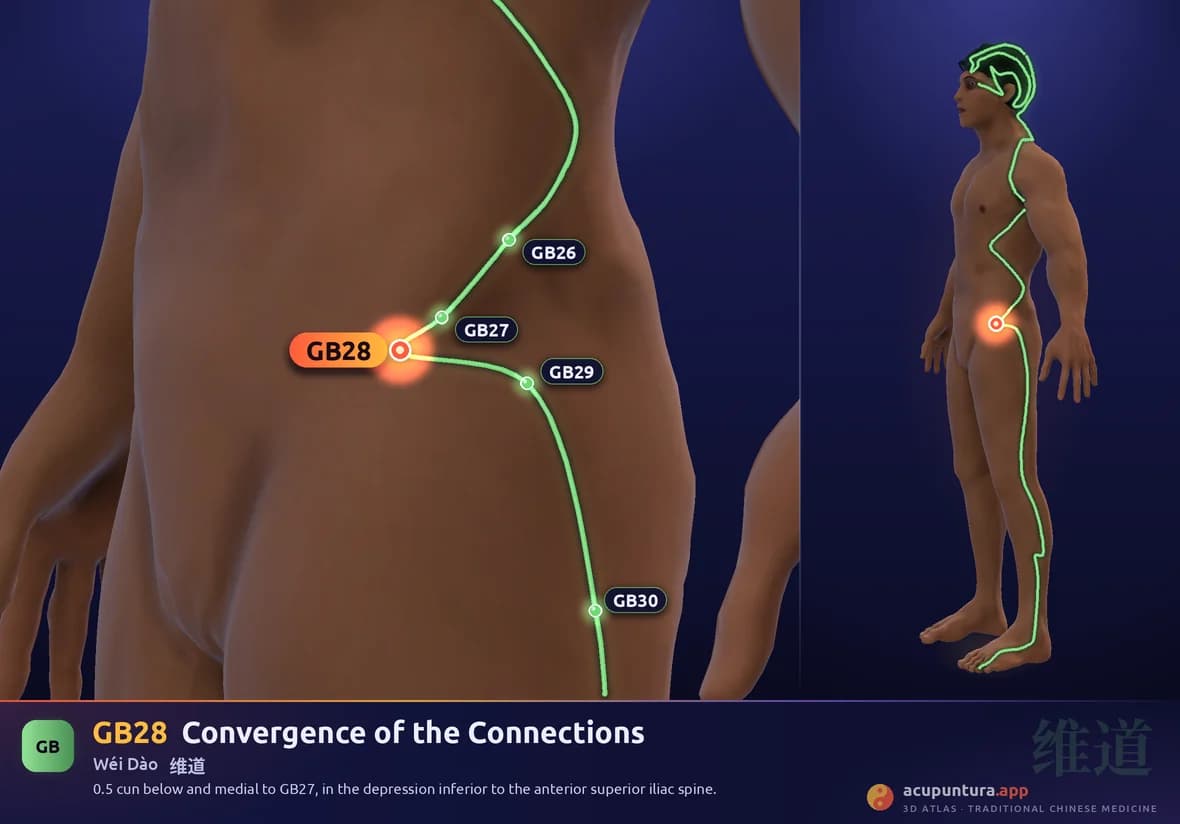
Gallbladder Channel
Convergence of the Connections
维道Wéi DàoAnatomical location
0.5 cun below and medial to GB27, in the depression inferior to the anterior superior iliac spine.
Main function
Regulates the Dai Mai, relieves pelvic pain.
- Crossing point with the Dai Mai and Chong Mai
Therapeutic indications
- Pelvic pain
- leukorrhea
- hernia
- uterine prolapse
- hypogastric pain
- constipation
Name and classical tradition
Weidao, 维道, is “the path that binds.” 维 means to tie, to hold, to support, and it is also the character in the names of the Yang Wei Mai and Yin Wei Mai vessels; here, however, the vessel involved is the Dai Mai (Girdle Vessel), the belt that holds the longitudinal channels together. 道 is the path. The usual reading is that the point extends the course of the Girdle Vessel and returns it to the main route of the Gallbladder channel.
It is the third point in the series linked to the Dai Mai, after GB26 and GB27, and like them it is a crossing point of the foot Shaoyang with that vessel. The sources trace it to the Zhenjiu Jiayi Jing (Systematic Classic of Acupuncture and Moxibustion) and also mention the Lingshu (Spiritual Pivot), chapter Jing Mai, with no literal citation located in either case. The reference works give it the alternate name 外枢, “outer pivot,” which ties it to the 枢 of its neighbor Wushu.
Other names
- 外樞Jiayi Jing