Gallbladder Channel
The Five Points
五枢Wǔ ShūAnatomical location
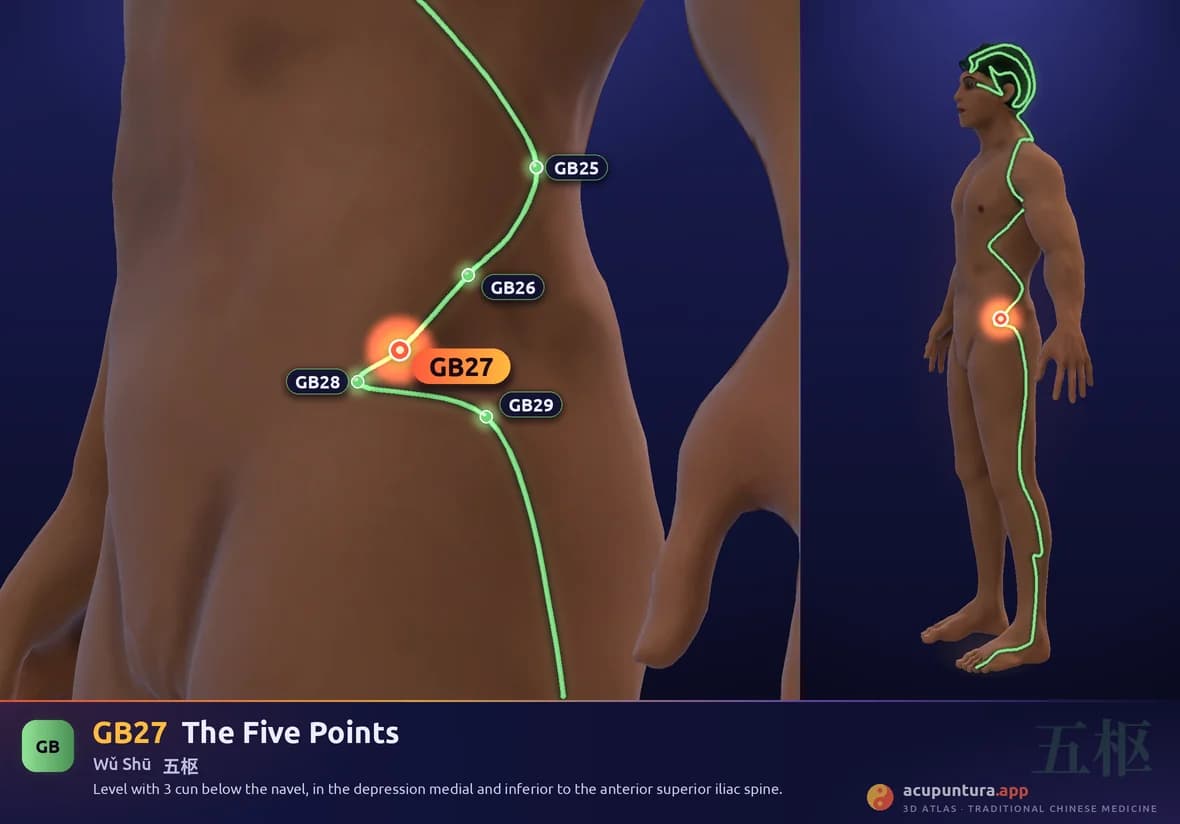
Level with 3 cun below the navel, in the depression medial and inferior to the anterior superior iliac spine.
Main function
Regulates the Dai Mai, relieves pelvic pain.
- Crossing point with the Dai Mai
Therapeutic indications
- Pelvic pain
- leukorrhea
- hernia
- uterine prolapse
- low back pain
- constipation
- lower abdominal pain
Name and classical tradition
Wushu, 五枢, combines 五, “five,” a number that in Chinese numerology also sits at the center of the series from one to nine, and 枢, “pivot” or “hinge,” the axis on which a door turns. There are two readings of the name, both from secondary sources. The first is positional: the point would sit at the central pivot of the body, halfway between ST25, Tianshu, the “celestial pivot” of the abdomen, and the pivot of the hip, the articulation of the femur. The second is based on the group: Wushu would be the center of a series of five points on the flank, GB25, GB26, Wushu, GB28, and GB29.
The two readings complement each other, although neither has a classical citation. The point is traced to the Zhenjiu Jiayi Jing (Systematic Classic of Acupuncture and Moxibustion) and is a crossing point of the foot Shaoyang with the Dai Mai (Girdle Vessel).