Gallbladder Channel
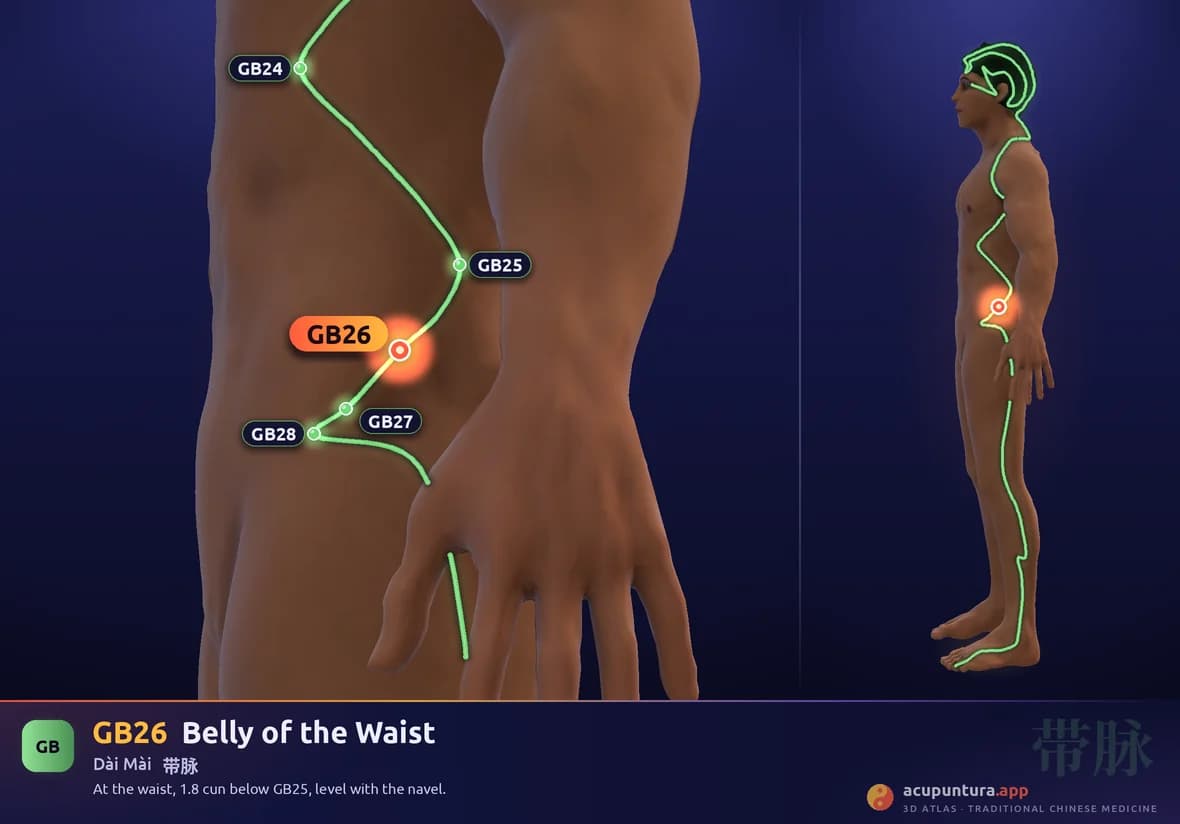
Belly of the Waist
带脉Dài MàiUse caution during pregnancy
Dai Mai point on the flank; avoid deep needling and dispersing technique.
Anatomical location
At the waist, 1.8 cun below GB25, level with the navel.
Main function
Regulates the Dai Mai, relieves low back pain.
- Crossing point with the Dai Mai
Therapeutic indications
- Low back pain
- leukorrhea
- menstrual disorders
- irregular menstruation
- amenorrhea
- low back and flank pain
- hernia
- lumbar weakness
Name and classical tradition
Daimai, 带脉, has exactly the same name as the Extraordinary Vessel it belongs to, and not by chance. 带 is the belt, the girdle; 脉 is the vessel. The Dai Mai is the only channel that runs horizontally around the body, encircling the waist and binding the longitudinal channels, and the point marks the place where that belt crosses the Gallbladder. The Suwen (Basic Questions) mentions the vessel in the Wei Lun (痿论) chapter, among other passages.
Secondary sources place the point in the Lingshu (Spiritual Pivot), in the Dian Kuang (癫狂) chapter, though the citation has not been checked. With it begins a small series of three points on the channel linked to the girdle vessel: Daimai, GB27, and GB28, all three crossing points between the Foot Shaoyang and the Dai Mai. GB41, the point on the foot that opens the same Extraordinary Vessel, is also associated with this group.