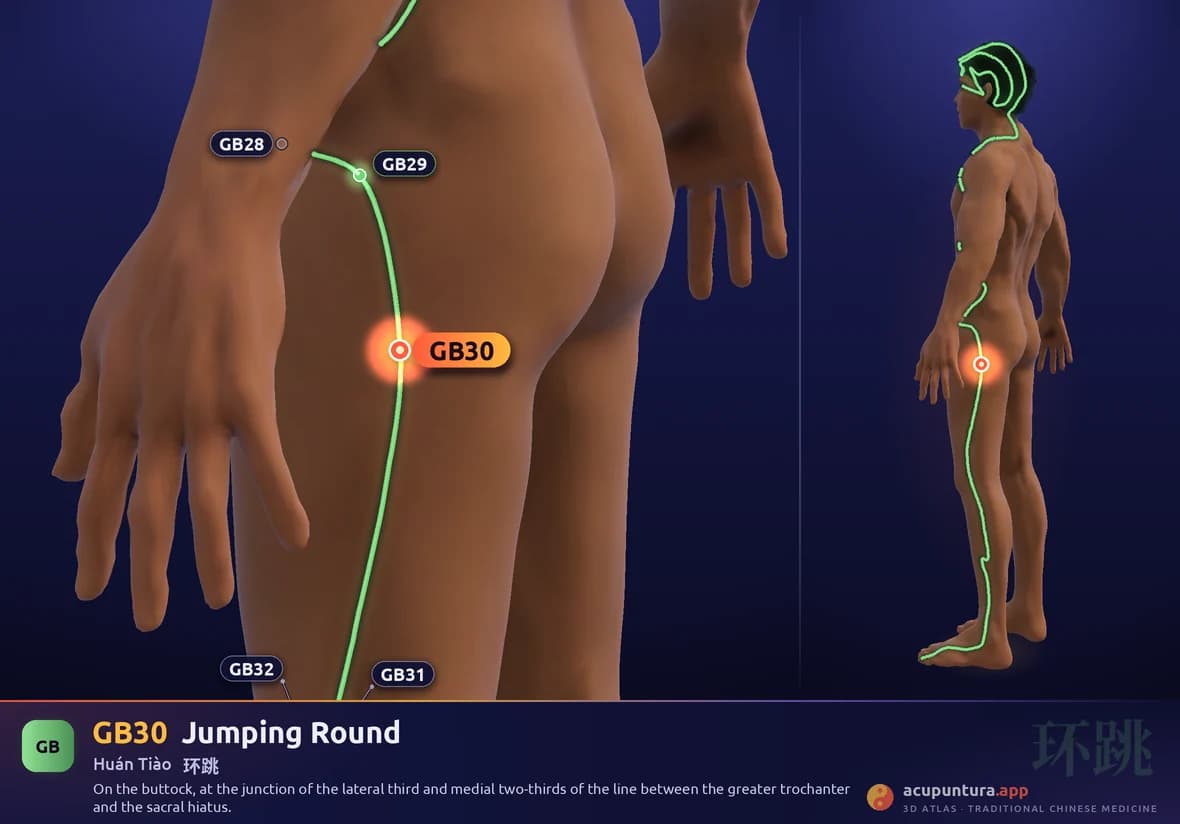
Gallbladder Channel
Jumping Round
环跳Huán TiàoAnatomical location
On the buttock, at the junction of the lateral third and medial two-thirds of the line between the greater trochanter and the sacral hiatus.
Main function
Regulates Qi and Blood, relieves hip pain.
- Crossing Point with the Bladder
Therapeutic indications
- Hip pain
- sciatica
- lumbago
- low back pain
- paralysis of the lower limb
- hemiplegia
- hives
- thigh pain
- lumbar disc herniation
- ankylosing spondylitis
Name and classical tradition
Huantiao, 环跳, combines 环, “to curve” or “to encircle,” and 跳, “to jump.” The usual reading ties the name to the position in which the point is located: the patient, lying on their side, flexes the hip and knee like someone crouching to jump. The name would thus describe a gesture rather than a place.
The alternate names are numerous, and the oldest are anatomical. The Zhenjiu Jiayi Jing (Systematic Classic of Acupuncture and Moxibustion) records it, depending on the variant, as 髀厌 or 髀枢. 髀 is the thigh or femur, 枢 the pivot, and 厌, as in GB4, is read as a “place of fitting together”: the hip joint. A modern gloss links 髀 to the Spleen and 厌 to the rejection of Dampness, but it is speculative, and the anatomical reading is far more solid. Others include 环各, 膑骨, 髋骨, and 分中.
It is a crossing point of the foot Shaoyang and Taiyang, and the tradition includes it among the nine needles for restoring Yang (回阳九针穴), the group of points used in severe collapse patterns.