Gallbladder Channel
Knee Pass
膝阳关Xī Yáng GuānAnatomical location
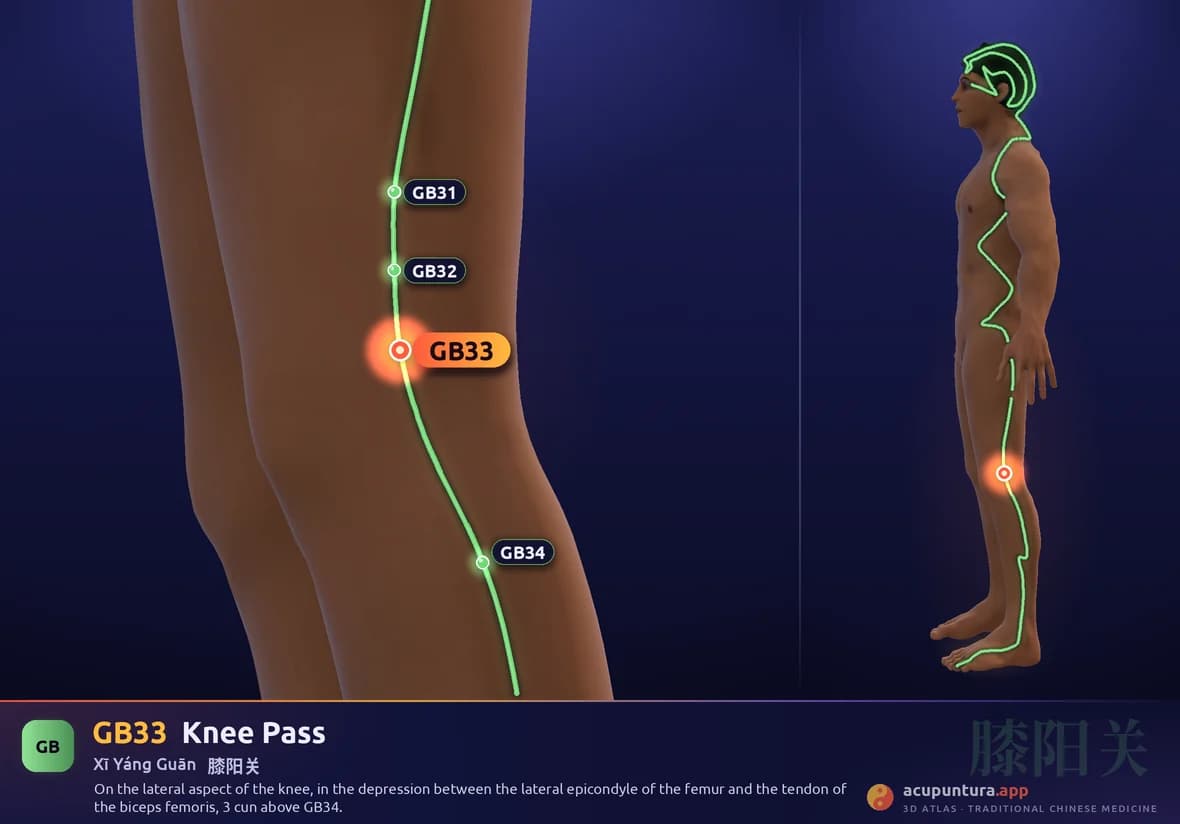
On the lateral aspect of the knee, in the depression between the lateral epicondyle of the femur and the tendon of the biceps femoris, 3 cun above GB34.
Main function
Eliminates Wind-Dampness, relieves knee pain.
Therapeutic indications
- Knee pain
- sciatica
- joint stiffness
- knee pain and swelling
- popliteal contracture
- numbness of the leg
Name and classical tradition
Xiyangguan, 膝阳关, is the “yang barrier of the knee.” 阳 indicates the outer, yang side of the joint, and 关 the barrier, the pass. The prefix 膝, “knee,” was added to distinguish it from GV3, Yaoyangguan, the “yang barrier of the lumbar region” on the Du Mai: without it, the two points would have had the same name.
The point has one of the most eventful histories of names and locations in the Atlas. The Zhenjiu Jiayi Jing (Systematic Classic of Acupuncture and Moxibustion) called it simply 陽關 and placed it “在陽陵泉上三寸,犢鼻外陷者中,” three cun above Yanglingquan, with a prohibition: “禁不可灸,” no moxibustion. In the Tang period, the Qianjin Yaofang (Formulas Worth a Thousand Gold) reverses the order and calls it 关阳, and the Qianjin Yifang (Supplement to the Formulas Worth a Thousand Gold), by the same Sun Simiao, places it five cun above GB34. In the Song dynasty, the Zhenjiu Zisheng Jing (Classic of Nourishing Life with Acupuncture and Moxibustion) puts it only two cun from that point. The Zhenjiu Dacheng (Great Compendium of Acupuncture and Moxibustion), in the Ming period, calls it 足阳关, “yang barrier of the foot,” and the Zhenjiu Jicheng (Complete Collection of Acupuncture and Moxibustion), in the Qing period, proposes yet another location: one cun beside the “eye of the knee.” Over more than a thousand years, the name changed form several times and the exact position was debated from one work to the next.
The reference works add other aliases: 寒府, 阳陵, and 关陵. There is also a modern energetic gloss about Yang becoming blocked at this pass, with no citation to support it.