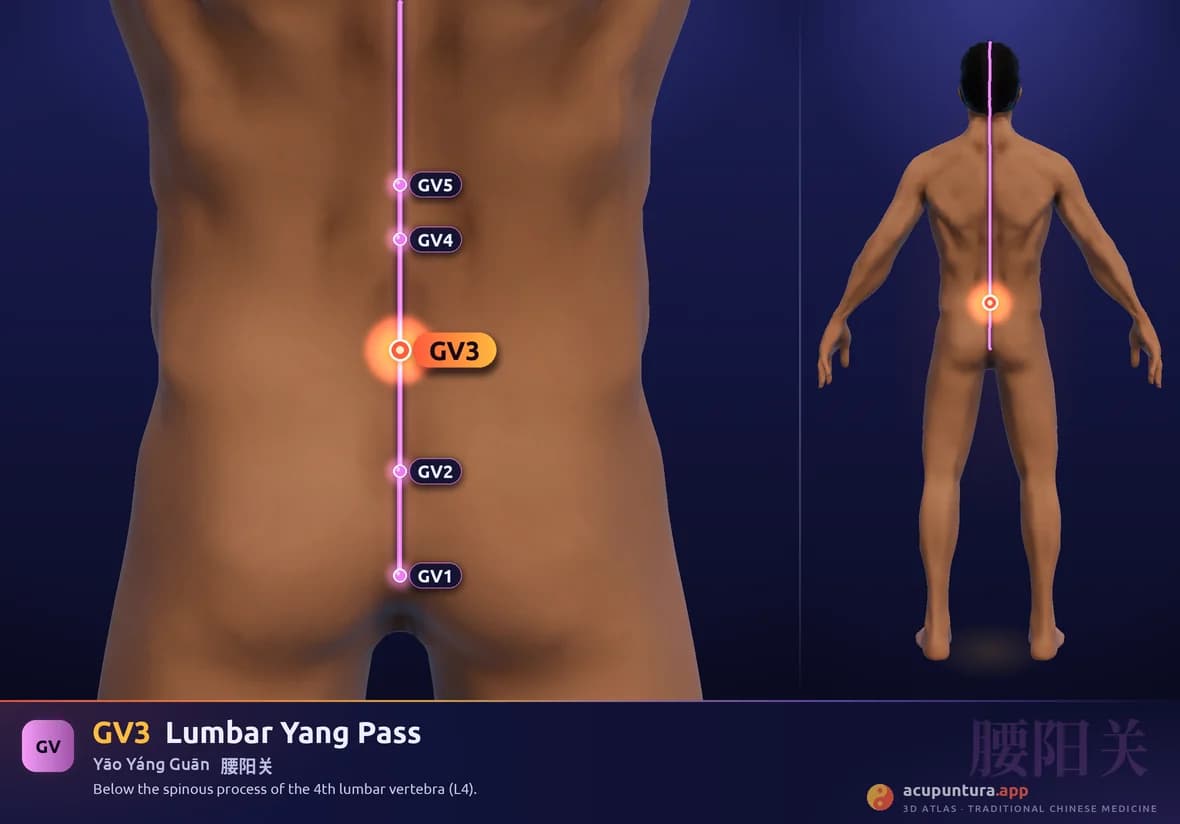
Du Mai (Governing Vessel) Channel
Lumbar Yang Pass
腰阳关Yāo Yáng GuānAnatomical location
Below the spinous process of the 4th lumbar vertebra (L4).
Main function
Regulates Kidney Yang, strengthens the lumbar region, relieves pain.
Therapeutic indications
- Low back pain
- knee pain
- impotence
- menstrual disorders
- paralysis of the legs
- Low back pain
- Lumbar stiffness
- Sciatica
- Paralysis of the lower limb
- Irregular menstruation
- Leukorrhea
- Diarrhea
- Lumbar disc herniation
- Ankylosing spondylitis
Name and classical tradition
Yaoyangguan, 腰阳关, is the “yang barrier of the waist.” 腰 is the lumbar region; 阳 (陽) is yang; 关 (關) is the barrier, the pass. The modern gloss explains that the Yang Qi rising along the Du Mai pools here. The point lies below the fourth lumbar vertebra, on the midline.
Its name has an echo in the leg: GB33, Xiyangguan, the “yang barrier of the knee,” which was originally called 陽關 and had to add 膝 to distinguish itself from this point. The two Yangguan were thus told apart by body region.
The sources attribute Yaoyangguan to the Suwen (Basic Questions), chapter Gu Kong Lun (骨空論), with no confirmed verbatim quotation. The reference works record the alternative names 脊陽關 and 背陽關. Another name sometimes attributed to it, 背解, belongs in the Jiayi Jing to its neighbor GV2.