Gallbladder Channel
Ankle Hill
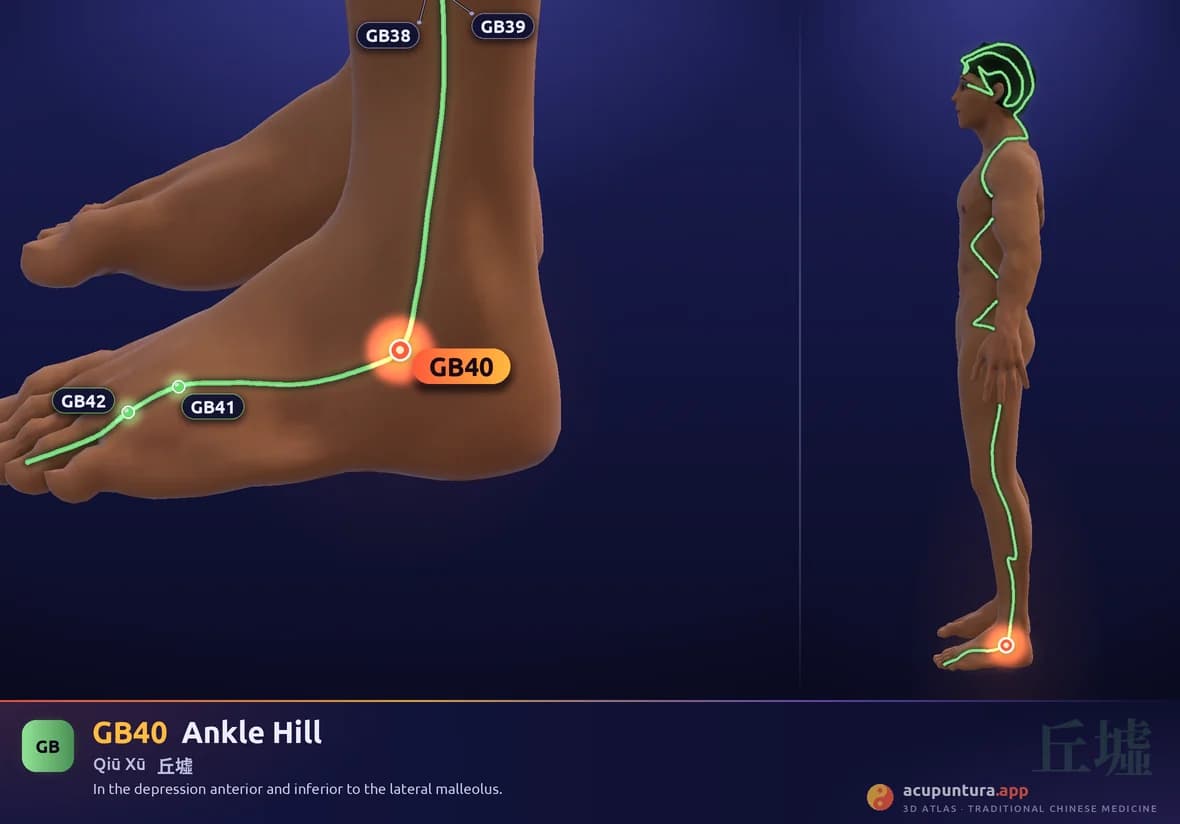
丘墟Qiū XūAnatomical location
In the depression anterior and inferior to the lateral malleolus.
Main function
Regulates the Liver and Gallbladder, benefits the eyes.
- Yuan (Source) point
- Ryodoraku point F5 (Gallbladder)
Therapeutic indications
- Ankle pain
- headache
- jaundice
- ankle pain and swelling
- ankle sprain
- costal pain
- vomiting
- axillary pain
- malaria
- blurred vision
- gallstones and biliary colic
Ryodoraku
F5Vesícula BiliarMeasurement point no. 11
Yuan-Source point of the Gallbladder, anterior to the lateral malleolus.
Name and classical tradition
Qiuxu, 丘墟, combines two words for “hill.” 丘 is a small elevation; 墟 is a larger promontory, a mound, and also the place where the ruins of a city remain. The great hill is the lateral malleolus, the bony prominence of the ankle, and the point lies in the depression in front of and below it. It is a straightforward anatomical name, like that of its neighbor on the leg, GB36, with which it shares the 丘.
The Lingshu (Spiritual Pivot), in the Ben Shu (本输) chapter, defines it this way: «过于丘墟,丘墟,外踝之前下陷者中也,为原». The Qi of the channel passes through Qiuxu; Qiuxu lies in the depression in front of and below the lateral malleolus; it is the Yuan-Source point. It is a direct, complete, verified quotation, and it makes Qiuxu the Yuan-Source point (原穴) of the Gallbladder, one of the central points of the channel in clinical practice.