Gallbladder Channel
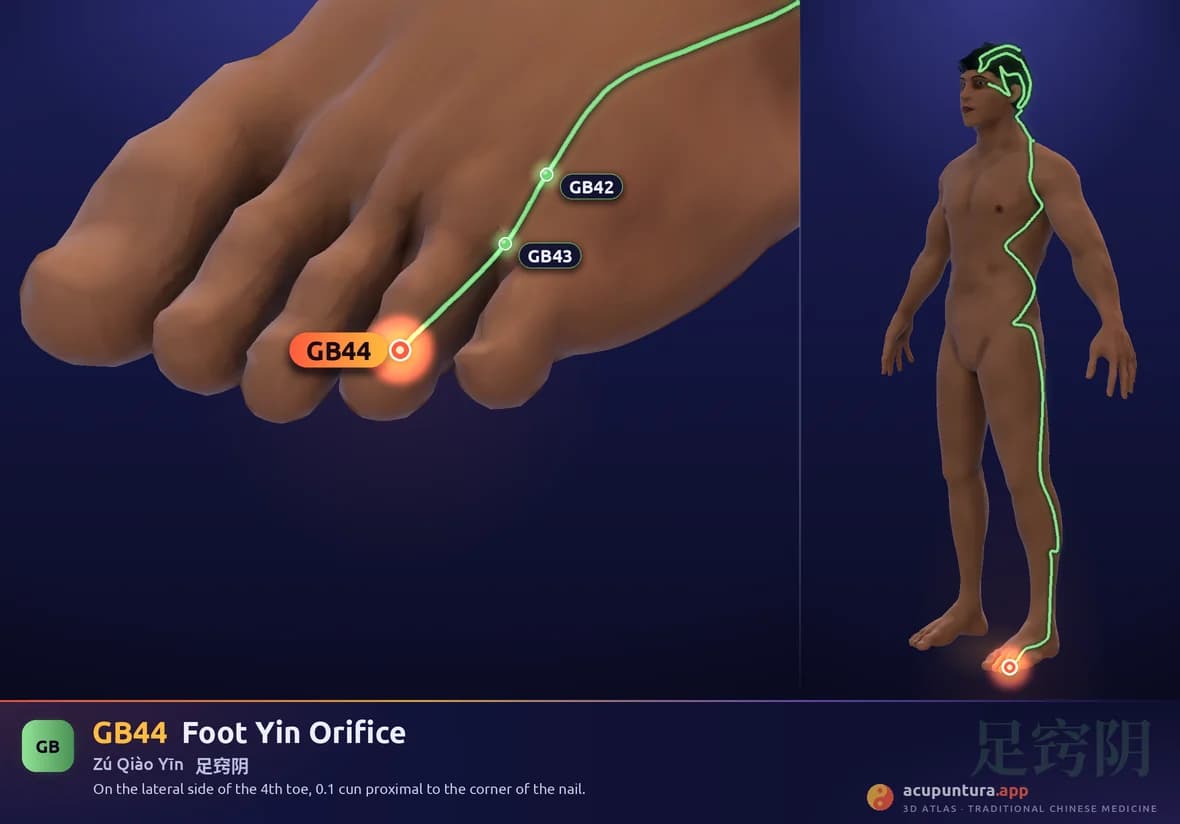
Foot Yin Orifice
足窍阴Zú Qiào YīnAnatomical location
On the lateral side of the 4th toe, 0.1 cun proximal to the corner of the nail.
Main function
Regulates the Liver, relieves headache.
- Jing-Well point (Metal)
Therapeutic indications
- Headache
- tinnitus
- insomnia
- migraine
- eye pain
- deafness
- sore throat
- excessive dreaming
- fever
- costal pain
- irregular menstruation
Name and classical tradition
Zuqiaoyin, 足窍阴, is the last point of the channel, at the corner of the nail of the fourth toe. In the Lingshu (Spiritual Pivot), Ben Shu (本输) chapter, it was called simply 窍阴. In the Song period, the Shengji Zonglu added 足, “foot,” to distinguish it from the 窍阴 of the head, GB11. With the pair GB15 and GB41, it illustrates how the Song dynasty systematically ordered the nomenclature of this channel, which had repeated names at both of its ends.
窍 are the orifices of the senses, and 阴 is yin. The name repeats the semantic field of its namesake on the head, but applies it to the opposite end of the channel, where Qi begins to well up. What exactly that 阴 meant to whoever named the point is not clarified by any classical commentary.
It is the Jing-Well point (井穴) of the channel, which on the yang channels corresponds to Metal. The Lingshu, in the Jiu Zhen Shi Er Yuan (九针十二原) chapter, states the general principle of this category: «所出为井», the place where Qi emerges is the well. From here, the transport sequence continues to GB43.