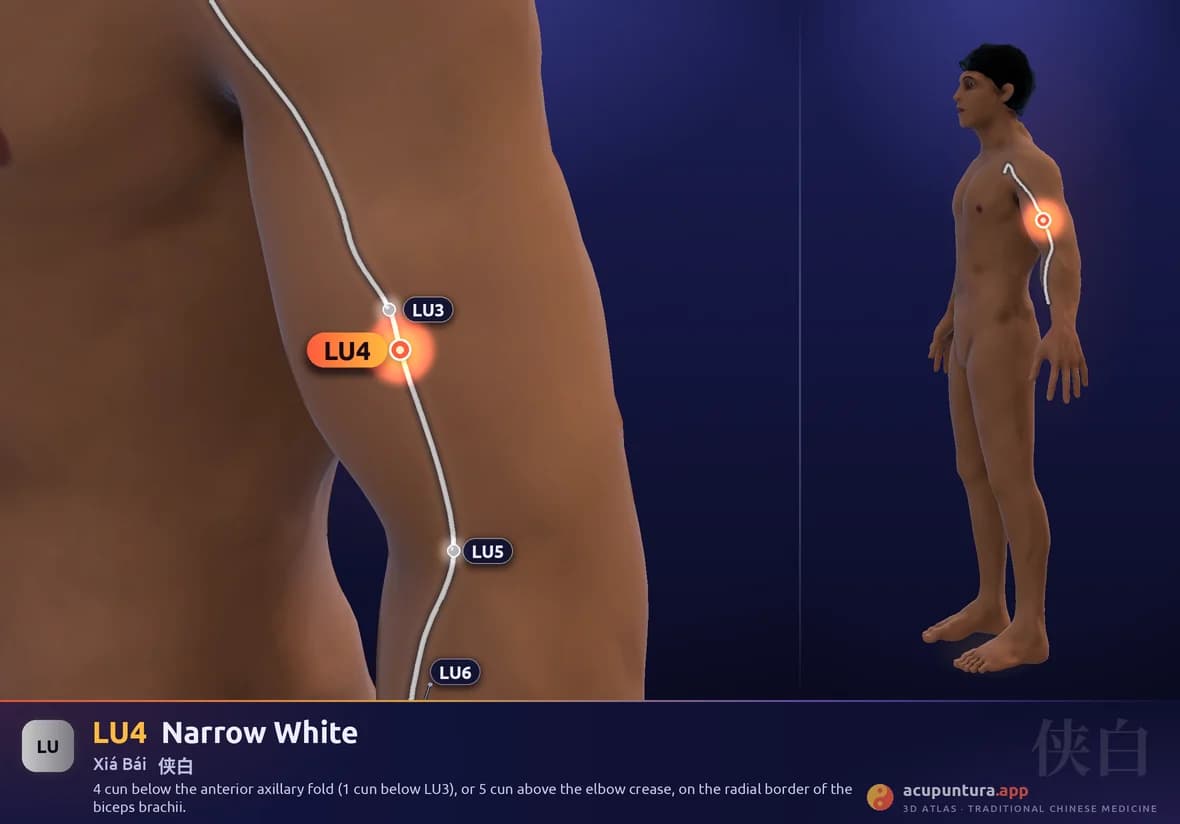
Lung Channel
Narrow White
侠白Xiá BáiAnatomical location
4 cun below the anterior axillary fold (1 cun below LU3), or 5 cun above the elbow crease, on the radial border of the biceps brachii.
Main function
Regulates the Lung, calms cough, relieves dyspnea.
Therapeutic indications
- Cough
- asthma
- arm pain
- chest pain
- chest oppression
- nausea
- heart pain
- pain on the medial side of the arm
- sensation of heat in the chest
Name and classical tradition
Xiabai, 俠白 (侠白 in simplified characters), is one of those names in which anatomy and symbolism overlap. 白 is white, the color that the Five Phases correspondence assigns to Metal and, with it, to the Lung. 俠 is less obvious: reference works read it as equivalent to 夾, "to flank," "to have at one's sides." With that key, the name would mean something like "that which flanks the white."
Two readings follow from this. The anatomical one places the point next to the "white flesh" (肉白) of the belly of the biceps. The symbolic one, which reference works support with the phrase "俠與夾通,白,肺色也" (俠 is equivalent to 夾; white is the color of the lung), imagines the arms hanging at the sides of the trunk, so that the point lies on both sides of the lung and embraces it. This second gloss circulates with no identified classical author, so it is best taken as a reasonable traditional interpretation and not as a fixed text. For that very reason, the variant 夾白 that appears in some modern sources looks more like a graphic form than a different name.
The oldest reference is the Zhenjiu Jiayi Jing (Systematic Classic of Acupuncture and Moxibustion) by Huangfu Mi (third century): "在天府下,去肘五寸動脈中," below LU3, 5 cun from the elbow, in the pulsation. The most vivid detail comes much later. In 1615, Gong Tingxian proposes in the Shoushi Baoyuan (Longevity and Life Preservation) a location method using ink: "先于乳頭上塗墨,令兩手直伸夾之,染墨處是穴." Ink is smeared on the nipple, the arms are stretched out so that they flank it, and the point is the place where the arm is stained. The method puts into practice precisely the 夾 of the name.