Du Mai (Governing Vessel) Channel
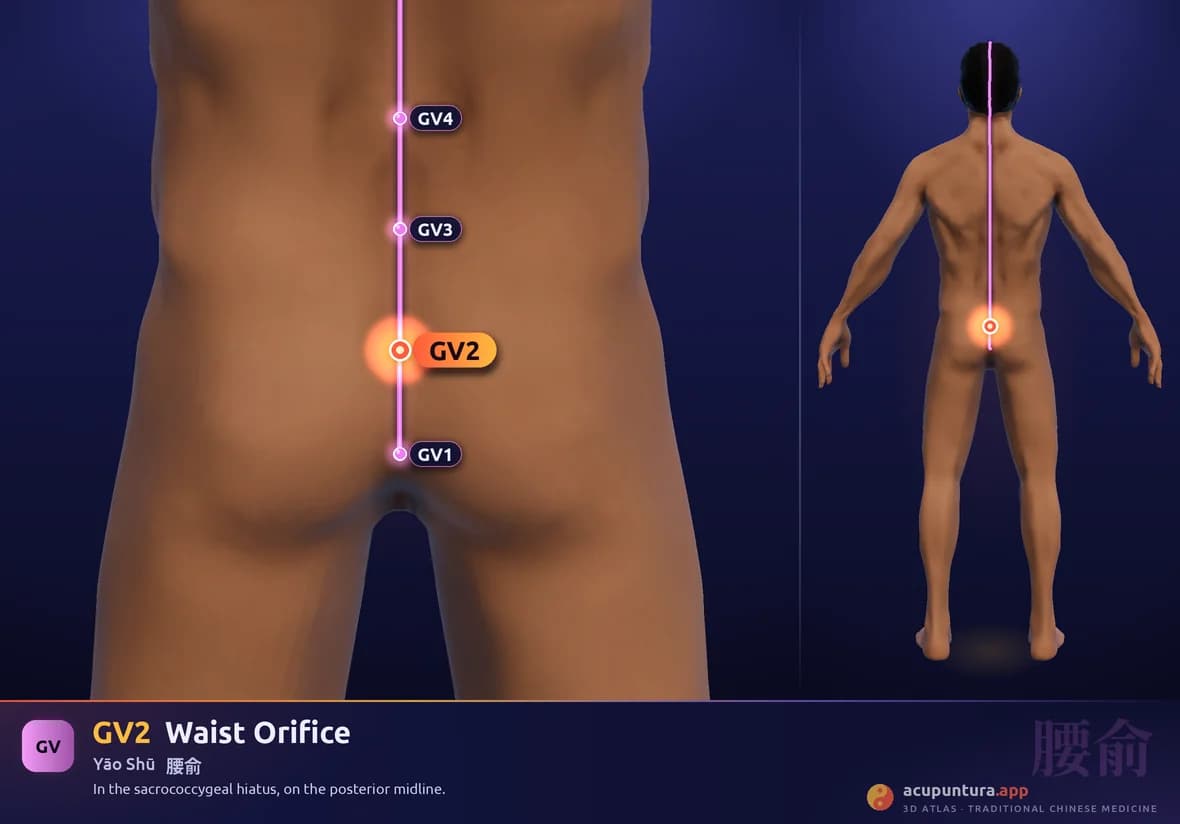
Waist Orifice
腰俞Yāo ShūAnatomical location
In the sacrococcygeal hiatus, on the posterior midline.
Main function
Regulates local Qi, relieves low back and sacral pain, benefits the intestines.
Therapeutic indications
- Low back pain
- hemorrhoids
- paralysis of the lower limbs
- menstrual disorders
- lumbago
- lumbar stiffness
- irregular menstruation
- paralysis of the lower limb
- epilepsy
Name and classical tradition
Yaoshu, 腰俞, is the “transport point of the lumbar region.” 腰 is the waist, the lower back; 俞 is the transport point. The point sits in the sacral hiatus, in the cleft at the end of the sacrum, the region the texts call “腰尻之解,” the juncture between the waist and the buttocks.
The sources attribute it to the Suwen (Basic Questions), in the chapter Miu Ci Lun (繆刺論), with no verbatim quotation recovered. The Zhenjiu Jiayi Jing (Systematic Classic of Acupuncture and Moxibustion) gives it three alternative names and locates it using the old vertebral count: “腰俞,一名背解,一名髓空,一名腰戶,在第二十一椎節下間.” That is, Yaoshu, also called Beijie, “back juncture,” Suikong, “marrow hollow,” and Yaohu, “lumbar door,” below the twenty-first vertebra. The reference works add 髓俞 and 腰柱.
Other names
- 背解Jiayi Jing
- 髓空Jiayi Jing
- 腰戶Jiayi Jing