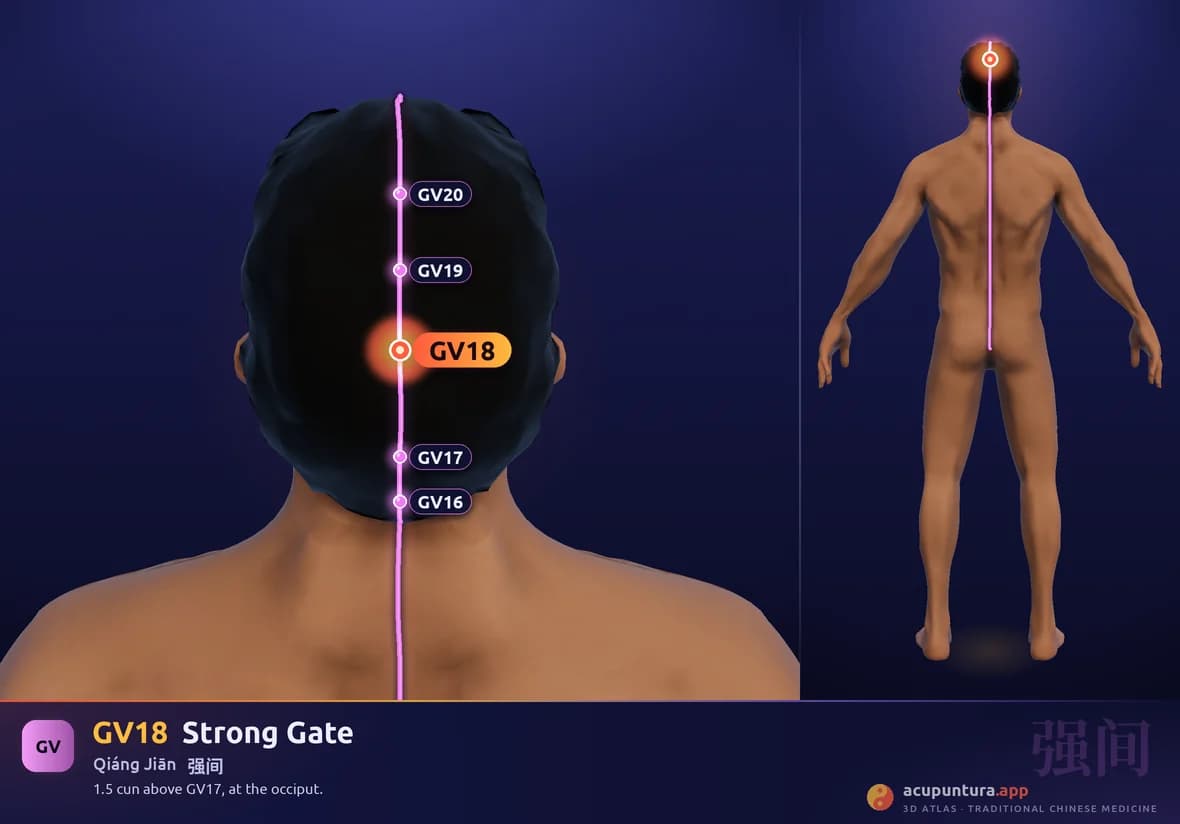
Du Mai (Governing Vessel) Channel
Strong Gate
强间Qiáng JiānAnatomical location
1.5 cun above GV17, at the occiput.
Main function
Calms Internal Wind, benefits the head, calms the Shen.
Therapeutic indications
- Headache
- vertigo
- epilepsy
- insomnia
- Cephalalgia
- Stiff neck
- Mania
Name and classical tradition
Qiangjian, 强间, is the “space of stiffness.” 强 (強) is rigid, tense; 间 (間), the space, what lies between. The point is at the junction of the parietal and occipital bones, and it treats stiffness of the nape: the name captures both its position and its use.
The Zhenjiu Jiayi Jing (Systematic Classic of Acupuncture and Moxibustion) devotes a full entry to it: «強間,一名大羽,在後頂後一寸五分,督脈氣所發,刺入三分,灸五壯». Qiangjian, also called Dayu, lies one and a half cun behind Houding; it is a place where the Qi of the Du Mai emerges; needle to a depth of three fen and apply five cones of moxa. The citation gives the alternative name, 大羽, “great feather,” the location relative to GV19, and the needling technique, and it is one of the best-verified citations for the Du Mai.
Other names
- 大羽Jiayi Jing